
Peptides and Tissue Repair: What Has Actually Been Studied in Humans? | Infinite Longevity
Peptides and Tissue Repair: What Has Actually Been Studied in Humans?
Few peptides get talked about as much as BPC-157 and TB-500.
They show up in recovery forums, clinic menus, and social media posts about tendons, joints, and injuries.
They are often described with confident language.
“Healing peptides.”
“Injury repair.”
“The recovery stack.”
But confident language is not the same as human evidence.
In 2026, the question of what has actually been studied in people became impossible to ignore. A new review, a systematic review, and an FDA advisory committee meeting all looked closely at the same evidence.
They reached a similar starting point:
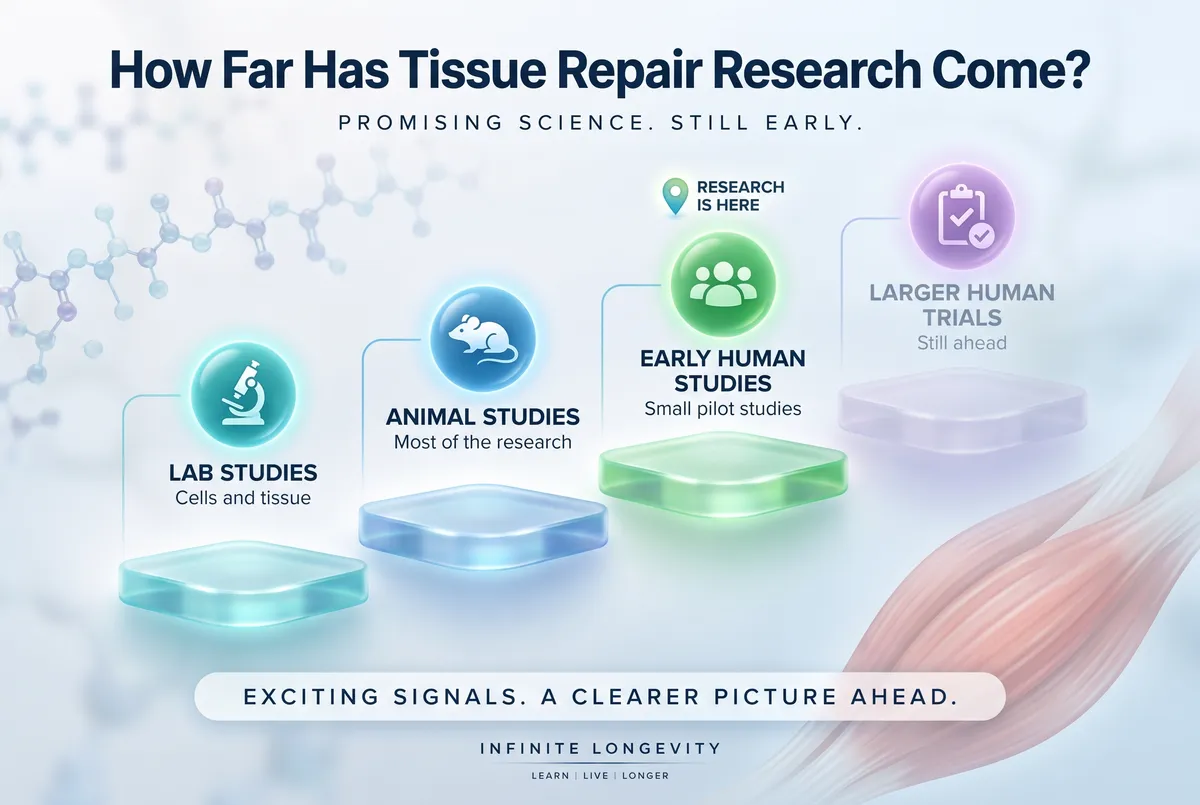
Most of what we know about these peptides and tissue repair comes from animals and cells, not from controlled human trials.
A lot of research is not the same as a lot of human research. For tissue repair peptides, that difference is the whole story.
The Quick Answer
BPC-157 has been studied extensively in laboratory and animal models of tendon, ligament, muscle, and gut injury. Human data are very limited. A 2026 review in Pharmaceutics described BPC-157 as having no approved formulation, no validated dosing regimen, and no completed Phase II clinical trial, with available clinical data coming from fewer than 30 people across three uncontrolled pilot studies. (PubMed)
TB-500 is even thinner on human evidence. It is a short synthetic fragment of a larger natural protein called thymosin beta-4. In its 2026 review, FDA reported that it did not find any published study in which TB-500 itself was given to humans. (FDA)
Full-length thymosin beta-4, the parent protein, is different. It has been tested in small human trials as a topical gel for chronic skin ulcers and as eye drops for corneal healing. Those studies are real, but they do not automatically apply to TB-500.
So the useful question is not:
“Do healing peptides work?”
It is:
“Which molecule, in which tissue, given which way, was actually tested in people, and what happened?”
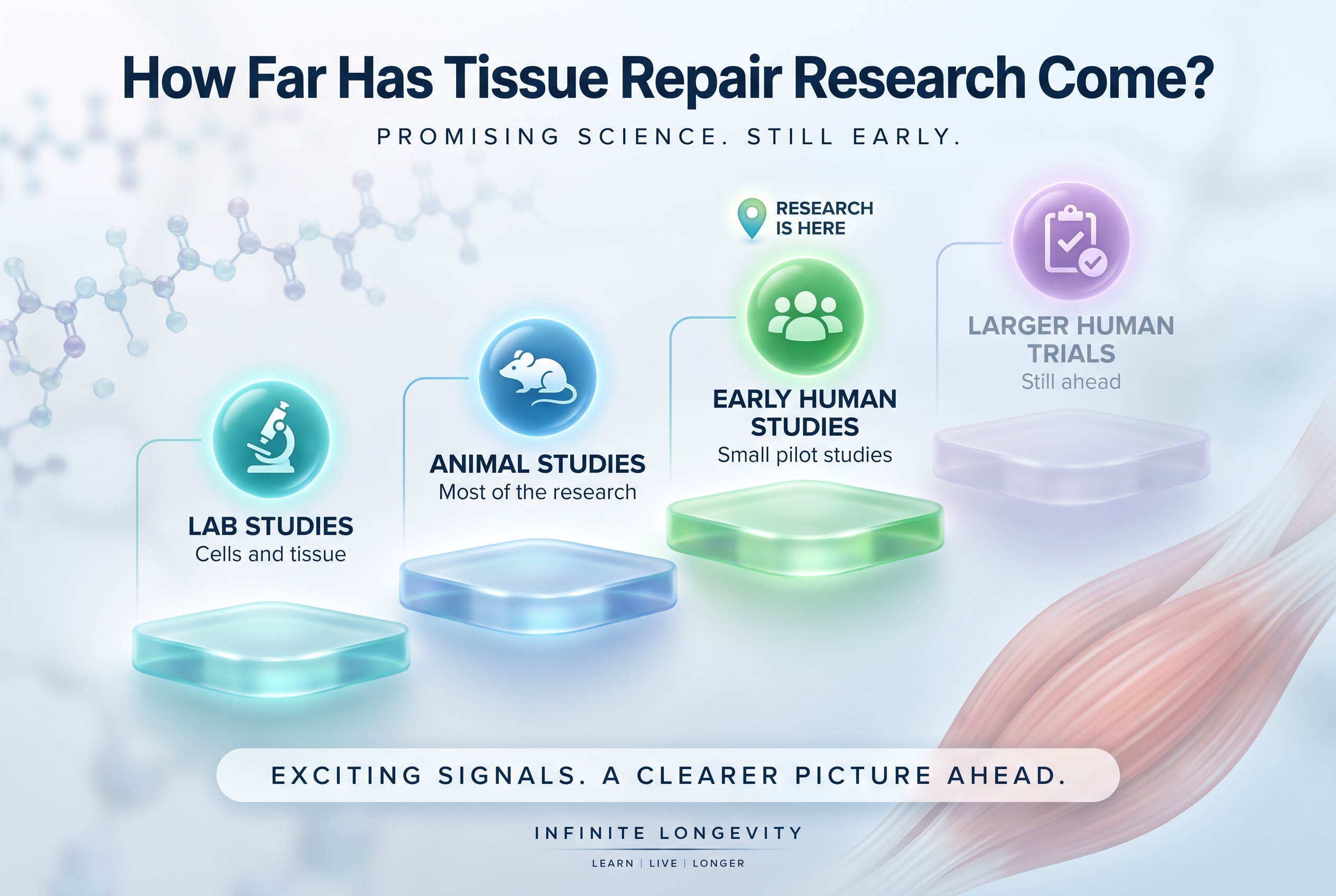
Alt text: Infographic showing tissue repair peptide research progressing from lab and animal studies to early human studies, with larger human trials still ahead.
First, Why Tissue Repair Is Hard to Study
Tissue repair sounds simple.
Something is injured. Something helps it heal faster.
In practice, it is one of the hardest things to prove in humans.
That is because:
Many injuries improve on their own over time
Pain often fluctuates, which makes before-and-after comparisons misleading
Rest, rehab, and time happen alongside any treatment
People who expect to feel better often report feeling better
“Healed” can mean less pain, better function, or actual tissue changes on imaging
This is why controlled trials matter so much in this area.
Without a comparison group, it is very difficult to know whether improvement came from the peptide, from time, from rehab, or from expectation.
If you want a refresher on why the body’s repair response is more complicated than “more healing is better,” see Inflammation Is Not Always the Enemy.
What Is BPC-157?
BPC-157 stands for Body Protection Compound 157.
It is a synthetic chain of 15 amino acids. It was derived from a protein fragment originally described in human gastric juice and was first reported by researchers in Croatia in the early 1990s.
Since then, it has been studied in a wide range of animal models, including injuries to:
Tendons
Ligaments
Muscle
Bone
The stomach and intestinal lining
Blood vessels
Researchers have proposed several mechanisms, including effects on blood vessel growth, growth factor signaling, nitric oxide, and inflammation.
But FDA’s 2026 evaluation also pointed out that BPC-157’s molecular targets have not been identified, its mechanisms remain poorly understood, and dose-response relationships in animal studies have generally not been established. (FDA)
That is an important caution.
A long list of proposed mechanisms is not the same as a well-understood mechanism.
What Has Actually Been Studied in Humans: BPC-157
Here is where it gets interesting.
Depending on which review you read, BPC-157 has either one human study or five.
Both are correct.
A 2025 systematic review focused on orthopedic sports medicine screened more than 500 articles and included 36 studies. Thirty-five were preclinical. One was clinical. (HSS Journal)
FDA’s broader 2026 search, which was not limited to musculoskeletal injuries, identified five clinical studies across any condition. (FDA)
Here is what those five studies were:
1. A rectal enema safety study in healthy volunteers
An early study in healthy men tested BPC-157, under the development code PL 14736, as an enema. It was designed to look at safety and tolerability, not healing. Results appear in meeting abstracts rather than a full peer-reviewed paper.
2. A small ulcerative colitis trial
This is the only randomized, placebo-controlled trial of BPC-157 identified by FDA.
About 53 people with mild to moderate ulcerative colitis received either a BPC-157 enema or placebo for two weeks.
Both groups improved. The BPC-157 group improved somewhat more on average, but the confidence interval for the difference between groups crossed zero, which means the result did not clearly separate from placebo.
The study was only ever published as a meeting abstract. FDA noted that key details, including how the main outcome was defined, were missing. (FDA)
3. A knee pain case series
This is the study most often cited online.
It was a retrospective review of fewer than 20 patients at a single practice who received knee injections of BPC-157, some combined with thymosin beta-4. Most reported pain relief.
But there was no control group, no blinding, and no imaging to confirm tissue healing. This is the “one clinical study” counted in the orthopedic review, which classified the overall evidence at the lowest levels used in clinical research. (HSS Journal)
4. An interstitial cystitis pilot
Twelve patients with a chronic bladder pain condition received BPC-157 injected into the bladder wall during a procedure. There was no comparison group.
5. An intravenous safety pilot in two people
Two healthy adults received BPC-157 by IV infusion to look at short-term safety. Two people cannot establish safety, but it is the only published human data on this route.
Notice what is missing:
There is no published controlled human trial of BPC-157 for a tendon, ligament, muscle, or joint injury.
There is also no human pharmacokinetic data for oral, under-the-skin, nasal, or topical use, which are the forms most commonly discussed online. A registered Phase 1 trial of oral BPC-157 tablets in healthy volunteers never posted results, and FDA could not find an associated publication. (FDA, ClinicalTrials.gov)
What Is TB-500?
TB-500 is where naming causes the most confusion.
Many websites describe TB-500 as “synthetic thymosin beta-4” or use the two names interchangeably.
They are not the same substance.
Thymosin beta-4 (Tβ4) is a natural protein made of 43 amino acids. It is found in almost every cell and is involved in how cells move and organize their internal structure, which is one reason researchers became interested in its role in wound repair.
TB-500 is a short synthetic fragment of just seven amino acids, taken from positions 17 to 23 of thymosin beta-4, with a chemical modification called acetylation added to one end. (FDA)
That modification matters.
FDA explained that acetylation can change how a peptide behaves, so results from the unmodified fragment cannot be directly applied to TB-500. In one laboratory study FDA reviewed, TB-500 itself did not speed closure of scratch wounds in cultured cells, while one of its breakdown products had a small effect. (FDA)
Thymosin beta-4 is the whole protein. TB-500 is a modified seven-amino-acid piece of it. Evidence for one is not automatically evidence for the other.
What Has Actually Been Studied in Humans: Thymosin Beta-4 and TB-500
TB-500 (the fragment)
FDA’s 2026 evaluation found no published studies in which TB-500 was given to humans for any condition, no human pharmacokinetic data, and no animal toxicity studies. FDA concluded that potential safety risks in humans are unknown. (FDA)
A 2026 scoping review reached a similar conclusion. Direct TB-500 evidence was limited to a single study involving metabolite analysis and cell-culture testing, not long-term animal or human repair studies. (Applied Sciences)
Thymosin beta-4 (the full protein)
The parent protein has more human research, mostly in two settings.
Chronic skin ulcers. Topical Tβ4 gel was tested in Phase 2 trials in people with venous stasis ulcers and pressure ulcers. In a European trial of 73 patients with venous ulcers, results suggested one concentration might speed healing, with complete healing within three months in about a quarter of patients. (PubMed) Across the ulcer trials, researchers reported that healing was faster by almost a month among the patients who did heal. (Annals of the NYAS)
Corneal healing. Tβ4 eye drops were tested in a small Phase 3 trial of 18 patients with a condition called neurotrophic keratopathy. Six of 10 treated patients had complete healing at four weeks, compared with one of eight on placebo. The four-week difference did not reach conventional statistical significance, although a later time point did. (PMC)
These findings are genuinely interesting.
But notice the details:
They used the full 43-amino-acid protein, not TB-500
They applied it topically to skin or the eye, not by injection
They studied surface wounds, not tendons, ligaments, or muscle
None has led to an FDA-approved thymosin beta-4 product
That is why the scoping review described human thymosin beta-4 evidence as concentrated in eye and skin settings, with limited human evidence directly relevant to musculoskeletal use. (Applied Sciences)
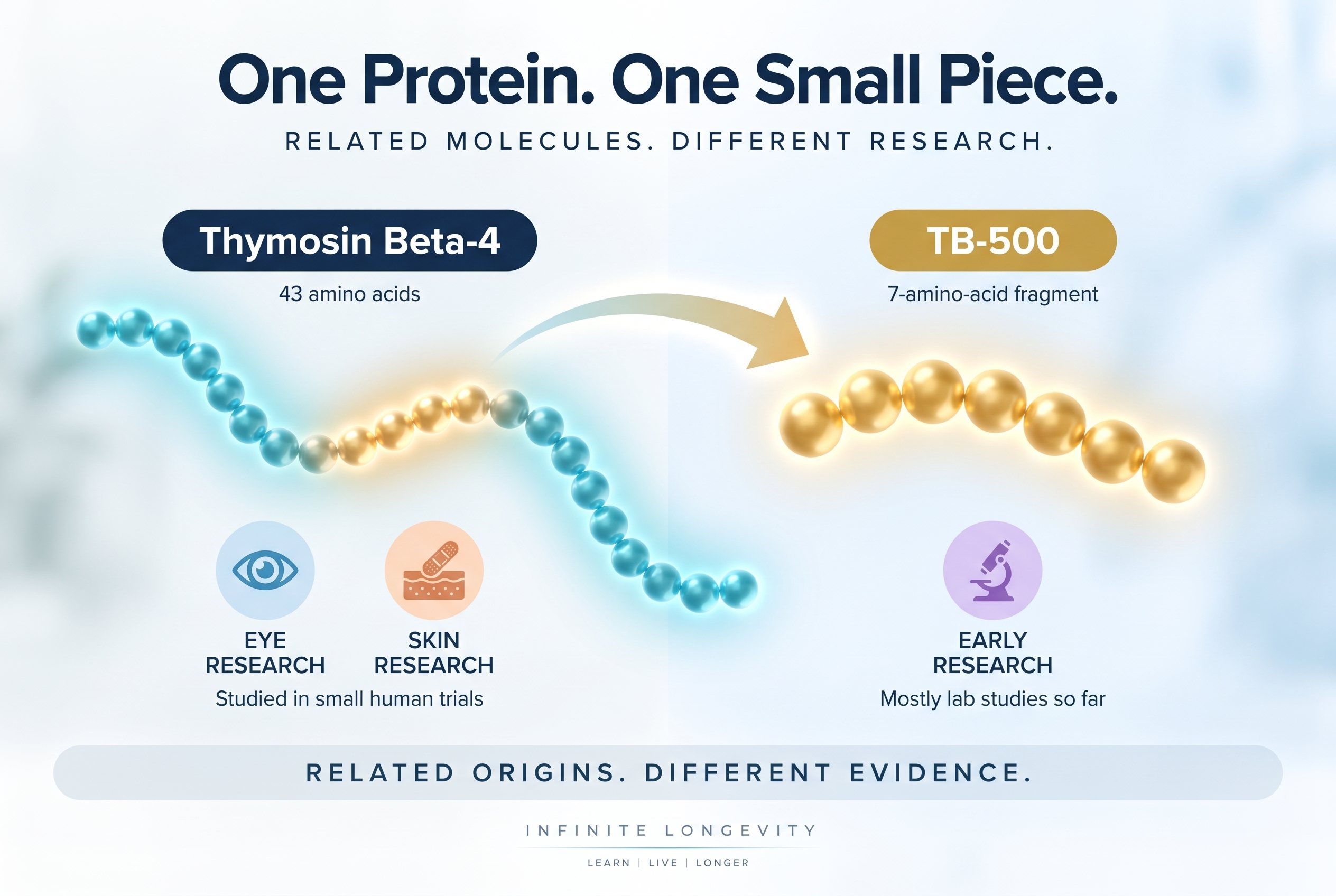
Alt text: Infographic showing TB-500 as a seven-amino-acid fragment of the larger thymosin beta-4 protein, which has been studied in small human eye and skin trials.
What Happened at the FDA in 2026?
In July 2026, FDA’s Pharmacy Compounding Advisory Committee reviewed BPC-157, TB-500, and several other peptides to decide whether they should be added to the list of substances that licensed compounding pharmacies may use.
FDA’s own scientists recommended against adding any of the peptides reviewed, citing limited clinical trial data, quality and consistency concerns, and the risk of unwanted immune reactions. (ABC News)
The committee voted narrowly to recommend adding them anyway. (NCPA)
That vote is important, and it is easy to misread.
Here is what it means and does not mean:
The vote is advisory. FDA still has to make its own decision.
Being eligible for compounding is not the same as being FDA-approved.
The vote was not a finding that either peptide is safe or effective.
FDA reviewed BPC-157 for ulcerative colitis and TB-500 for wound healing. Tendon, ligament, and muscle injuries were not the uses under review.
Both BPC-157 and TB-500 also remain on the World Anti-Doping Agency’s Prohibited List. (WADA)
For a similar example of an emerging peptide moving through this process, see MOTS-c and Humanin: Why Scientists Are Studying Peptides Made by Mitochondria.
Where the Evidence Stands
Better established
BPC-157 and thymosin beta-4 have been studied extensively in laboratory and animal models of tissue injury.
Full-length thymosin beta-4 has been tested in small randomized human trials as a topical gel for chronic skin ulcers and as eye drops for corneal healing.
Emerging or very limited human evidence
BPC-157 has five small human studies across different conditions, fewer than 30 participants in its uncontrolled pilots, and one small randomized trial in ulcerative colitis that was never fully published.
Strong preclinical interest
Animal and cell studies suggest possible effects involving:
Tendon and ligament healing
Muscle injury
Gut lining protection
Blood vessel formation
Inflammation signaling
Cell migration
Not established
Current evidence does not establish BPC-157, TB-500, or thymosin beta-4 as proven treatments for:
Tendon or ligament injuries
Muscle tears
Joint pain or arthritis
Surgical recovery
Faster return to sport
Gut conditions
Human safety, especially with repeated or long-term use, has not been adequately characterized for either BPC-157 or TB-500.
Why This Topic Gets Overhyped Online
Tissue repair peptides are a perfect setup for overstatement.
The animal research is large. The mechanisms sound impressive. And injuries are frustrating, so people want something that works.
That makes it easy to jump from:
“BPC-157 improved tendon healing in rats.”
to:
“BPC-157 heals tendons.”
Or from:
“Thymosin beta-4 gel helped some chronic skin ulcers heal faster.”
to:
“TB-500 repairs injuries.”
Each jump changes something important.
The species changes.
The molecule changes.
The tissue changes.
The route changes.
By the time a claim reaches social media, it may describe a study that was never done.
What This Research Does Not Mean
Research on tissue repair peptides does not currently mean:
BPC-157 is a proven treatment for tendon, ligament, or joint injuries
TB-500 has been tested in humans
TB-500 and thymosin beta-4 are the same thing
Topical results in skin or eyes apply to injected use in muscles or tendons
A compounding vote means FDA considers these peptides safe or effective
Combining peptides in a “stack” has been studied or shown to work better
A peptide purchased online matches the identity, purity, or formulation used in any published study
That final point deserves emphasis.
FDA noted that products are sold under these common names with inconsistent chemical identities, and that many Certificates of Analysis report purity without identifying impurities or testing for aggregates and endotoxins. (FDA)
For more on that distinction:
What “Research Use Only” Actually Means
Why Certificates of Analysis Matter
What Laboratory Testing Can and Cannot Prove
Try This: The Tissue Repair Evidence Check
When you see a claim about a peptide and healing, ask six questions.
1. Was the study in humans?
Rat tendon results are not human tendon outcomes.
2. Was it the same molecule?
Thymosin beta-4?
TB-500?
A different salt or modified version?
3. Was it the same tissue?
Skin?
Eye?
Gut?
Tendon?
Healing in one tissue does not predict healing in another.
4. Was it given the same way?
Topical, oral, enema, and injected routes can behave very differently in the body.
5. Was there a comparison group?
Without placebo or a control group, time, rehab, and expectation can look like a treatment effect.
6. What was actually measured?
Pain scores?
Function?
Imaging?
Complete wound closure?
“I felt better” and “the tissue healed” are different outcomes.
Those six questions can separate a real finding from a claim that borrowed its credibility from a different study.
Frequently Asked Questions
Has BPC-157 been tested in humans?
Yes, but only in a handful of small studies. FDA identified five clinical studies, including one small randomized ulcerative colitis trial published only as a meeting abstract. A 2026 review noted that available clinical data come from fewer than 30 people across three uncontrolled pilot studies. (PubMed)
Is there a human trial of BPC-157 for tendon or ligament injuries?
No published controlled human trial of BPC-157 for tendon, ligament, or muscle injury was identified in the 2025 orthopedic systematic review or FDA’s 2026 evaluation. The most-cited human study is an uncontrolled knee pain case series.
Has TB-500 been tested in humans?
FDA’s 2026 evaluation did not identify any published study in which TB-500 itself was given to humans. Human trials exist for full-length thymosin beta-4, which is a different molecule. (FDA)
Is TB-500 the same as thymosin beta-4?
No. Thymosin beta-4 is a 43-amino-acid natural protein. TB-500 is an acetylated seven-amino-acid synthetic fragment of it. FDA noted that findings for one cannot simply be applied to the other.
Are BPC-157 or TB-500 FDA-approved?
No. Neither is a component of an FDA-approved drug. In July 2026, an FDA advisory committee narrowly recommended adding both to the list of substances eligible for pharmacy compounding, but that recommendation is non-binding and is not an approval. (NCPA)
Why is there so much animal research but so little human research?
Moving a compound into human trials requires characterized formulations, pharmacokinetic data, toxicology studies, and funding. The 2026 Pharmaceutics review argued that the main barrier for BPC-157 is not a lack of biological activity in animals, but the absence of this basic pharmaceutical development work. (PubMed)
What are the known safety concerns?
The main concern is that safety has not been adequately studied. FDA also raised concerns about possible immune reactions to injected peptides, particularly when products contain unidentified impurities or clumped peptide aggregates. (FDA)
Choose Your Next Guide
Start with the peptide foundation:
What Are Peptides, Really?
Understand why recovery changes over time:
Why Recovery Takes Longer Than It Used To
Understand the body’s repair response:
Inflammation Is Not Always the Enemy
Understand research labeling:
What “Research Use Only” Actually Means
Understand what lab results can verify:
What Laboratory Testing Can and Cannot Prove
Explore Inflammation & Recovery:
Inflammation & Recovery
The Most Important Takeaway
BPC-157 and TB-500 are not being discussed out of nowhere.
There is a large body of animal research on tissue repair, and full-length thymosin beta-4 has produced interesting results in small human trials for skin ulcers and corneal healing.
But the human evidence for the uses people talk about most, tendons, ligaments, muscles, and joints, is very thin for BPC-157 and essentially absent for TB-500.
That makes these peptides worth studying.
It does not make them proven.
So the useful conclusion today is not:
“These are the healing peptides.”
It is:
“These are compounds with strong preclinical interest that still need the controlled human trials that would tell us whether they work, for what, and how safely.”
That is a much more honest place to start.
About Infinite Longevity
Infinite Longevity is an educational wellness platform focused on helping adults better understand the science, research, and practical factors connected to healthy aging, metabolic health, recovery, performance, and emerging peptide research.
Our Learning Center translates complex topics into clear, practical information using current government resources, peer-reviewed research, and recognized medical and scientific sources.
Our content is designed to support better questions and more informed conversations with qualified healthcare professionals. It is not intended to diagnose a condition, prescribe treatment, or replace personalized medical care.
Founded by Marcia Riner, Infinite Longevity was created to make complex wellness and longevity information easier to understand, evaluate, and use responsibly.
Sources
Emerging Use of BPC-157 in Orthopaedic Sports Medicine: A Systematic Review (HSS Journal, 2025)
The Effect of Thymosin Treatment of Venous Ulcers (Annals of the New York Academy of Sciences, 2010)
ClinicalTrials.gov: Phase 1 Study of Oral BPC-157 in Healthy Volunteers (NCT02637284)
NCPA: FDA Advisory Committee Nominates Six Peptides for Pharmacies to Compound
ABC News: FDA Advisers Narrowly Vote to Add 6 Peptides to a Drug Compounding List
Important Notice
This guide is for general educational purposes only.
It does not recommend BPC-157, TB-500, thymosin beta-4, a research peptide, compounded product, supplement, or other treatment.
Laboratory, animal, and small uncontrolled human studies should not be treated as evidence that a compound is safe or effective for personal use. Anyone dealing with an injury or chronic condition should work with a qualified healthcare professional.