Why Recovery Takes Longer Than It Used To | Infinite Longeveity
Why Recovery Takes Longer Than It Used To
You finish a workout that used to feel completely manageable.
The next day, you expect a little soreness.
Instead, your legs feel heavy, your energy is low, and you are still feeling it two or three days later.
That can be frustrating, especially when your motivation has not changed.
But recovery is not just about how hard you trained.
Sleep, stress, nutrition, hydration, training volume, hormones, activity level, and the type of exercise you did can all influence how quickly you feel ready to go again.
And one important point often gets lost:
Feeling slower to recover does not automatically mean your body is becoming incapable.
Recovery is not wasted time between workouts. It is part of the training itself.
The Quick Answer
Recovery may feel slower over time because the body is responding to more than the workout itself. Sleep quality, stress, nutrition, training load, hormonal changes, medications, and how active you are between workouts can all influence soreness, fatigue, and performance.
Research does not show that age alone automatically causes dramatically worse muscle damage after exercise. The better question is often: What else has changed around your training?
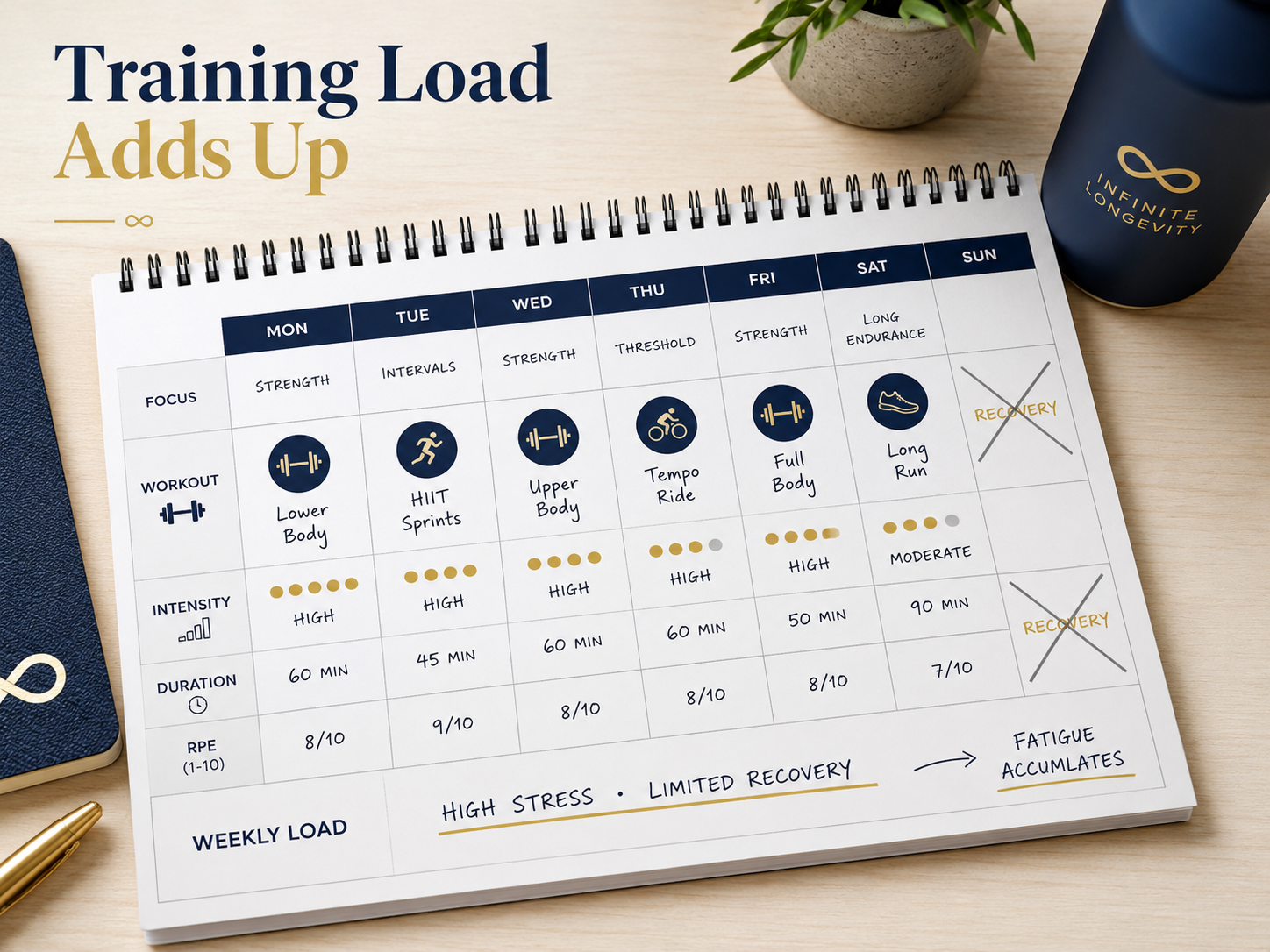
Alt text: A workout schedule showing repeated training days with too little recovery time between sessions.
Soreness and Recovery Are Not the Same Thing
Soreness is one signal.
Recovery is the bigger picture.
You can feel very little soreness and still be under-recovered. You can also feel sore and still be functioning normally.
Recovery may include:
Muscle repair
Restoration of energy
Nervous system recovery
Rehydration
Replenishing stored carbohydrate
Returning strength and coordination
Mental readiness to train again
That is why judging recovery only by how sore you feel can be misleading.
You may wake up without much soreness but still notice:
Your usual weights feel unusually heavy
Your coordination feels off
You are more irritable
Your resting heart rate is higher than normal
You are sleeping poorly
You dread a workout you normally enjoy
Performance continues to decline
Those patterns may tell you more than soreness alone.
Does Age Really Slow Recovery?
This is where the answer gets more interesting.
It is commonly assumed that older adults automatically recover much more slowly from exercise. The research is not that simple.
A review of resistance-exercise recovery found mixed results. Some studies reported slower recovery in older adults, while others found no meaningful difference or even greater soreness in younger adults.
A newer systematic review and meta-analysis found that advancing age was not associated with greater exercise-induced muscle damage overall. In fact, younger participants reported greater soreness in several comparisons.
That does not mean everyone recovers exactly the same way.
It means age by itself is not a good explanation for every difficult recovery day.
Training history, fitness level, exercise type, sleep, health conditions, medications, nutrition, and total activity matter too.
An older adult who trains consistently may recover better from a familiar workout than a younger person who suddenly does something their body is not prepared for.
Training Load May Be the Bigger Issue
Recovery becomes harder when the demand repeatedly exceeds what your body is prepared to handle.
That can happen when you:
Add weight too quickly
Increase mileage suddenly
Add more training days
Start a new sport
Return after a long break
Combine several demanding activities
Train hard while sleeping poorly
Continue pushing through unusual fatigue
One workout may not be the problem.
The accumulation can be.
Think of recovery as a balance between stress applied and capacity available.
If your training load increases while sleep, nutrition, stress, or recovery time gets worse, that balance changes.
This is why a workout routine that once felt easy may suddenly feel much harder during a stressful month.
Your workout did not exist in isolation. Your body arrived carrying everything else that happened that week.
Sleep Does More Than Make You Feel Rested
Sleep is one of the most consistent factors connected with recovery and performance.
A 2026 review of physical activity, performance, and recovery describes sleep as an important part of the recovery process, although researchers are still working to understand the exact relationships across different populations and types of exercise.
Research also shows that sleep loss can negatively affect physical performance.
A systematic review and meta-analysis found that acute sleep loss reduced exercise performance across several categories, including strength, endurance, speed, and skill.
Another meta-analysis found a moderate negative effect of sleep deprivation on endurance performance, with longer efforts being more affected.
That does not mean one bad night ruins your progress.
But several short or disrupted nights can change how demanding a familiar workout feels.
You may notice:
Reduced motivation
Higher perceived effort
Poorer coordination
Lower endurance
Slower decision-making
Less patience with discomfort
Sometimes the workout has not become harder. You simply arrived at it with less recovery available.
Stress Counts, Even When It Is Not Physical
Your body does not separate life stress and training stress as neatly as your calendar does.
A hard workout is stress.
So is:
Poor sleep
Work deadlines
Travel
Caregiving
Relationship conflict
Illness
Calorie restriction
Pain
Emotional strain
Exercise can be beneficial during stressful periods, but your ability to tolerate the same training load may temporarily change.
This is why a rigid plan can sometimes work against you.
If Monday says “heavy lower body” but you slept four hours, traveled all weekend, and feel unusually depleted, modifying the session may be smarter than proving you can push through it.
Consistency matters.
So does adaptability.
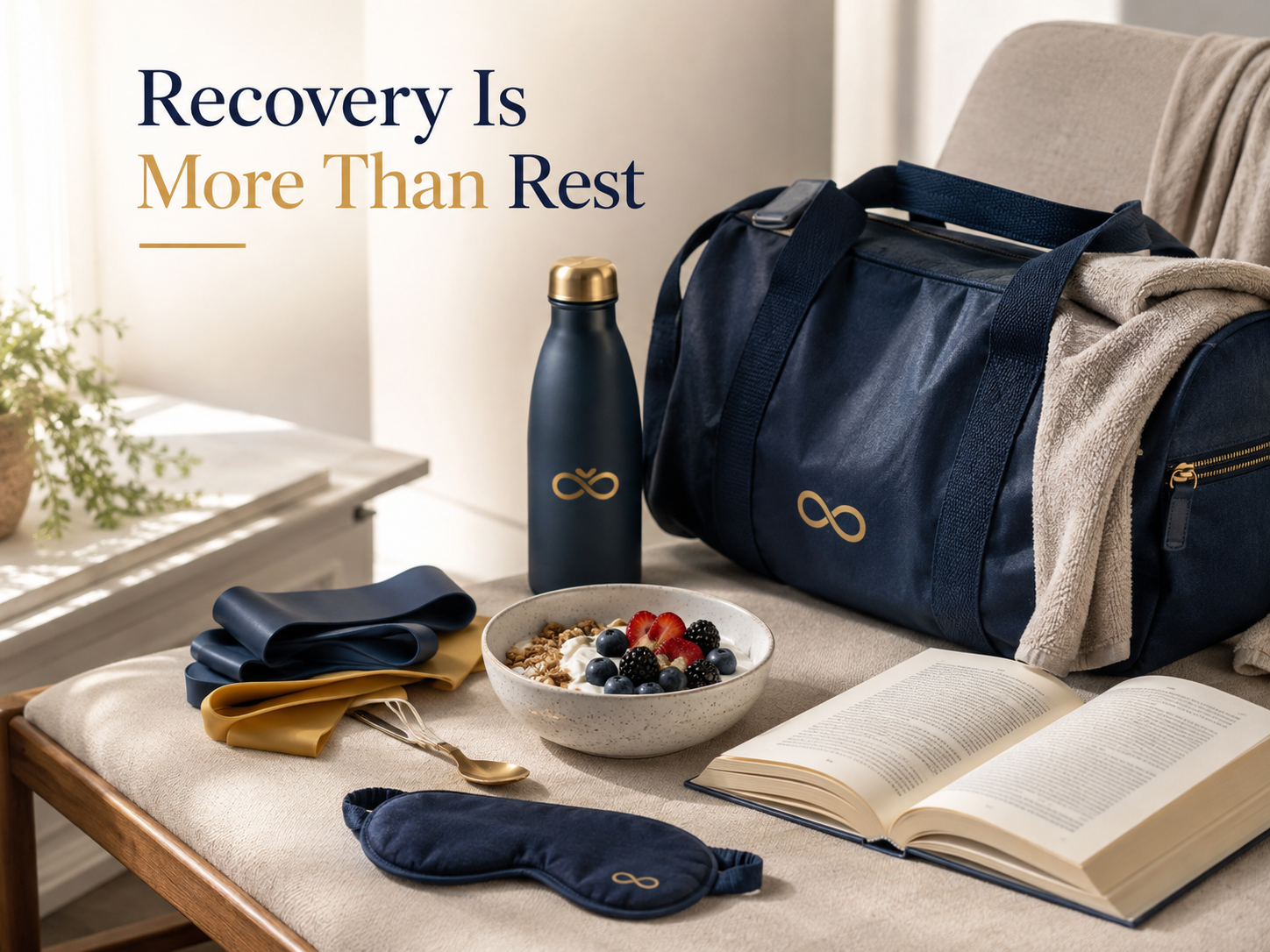
Alt text: Everyday recovery tools including sleep, nutrition, hydration, and lighter movement after exercise.
Nutrition Helps Rebuild What Training Uses
Exercise creates demand.
Recovery requires resources.
Protein provides amino acids used in muscle protein remodeling. Carbohydrates can help replenish glycogen, the stored form of carbohydrate used during activity. Fluids and electrolytes help replace what is lost through sweat.
You do not need a complicated post-workout ritual after every session.
But consistently under-eating while training hard can make recovery more difficult.
Watch for patterns such as:
Training after long periods without food
Skipping meals after exercise
Cutting calories aggressively while increasing training
Eating very little protein
Drinking heavily after hard training
Not replacing fluids after sweating heavily
The goal is not perfection.
It is giving your body enough material to respond to the work you are asking it to do.
If you have kidney disease, diabetes, gastrointestinal conditions, cardiovascular concerns, or other medical issues, nutrition and hydration recommendations should be individualized with a qualified professional.
Hormones May Influence the Experience of Recovery
Hormonal transitions may affect sleep, muscle, connective tissue, temperature regulation, body composition, and how exercise feels.
For women, perimenopause and menopause may introduce sleep disruption, hot flashes, fatigue, and changes in body composition that indirectly affect recovery.
For men and women, endocrine conditions, thyroid disorders, low energy availability, medications, and other medical factors can also influence fatigue and exercise tolerance.
This does not mean every difficult recovery period should be blamed on hormones.
It means persistent changes deserve context.
If your recovery suddenly becomes much worse without a clear change in training, consider what else has changed.
That may include:
Sleep
Hormonal symptoms
Medications
Illness
Stress
Calorie intake
Iron status
Thyroid function
Pain or injury
A healthcare professional can help determine whether a medical issue is contributing.
Where Peptide Research Fits Into Recovery
Peptides are also being studied for their roles in inflammation, tissue signaling, repair, and recovery.
That does not mean there is one established “recovery peptide.” The evidence varies widely depending on the compound. Some peptide pathways are well understood biologically, while other compounds discussed online may have only laboratory, animal, or limited human research behind them.
This distinction matters because research suggesting that a peptide influences a biological pathway is not the same as showing that a specific peptide product is safe or effective for improving recovery in people.
If you are exploring this area, start by understanding the science and the level of evidence rather than beginning with a product claim.
Continue learning: Read What Are Peptides, Really? and What “Research Use Only” Actually Means.
More Recovery Does Not Always Mean Doing Nothing
Recovery days do not have to mean lying on the couch.
Depending on the situation, lighter activity may feel better than complete inactivity.
That might include:
Walking
Gentle cycling
Mobility work
Easy swimming
Stretching
Very light resistance work
Recreational movement
The purpose is different from training.
You are not trying to create another hard stimulus.
You are keeping the body moving without adding significant fatigue.
Complete rest may still be appropriate when you are sick, injured, severely fatigued, or advised to rest by a healthcare professional.
The right recovery strategy depends on why you are tired.
What Is Affecting Your Recovery?
Check the statements that feel familiar:
☐ I increased my workout volume or intensity recently.
☐ I am doing more activities than my training plan reflects.
☐ My sleep has been shorter or more disrupted.
☐ Stress has been unusually high.
☐ I am eating less while training more.
☐ I often train without enough time between hard sessions.
☐ I am carrying soreness into the next workout.
☐ My medications or health status recently changed.
Choose the one or two factors that stand out most.
The purpose is not to find something to blame.
It is to find something you can adjust.
One Practical Next Step: Use a 48-Hour Recovery Check
After your next challenging workout, check in at approximately 24 and 48 hours.
Ask:
How does my body feel?
Normal soreness
Unusual pain
Heavy or weak
Mostly recovered
How is my energy?
Normal
Slightly low
Very low
How did I sleep?
Well
Fairly
Poorly
How does movement feel?
Normal
Stiff but improving
Worse than yesterday
Am I ready for another hard session?
Yes
Maybe, but lighter
No
You do not need a perfect score.
You are looking for your own pattern.
If you consistently feel depleted at 48 hours, consider adjusting one variable:
Reduce training volume
Space hard sessions farther apart
Protect sleep
Improve post-workout nutrition
Add a lighter day
Review symptoms with a healthcare professional
When to Speak With a Healthcare Professional
Normal soreness usually improves gradually.
Seek medical guidance when you experience:
Severe or worsening pain
Significant swelling
Sudden weakness
Joint instability
Pain that changes how you walk
Persistent fatigue unrelated to training
Shortness of breath or chest symptoms
Dark urine after unusually intense exercise
Repeated inability to recover between normal workouts
Symptoms following a medication change
A major change in exercise tolerance
Pain that feels sharp, localized, or progressively worse should not simply be treated as “normal soreness.”
Frequently Asked Questions
How long should muscle soreness last?
Delayed-onset muscle soreness commonly appears after unfamiliar or demanding exercise and often peaks during the first few days. The duration varies with the person, exercise, and training history. Soreness that is severe, worsening, or associated with swelling or weakness deserves more attention.
Should I train when I am still sore?
Mild soreness does not always require complete rest. A lighter session, different muscle group, or easy activity may be reasonable. Significant soreness, loss of strength, altered movement, or pain are stronger reasons to reduce the load.
Does recovery always get worse with age?
No. Current evidence does not show that advancing age automatically produces greater exercise-induced muscle damage or dramatically worse recovery. Individual fitness, training history, health, sleep, nutrition, and exercise type matter considerably.
Choose Your Next Guide
If soreness and inflammation are confusing:
Read Inflammation Is Not Always the Enemy.
If maintaining strength is your priority:
Read Why Muscle Matters More Than Most People Realize.
To explore the full pathway:
Return to Inflammation and Recovery.
The Most Important Takeaway
Recovery is not a sign that you are doing less.
It is how your body adapts to what you just asked it to do.
If recovery feels harder than it once did, do not automatically assume age is the problem.
Look at the full picture:
Training load. Sleep. Stress. Nutrition. Hormones. Health. Recovery time.
The most useful question may be:
“What am I asking my body to recover from, and what am I giving it to work with?”
That is a much better starting point.
Related Reading
Inflammation Is Not Always the Enemy
https://infinite-longevity.com/post/inflammation-is-not-always-the-enemy
Why Muscle Matters More Than Most People Realize
https://infinite-longevity.com/post/why-muscle-matters
Strength, Endurance, and Power Are Not the Same
https://infinite-longevity.com/post/strength-endurance-and-power
Explore Recovery & Inflammation
https://infinite-longevity.com/recovery-inflammation
About Infinite Longevity
Infinite Longevity is an educational wellness platform focused on helping adults better understand the science, research, and practical factors connected to healthy aging, metabolic health, recovery, performance, and emerging peptide research.
Our Learning Center translates complex topics into clear, practical information using current government resources, peer-reviewed research, and recognized medical and scientific sources.
Our content is designed to support better questions and more informed conversations with qualified healthcare professionals. It is not intended to diagnose a condition, prescribe treatment, or replace personalized medical care.
Founded by Marcia Riner, Infinite Longevity was created to make complex wellness and longevity information easier to understand, evaluate, and use responsibly.
Sources
Aging and Recovery After Resistance-Exercise-Induced Muscle Damage: Current Evidence
Advancing Age Is Not Associated With Greater Exercise-Induced Muscle Damage
Physical Activity, Athletic Performance, and Recovery: The Role of Sleep
How Much Does Sleep Deprivation Impair Endurance Performance?
Sleep Interventions Designed to Improve Athletic Performance and Recovery
Important Notice
This guide is for general educational purposes only. It does not diagnose an injury or medical condition, provide individual medical advice, prescribe an exercise or nutrition program, recommend treatment, or replace care from a qualified healthcare professional.
Speak with an appropriate licensed healthcare professional about persistent fatigue, pain, injuries, medication effects, hormonal concerns, nutrition, exercise safety, or significant changes in physical performance.