
Strength, Endurance, and Power Are Not the Same | Infinite Longevity
Strength, Endurance, and Power Are Not the Same
You can be strong and still get winded climbing a hill.
You can walk for hours and still struggle to lift a heavy suitcase.
You can lift plenty of weight but react too slowly when you lose your balance.
That is because physical capability is not one thing.
Strength, endurance, and power are different abilities.
They overlap, but each one helps your body handle a different kind of demand.
And as life moves forward, maintaining all three can help you keep more of the activities you enjoy within reach.
Being fit is not about being good at one kind of exercise. It is about having enough capacity for the different demands life puts in front of you.
The Quick Answer
Strength is your ability to produce force.
Endurance is your ability to continue an activity over time.
Power is your ability to produce force quickly.
Each supports different everyday activities. Strength helps you lift and carry. Endurance helps you walk, hike, cycle, or remain active longer. Power helps with quick movements such as climbing a step, accelerating, standing quickly, or reacting when you lose your balance.
Current CDC guidance recommends that adults maintain both aerobic fitness and muscle strength, with balance activities becoming especially important later in life. (cdc.gov)

Alt text: Everyday activities showing strength, endurance, and power as different parts of physical capability.
Strength Is About Force
Strength is your ability to produce force against resistance.
That resistance could be:
A dumbbell
A grocery bag
Your own body weight
A suitcase
A heavy door
A piece of furniture
If you are trying to lift something heavy, push something away, pull something toward you, or stand up from a low position, strength is involved.
The CDC recommends muscle-strengthening activity involving the major muscle groups at least two days each week for adults 65 and older. Those activities can include weights, resistance bands, body-weight exercises, gardening, and some forms of yoga.
Strength gives you capacity.
If lifting a 25-pound suitcase requires nearly everything you have, the task feels difficult.
If you are capable of lifting substantially more than that, the same suitcase takes a smaller percentage of your available strength.
That reserve matters.
It can make everyday activities feel easier rather than constantly pushing you toward your limit.
Endurance Is About How Long You Can Keep Going
Endurance is different.
It is your ability to sustain activity over time.
That may mean:
Walking through an airport
Hiking
Dancing for an evening
Cycling
Swimming
Gardening for an afternoon
Playing a round of golf
Exploring a new city
This is where aerobic fitness becomes important.
CDC guidance currently recommends at least 150 minutes of moderate-intensity aerobic activity per week, or 75 minutes of vigorous activity, or an equivalent combination for adults 65 and older.
That does not mean everyone needs to count minutes obsessively.
It means your heart, lungs, circulation, and working muscles benefit from regularly being asked to sustain activity.
A person can have excellent strength and still have relatively poor endurance.
That is why lifting weights alone does not necessarily prepare you for a five-mile hike.
Power Is Strength With a Clock Attached
Power is often overlooked.
In simple terms:
Strength asks, “Can you produce force?”
Power asks, “How quickly can you produce it?”
That difference becomes important in real life.
Imagine stumbling off a curb.
Your body does not have ten seconds to slowly generate force.
You need your leg to respond quickly enough to catch you.
Or consider:
Getting across a street before the light changes
Quickly rising from a low chair
Stepping onto a moving escalator
Accelerating up a steep step
Catching yourself when you slip
Lifting something quickly into place
These activities depend partly on power.
The National Institute on Aging notes that muscle power and physical performance tend to decline over time, with declines accelerating later in life. The good news is that maintaining an active lifestyle can substantially slow losses in strength and power and help preserve mobility and independence.
Strength gives you force. Power determines how quickly you can use it when life does not give you much warning.
Power Can Decline Before You Think You Are “Weak”
This is one reason someone can still feel reasonably strong but notice everyday movement becoming slower.
You may still be able to stand from a chair.
It simply takes more effort.
You may still climb stairs.
But you move more cautiously.
You may still lift something heavy.
But fast movements feel less natural.
Muscle strength, power, coordination, and nervous-system function all contribute to how quickly the body can respond.
That makes maintaining physical performance about more than preserving muscle size alone.
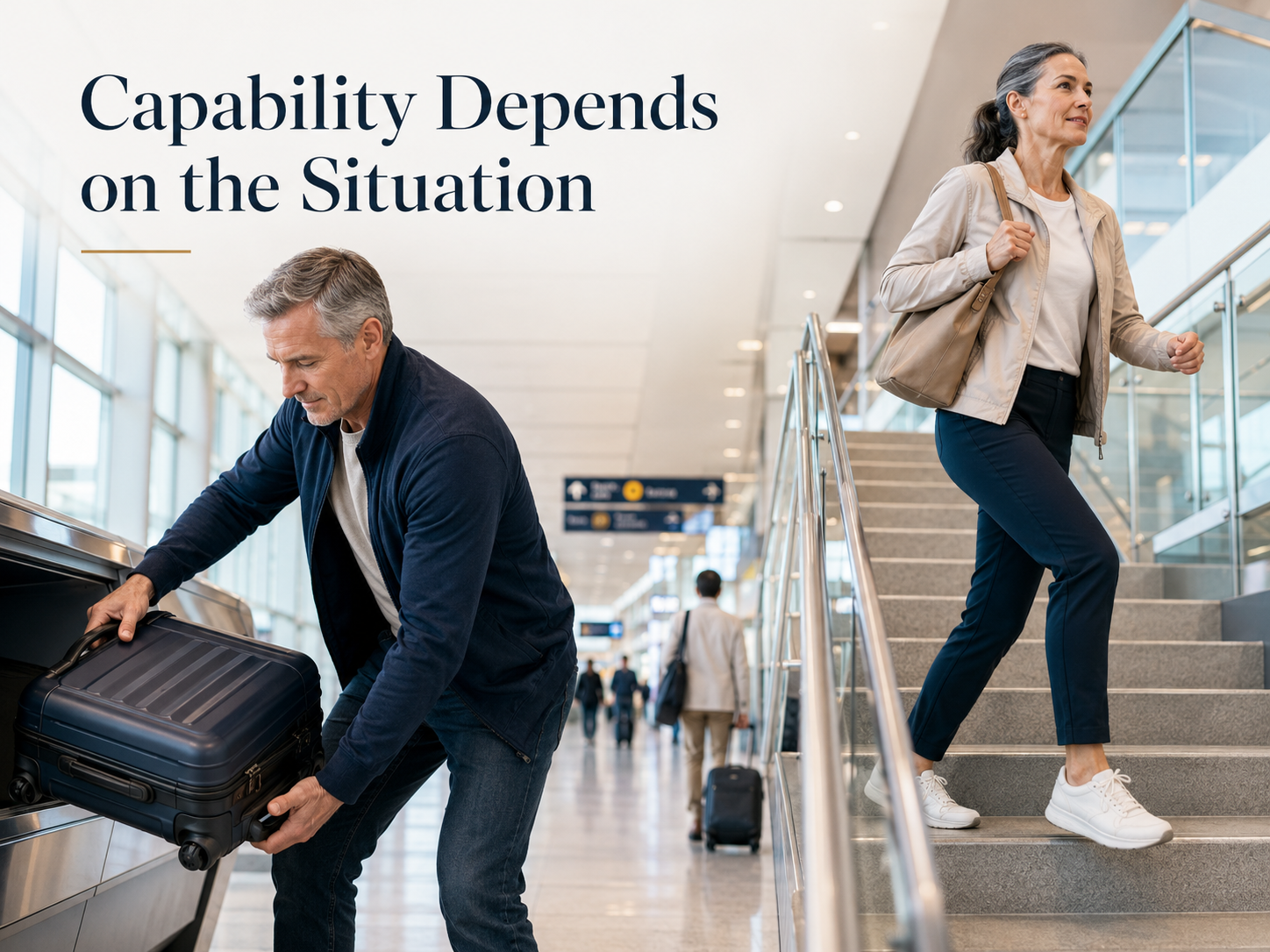
Alt text: Travel activities showing how strength, endurance, and quick movement support different everyday demands.
Balance Deserves a Place in the Conversation Too
Strength, endurance, and power are important.
But balance helps you use them safely.
CDC guidance for adults 65 and older specifically recommends including balance activities along with aerobic and muscle-strengthening exercise.
Balance depends on several systems working together, including:
Vision
Inner-ear function
Sensation in the feet and joints
Muscle strength
Reaction speed
Coordination
This is why a complete physical-capability plan may include more than cardio and weights.
Balance work can include:
Standing on one leg
Heel-to-toe walking
Tai chi
Yoga
Controlled stepping
Activities on varied terrain
Some recreational activities naturally challenge multiple abilities at the same time.
Hiking, for example, may combine endurance, leg strength, balance, and occasional bursts of power.
Different Activities Train Different Abilities
A long walk is excellent activity.
But it does not challenge your body in exactly the same way as resistance training.
Heavy resistance training can improve strength.
But it does not create the same aerobic challenge as cycling for 45 minutes.
Slow strength exercises can build force.
But they may not train rapid force production as directly as appropriately designed power movements.
CDC refers to activities combining aerobic, strength, and balance demands as multicomponent physical activity. Examples may include gardening, tai chi, yoga, and certain sports.
That means you do not necessarily need three completely separate workout programs.
You need enough variety that one ability is not carrying the entire load.
Everyday Life Gives You Clues About What You Need
Your exercise program can look great on paper while missing the ability that matters most to your actual life.
Ask yourself what feels harder lately.
Strength
Do you notice difficulty:
Carrying bags?
Moving boxes?
Opening heavy doors?
Lifting luggage?
Getting up from the floor?
Endurance
Do you notice difficulty:
Walking longer distances?
Climbing multiple flights of stairs?
Traveling?
Hiking?
Staying active through a long day?
Power
Do you notice:
Slower reactions?
Difficulty stepping up quickly?
Trouble accelerating?
Feeling hesitant when you need to move suddenly?
Recovering balance more slowly?
Your answer can help identify what your current routine may be missing.
You Do Not Have to Train Like an Athlete
The word power can make people picture Olympic lifting, jumping onto high boxes, or explosive athletic drills.
That is not necessary for everyone.
Power training simply involves practicing appropriate movements with an emphasis on producing force more quickly.
For some people, that might eventually include athletic movements.
For someone else, it may begin with:
Standing from a chair with controlled speed
Stepping up more briskly
Pushing away from a wall
Using light resistance with faster intent
The appropriate level depends on your current strength, balance, health, joints, and experience.
If you have osteoporosis, cardiovascular disease, joint problems, a history of falls, or other medical concerns, get professional guidance before adding fast or explosive movements.
Strength Alone Is Not the Goal
We tend to celebrate numbers.
How much can you bench?
How heavy can you squat?
How far can you run?
But those numbers are only useful if they support the life you want.
The National Institute on Aging emphasizes physical activity because it helps adults maintain physical function, complete everyday tasks, and preserve independence.
The practical goal may be:
Enough strength to lift what you need.
Enough endurance to stay active as long as you want.
Enough power to move quickly when you need to.
That is a more useful definition of fitness.
Which Ability Needs More Attention?
Check the statements that sound most like you:
I am strong but get winded easily.
I can walk a long time but lifting heavy objects is difficult.
I exercise regularly but quick movements feel awkward.
I avoid stairs because my legs fatigue.
I have good endurance but very little strength training.
I lift weights but do almost no aerobic activity.
I feel slower reacting when I stumble or change direction.
My balance has become less reliable.
Look for the ability you may be neglecting.
You do not need to abandon what you are already good at.
You may simply need to add what is missing.
One Practical Next Step: Build a Capability Week
For one week, look at your normal movement.
Did you include something that challenged:
Strength?
Examples:
Resistance training
Carrying
Bands
Body-weight resistance
Endurance?
Examples:
Brisk walking
Cycling
Swimming
Hiking
Dancing
Balance or Power?
Examples:
Controlled step-ups
Balance practice
Tai chi
Appropriate faster movements
Recreational sports
You do not need to maximize all of them every week.
The goal is simply to notice whether your routine has become one-dimensional.
If every workout looks almost identical, your body may be getting very good at one thing while other capacities gradually fade.
When to Speak With a Healthcare Professional
Seek professional guidance if you notice:
Sudden loss of strength
Significant decline in exercise tolerance
New balance problems
Repeated falls
Chest pain during activity
Unusual shortness of breath
Dizziness or fainting
Persistent joint pain
Weakness primarily affecting one side
A rapid change in walking speed or physical capability
A physical therapist, qualified exercise professional, or healthcare provider can also help you determine which types of training are appropriate if you are returning after illness, injury, or a long period of inactivity.
Frequently Asked Questions
Is strength training enough if I walk every day?
Walking provides valuable aerobic activity, but current physical activity guidelines recommend both aerobic and muscle-strengthening activity because they provide different benefits. Balance activity is also recommended for older adults.
What is the difference between strength and power?
Strength is the ability to produce force. Power includes how quickly that force can be produced. You might have enough strength to stand from a chair slowly but need greater power to stand quickly or catch yourself after losing balance.
Do I need to train all three?
You do not need three complicated programs, but maintaining a mix of aerobic fitness, muscle strength, balance, and physical performance supports broader capability. Many activities train more than one quality at once.
Choose Your Next Guide
To understand why muscle itself matters:
Read Why Muscle Matters More Than Most People Realize.
To understand recovery between training sessions:
Read Why Recovery Takes Longer Than It Used To.
To explore the full pathway:
Return to Performance & Strength.
The Most Important Takeaway
Strength, endurance, and power are not competitors.
You need them for different reasons.
Strength helps you handle resistance.
Endurance helps you keep going.
Power helps you respond quickly.
The useful question is not:
“Which one is best?”
Ask:
“Do I have enough of each to support the life I want to keep living?”
That is what physical capability is really about.
Related Reading
Why Muscle Matters More Than Most People Realize
https://infinite-longevity.com/post/why-muscle-matters
Why Strength Matters More as Life Moves Forward
https://infinite-longevity.com/post/why-strength-matters-as-life-moves-forward
Why Recovery Takes Longer Than It Used To
https://infinite-longevity.com/post/why-recovery-takes-longer
Explore Performance & Strength →
https://infinite-longevity.com/performance-and-strength
About Infinite Longevity
Infinite Longevity is an educational wellness platform focused on helping adults better understand the science, research, and practical factors connected to healthy aging, metabolic health, recovery, performance, and emerging peptide research.
Our Learning Center translates complex topics into clear, practical information using current government resources, peer-reviewed research, and recognized medical and scientific sources.
Our content is designed to support better questions and more informed conversations with qualified healthcare professionals. It is not intended to diagnose a condition, prescribe treatment, or replace personalized medical care.
Founded by Marcia Riner, Infinite Longevity was created to make complex wellness and longevity information easier to understand, evaluate, and use responsibly.
Sources
National Institute on Aging: How Can Strength Training Build Healthier Bodies as We Age?
National Institute on Aging: Health Benefits of Exercise and Physical Activity
Important Notice
This guide is for general educational purposes only. It does not provide an individualized exercise prescription, diagnose weakness or balance problems, or replace care from a qualified healthcare professional.
Speak with an appropriate licensed healthcare professional or qualified exercise professional before beginning unfamiliar, high-intensity, or rapid movement exercises if you have cardiovascular disease, osteoporosis, balance problems, significant joint issues, previous falls, or other medical concerns.