MOTS-c and Humanin: Why Scientists Are Studying Peptides Made by Mitochondria | Infinite Longevity
MOTS-c and Humanin: Why Scientists Are Studying Peptides Made by Mitochondria
Most people know mitochondria as the parts of our cells that help produce energy.
That description is true.
It is also incomplete.
Scientists have discovered that mitochondria can produce small signaling peptides that appear to communicate with the rest of the cell and may influence how the body responds to metabolic stress.
Two of the best-known are:
MOTS-c
and
Humanin
They are called mitochondrial-derived peptides, or MDPs.
Researchers are studying them in connection with metabolism, exercise, insulin sensitivity, cellular stress, cardiovascular health, and neurobiology.
That sounds promising.
But this is still a developing field, and much of the evidence remains preclinical or early-stage.
Mitochondria do more than make energy. They may also send signals that help cells respond to stress and changing metabolic demands.
The Quick Answer
MOTS-c and Humanin are small peptides associated with mitochondrial DNA.
Researchers are studying them because they appear to participate in cellular signaling related to:
Energy metabolism
Stress responses
Glucose regulation
Insulin sensitivity
Exercise
Inflammation
Cell survival
Human studies exist, including research showing that exercise can affect circulating levels of MOTS-c and Humanin. But much of what we know about potential therapeutic effects still comes from laboratory and animal research. A 2026 systematic review found encouraging links between exercise and mitochondrial-derived peptides, but also emphasized that human evidence remains limited and more controlled trials are needed. (PubMed)
So the interesting question is not:
“Is MOTS-c a longevity peptide?”
It is:
“What have researchers actually shown about mitochondrial-derived peptides in humans?”
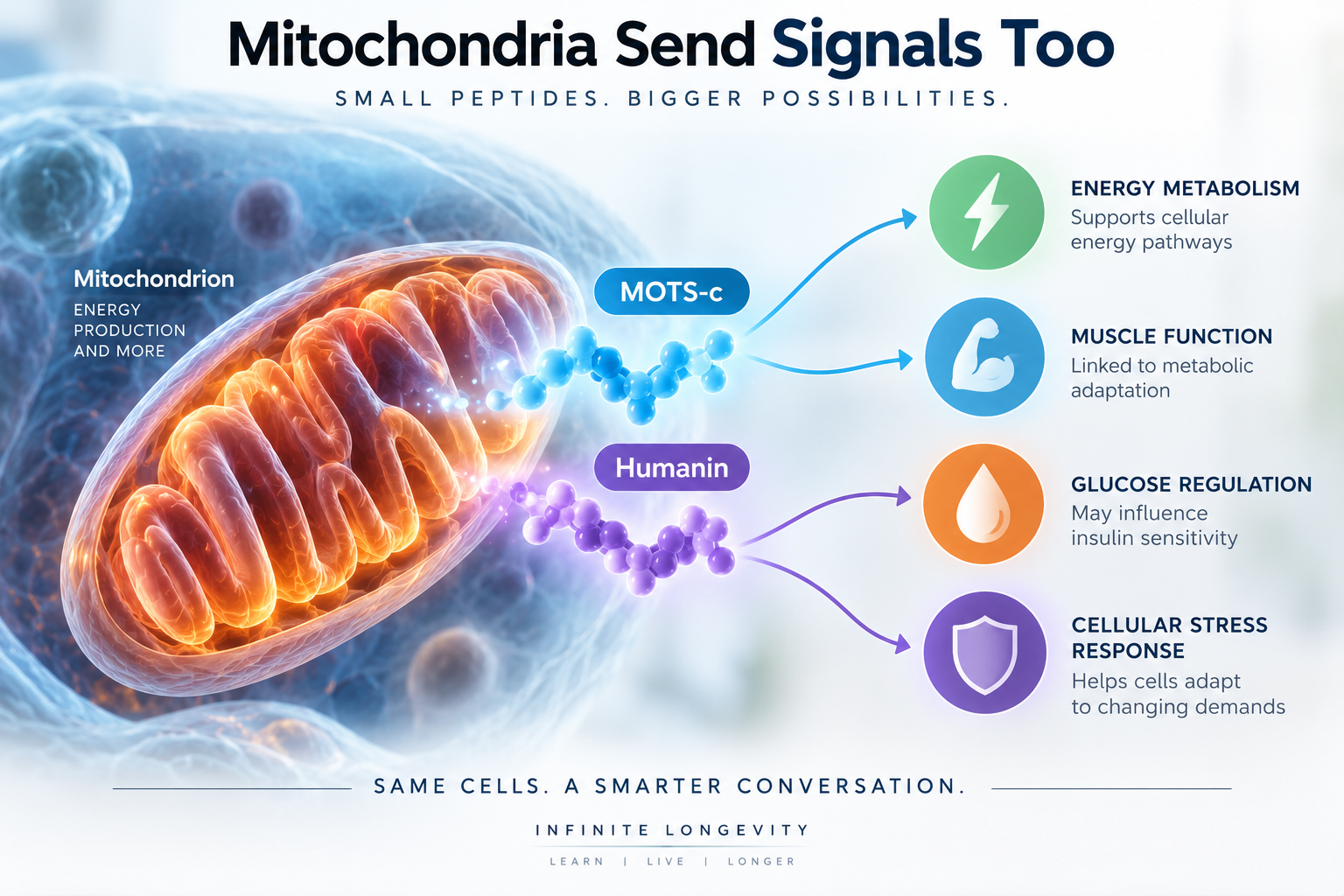
Alt text: Educational illustration showing mitochondria releasing MOTS-c and Humanin as signaling peptides connected with energy metabolism, muscle, glucose regulation, and cellular stress.
First, What Are Mitochondria Doing Besides Making Energy?
Mitochondria are often described as the “powerhouses of the cell.”
Their best-known job is helping convert nutrients into usable cellular energy.
But mitochondria also help regulate:
Cellular stress responses
Metabolism
Calcium balance
Oxidative signaling
Cell survival
Communication between different parts of the cell
That communication is important.
Cells need to know when energy demand changes, when nutrients are scarce, when oxidative stress increases, or when exercise creates a sudden metabolic challenge.
Mitochondrial-derived peptides may be part of that signaling network.
What Is MOTS-c?
MOTS-c stands for:
Mitochondrial Open Reading Frame of the 12S rRNA Type-c
It is a short peptide encoded within mitochondrial DNA.
Research has linked MOTS-c with several metabolic pathways, including those involved in:
Glucose metabolism
Insulin sensitivity
Skeletal muscle
Cellular stress adaptation
Energy balance
One proposed pathway involves AMPK, an important cellular energy sensor.
Researchers have also observed that MOTS-c can move into the cell nucleus during metabolic stress, where it may influence gene expression related to stress adaptation. (PubMed)
That makes MOTS-c interesting because it may act as a communication signal between:
Mitochondrial activity → cellular stress → nuclear response
That is very different from simply calling it an “energy peptide.”
What Is Humanin?
Humanin was one of the first mitochondrial-derived peptides identified.
It has been studied particularly in connection with:
Cellular stress
Oxidative stress
Cell survival
Metabolism
Cardiovascular biology
Neuroprotection
Researchers have investigated Humanin in models of metabolic disease, cardiovascular dysfunction, and neurodegenerative conditions.
Again, much of this work remains preclinical.
The fact that a peptide shows protective effects in cells or animals does not establish that it will produce the same results when administered to people.
That distinction is critical.
Exercise May Naturally Influence These Peptides
This is one of the most interesting parts of the research.
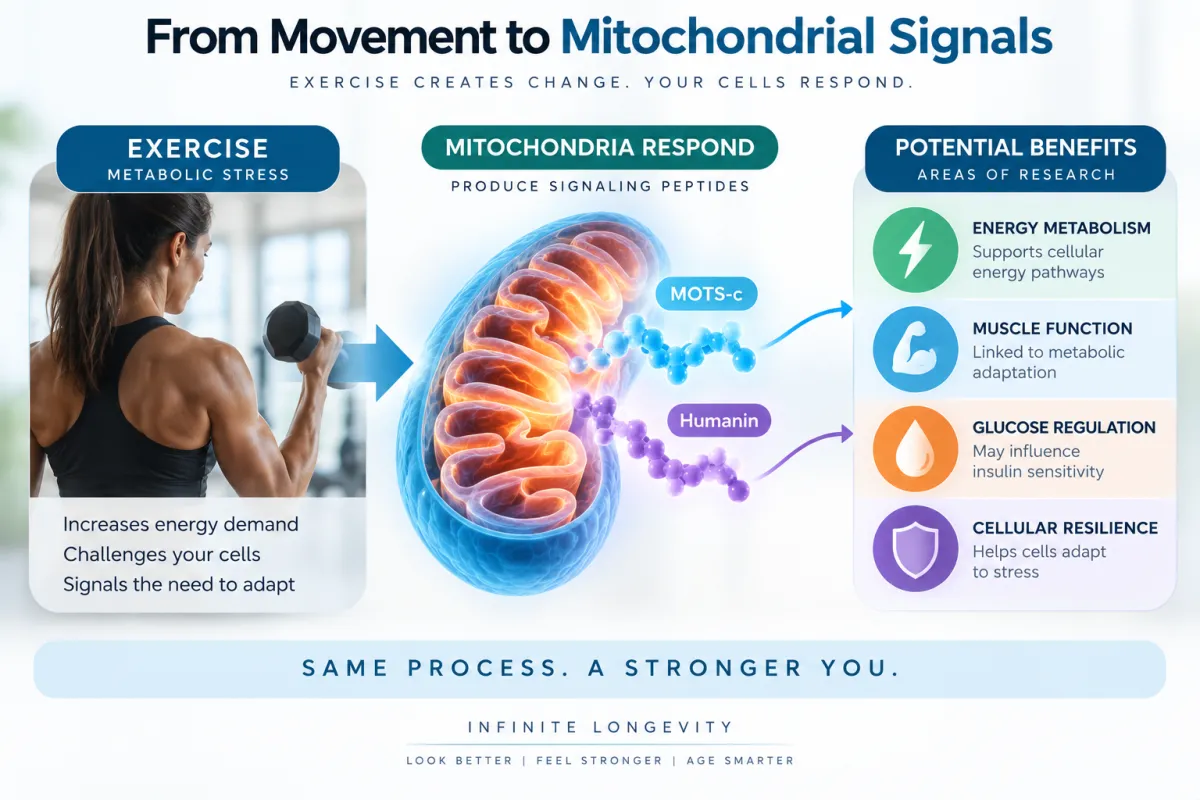
Exercise creates a temporary increase in energy demand and cellular stress.
That forces mitochondria to adapt.
Human research has shown that acute exercise can change levels of MOTS-c and Humanin in blood or muscle.
One controlled human study examined endurance exercise, resistance exercise, and a control condition and found exercise-related changes in mitochondrial-derived peptide biology. (PubMed)
A 2021 review similarly concluded that acute high-intensity exercise in humans can increase MOTS-c and Humanin concentrations, although longer-term training effects remain inconsistent. (PubMed)
A newer 2026 systematic review found that most included exercise studies showed a trend toward increased mitochondrial-derived peptide levels, but only nine studies met inclusion criteria and the authors emphasized that more human research is needed. (PubMed)
That gives us an important perspective:
The body may already use these peptides as part of its normal response to physical stress.
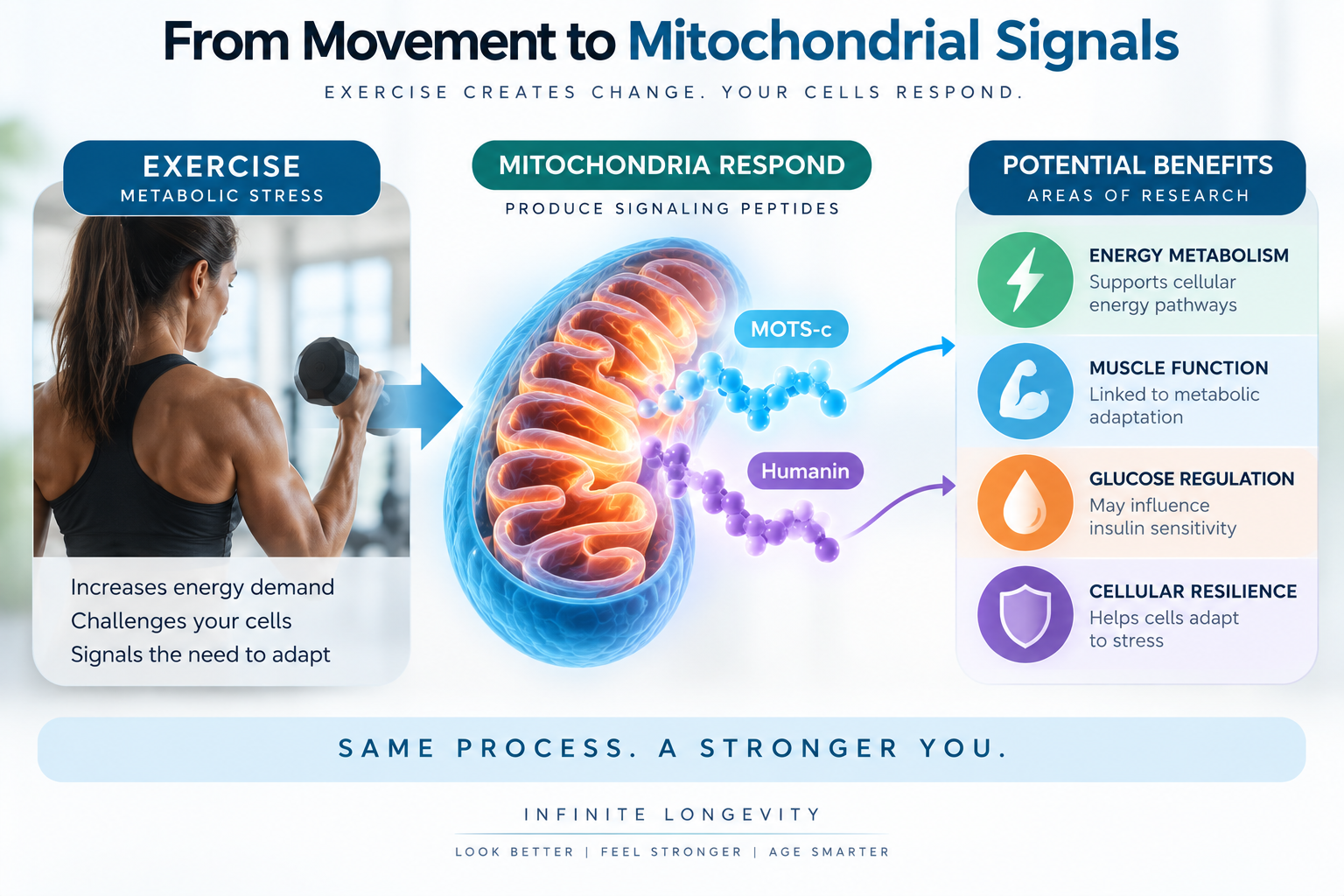
Alt text: Diagram showing exercise and metabolic stress influencing mitochondria and mitochondrial-derived peptides such as MOTS-c and Humanin.
Why Researchers Are Interested in MOTS-c and Muscle
Skeletal muscle is one of the body's largest metabolically active tissues.
During exercise, muscle dramatically increases its need for energy.
Research in animals suggests that MOTS-c may influence skeletal-muscle glucose metabolism and metabolic adaptation.
Animal studies have also reported improvements in exercise capacity and insulin sensitivity after experimentally administering MOTS-c.
But we need to keep that evidence in the correct category.
Animal performance data are not proof of improved human performance.
Human exercise studies so far are more useful for showing that MOTS-c appears to respond to exercise and may participate in normal physiological signaling.
That is interesting enough without overstating it.
What About Insulin Sensitivity?
This is one of the areas now moving further into human research.
A registered Phase 2a clinical study is evaluating investigational MOTS-c in adults with prediabetes and overweight or obesity to determine whether it can improve insulin sensitivity compared with placebo over 12 weeks. (ClinicalTrials.gov)
That is significant because it moves the conversation beyond animal models.
But it also tells us where the research stands.
A Phase 2a study means:
MOTS-c is being investigated.
It does not mean:
MOTS-c has been proven effective or approved for metabolic treatment.
Those are very different conclusions.
Where the Evidence Stands
Better established
Researchers have identified MOTS-c and Humanin as naturally occurring mitochondrial-derived peptides.
Human studies suggest their levels can change with exercise and metabolic conditions.
Emerging human evidence
Small human studies are evaluating associations with metabolism, exercise, and disease states.
Clinical research on MOTS-c is now moving into controlled intervention trials.
Strong preclinical interest
Animal and laboratory studies suggest potential effects involving:
Glucose metabolism
Insulin sensitivity
Exercise capacity
Stress adaptation
Inflammation
Cardiovascular biology
Neuroprotection
Not established
Neither the existence of these pathways nor promising animal studies establish MOTS-c or Humanin as proven treatments for:
Fat loss
Athletic performance
Diabetes
Anti-aging
Brain health
Cardiovascular disease
This is an emerging research field.
Why This Topic Gets Overhyped Online
The biology is fascinating.
That makes it easy to jump from:
“MOTS-c participates in cellular energy signaling.”
to:
“MOTS-c gives you more energy.”
Those statements are not equivalent.
Likewise:
“MOTS-c improved exercise performance in mice.”
does not mean:
“MOTS-c is a proven human performance peptide.”
This is a recurring problem in peptide discussions.
A mechanism becomes a benefit.
An animal result becomes a human claim.
A research compound becomes a product.
The science may be real while the marketing conclusion is still ahead of the evidence.
What About “Longevity”?
Humanin and MOTS-c frequently appear in longevity discussions because mitochondrial function, metabolic resilience, oxidative stress, and cellular signaling all intersect with biological aging research.
Researchers have also reported associations between mitochondrial-derived peptide levels and age-related or metabolic conditions.
That makes them interesting tools for studying aging biology.
It does not establish either peptide as a treatment that extends human lifespan.
The word longevity should not turn an interesting signaling pathway into a promise.
What This Research Does Not Mean
Research into mitochondrial-derived peptides does not currently mean:
MOTS-c is a proven exercise enhancer
Humanin prevents neurodegenerative disease
MOTS-c is an established treatment for insulin resistance
Either peptide has been proven to extend human lifespan
Research-use products are equivalent to compounds used in controlled trials
A peptide purchased online has the same identity, purity, formulation, handling, or quality as material used in published research
That final point is especially important.
A study tells you about the material and conditions used in that study.
It does not validate every product carrying the same peptide name.
For more on that distinction:
What “Research Use Only” Actually Means Infinite Longevity
and
What Laboratory Testing Can and Cannot Prove Infinite Longevity
Try This: The Human Evidence Check
When you see a claim about MOTS-c or another emerging peptide, ask:
1. Was the study in humans?
Do not treat mouse results as human outcomes.
2. Was the peptide administered or simply measured?
Finding a natural peptide level in blood is different from testing it as a treatment.
3. What was actually measured?
Insulin sensitivity?
Blood levels?
Exercise performance?
A laboratory marker?
4. Was there a placebo or comparison group?
Controlled trials provide different information from observational studies.
5. Has the result been reproduced?
One study is rarely the end of the story.
6. What stage is the research in?
Mechanism?
Animal research?
Small human study?
Phase 2?
Approved therapy?
That six-question check can prevent an interesting research finding from turning into a claim it does not support.
Frequently Asked Questions
What is MOTS-c?
MOTS-c is a mitochondrial-derived peptide encoded within mitochondrial DNA. Researchers are studying its potential role in metabolism, skeletal muscle, insulin sensitivity, stress responses, and exercise biology. (PubMed)
What is Humanin?
Humanin is another mitochondrial-derived peptide. Research has explored its roles in cellular stress, metabolism, cardiovascular biology, and neuroprotection.
Does exercise naturally increase MOTS-c?
Some human studies have reported increases or changes in MOTS-c and Humanin following acute exercise. However, longer-term responses are less consistent and more research is needed. (PubMed)
Is MOTS-c being studied in humans?
Yes. Human observational and exercise studies exist, and a Phase 2a clinical trial is evaluating investigational MOTS-c for insulin sensitivity in adults with prediabetes and overweight or obesity. (ClinicalTrials.gov)
Is MOTS-c an FDA-approved drug?
No FDA-approved MOTS-c drug has been established in the sources reviewed for this guide.
That is different from saying the peptide has no scientific research. It means research status and regulatory approval need to be kept separate.
Is MOTS-c an exercise mimetic?
Animal research has produced effects that overlap with some exercise adaptations, which has led researchers to explore that idea. Human evidence is not sufficient to describe MOTS-c as a proven substitute for exercise. (PubMed)
Are MOTS-c and Humanin anti-aging peptides?
They are being investigated in research related to metabolic stress and aging biology. That does not establish either one as a proven anti-aging treatment or human longevity therapy.
Choose Your Next Guide
Start with the peptide foundation:
What Are Peptides, Really? Infinite Longevity
See where multi-hormone metabolic research is heading:
What Comes After GLP-1? Why Researchers Are Studying Multi-Hormone Peptides Infinite Longevity
If training and physical performance interest you:
Why Progress Stalls Even When You’re Training Consistently Infinite Longevity
Understand research labeling:
What “Research Use Only” Actually Means Infinite Longevity
Explore Performance & Strength:
Performance & Strength Infinite Longevity
The Most Important Takeaway
Mitochondria are not just passive energy factories.
They appear to participate in a much larger signaling network.
MOTS-c and Humanin are part of that emerging story.
Exercise studies suggest that mitochondrial-derived peptide signaling responds to metabolic demand. Animal research has produced intriguing results involving metabolism and physical performance. And clinical researchers are beginning to test MOTS-c more directly in humans.
That makes the field worth watching.
But the useful conclusion today is not:
“MOTS-c is the next performance or longevity peptide.”
It is:
“Scientists have identified a new form of mitochondrial signaling, and we are still learning what it means in humans.”
That is interesting enough without getting ahead of the evidence.
About Infinite Longevity
Infinite Longevity is an educational wellness platform focused on helping adults better understand the science, research, and practical factors connected to healthy aging, metabolic health, recovery, performance, and emerging peptide research.
Our Learning Center translates complex topics into clear, practical information using current government resources, peer-reviewed research, and recognized medical and scientific sources.
Our content is designed to support better questions and more informed conversations with qualified healthcare professionals. It is not intended to diagnose a condition, prescribe treatment, or replace personalized medical care.
Founded by Marcia Riner, Infinite Longevity was created to make complex wellness and longevity information easier to understand, evaluate, and use responsibly.
Sources
Acute Endurance Exercise Stimulates Circulating Levels of Mitochondrial-Derived Peptides in Humans
Mitochondria-Derived Peptide MOTS-c: Effects and Mechanisms Related to Stress, Metabolism and Aging
MOTS-c: A Novel Mitochondrial-Derived Peptide Regulating Muscle and Fat Metabolism
ClinicalTrials.gov: MOTS-c for Improving Insulin Sensitivity in Adults With Prediabetes and Overweight/Obesity
Role of Humanin, a Mitochondrial-Derived Peptide, in Cardiovascular Disorders
Important Notice
This guide is for general educational purposes only.
It does not recommend MOTS-c, Humanin, a research peptide, compounded product, supplement, or other treatment.
Emerging laboratory, animal, observational, and early clinical research should not be treated as evidence that a compound is safe or effective for personal use.