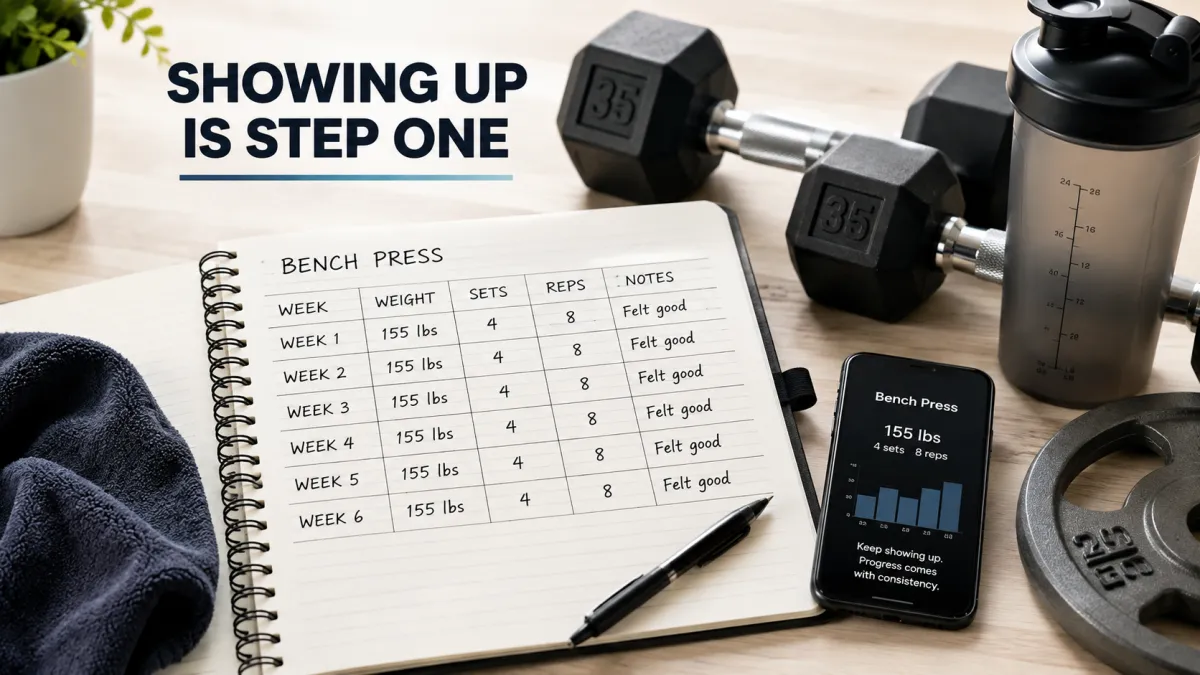
Why Progress Stalls Even When You’re Training Consistently | Infinite Longevity
Why Progress Stalls Even When You’re Training Consistently
You are showing up.
You are doing the workouts.
You are sweating, lifting, logging the sessions, and putting in the time.
But the weights are not moving up.
Your reps look about the same.
Your body does not seem to be changing much.
And eventually you start wondering:
Why am I working this hard if nothing is happening?
A plateau does not automatically mean your workouts have stopped working.
Sometimes your body has simply adapted to what you keep asking it to do.
Consistency gets you to the gym. Progress requires giving your body a reason to keep adapting.
The Quick Answer
Training progress often slows when the workout stops becoming meaningfully more challenging.
That does not mean every session needs to be harder than the last. It means that over time, something usually needs to progress, such as:
Weight
Repetitions
Sets
Exercise difficulty
Range of motion
Training quality
Total useful work
Resistance-training research supports progressive increases in training demand as an important part of continued strength and muscular development.
At the same time, doing more of everything is not automatically better.
Progress depends on the balance between training stimulus, nutrition, recovery, and consistency.
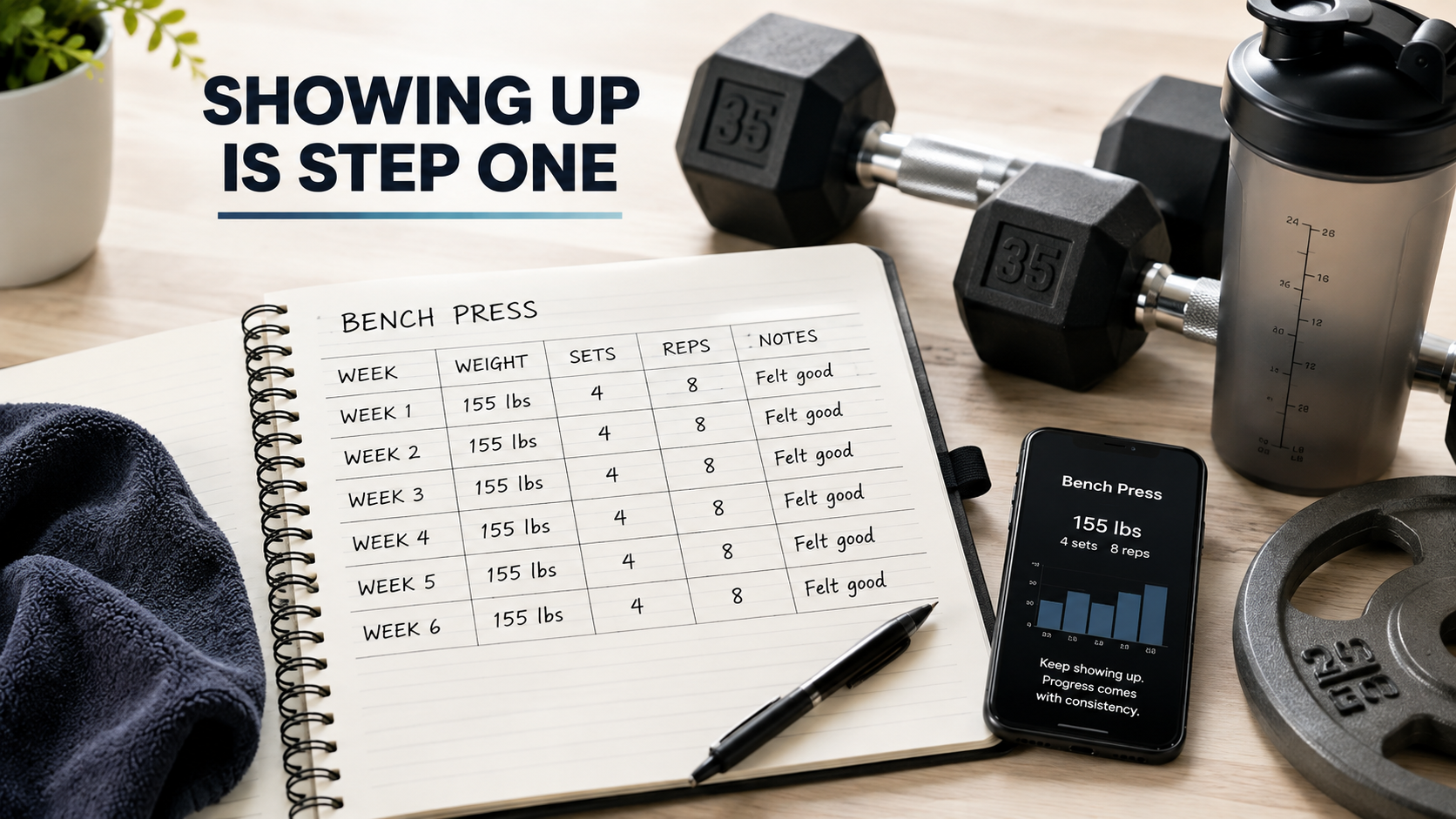
Alt text: A gym training log showing the same weights and repetitions repeated over several weeks, illustrating a workout plateau.
Your Body Gets Good at What You Keep Asking It to Do
This is one of the useful things about exercise.
Your body adapts.
A weight that once felt heavy eventually feels manageable.
A workout that once left you exhausted becomes normal.
Your heart, muscles, nervous system, coordination, and movement efficiency all become better at handling familiar demands.
That is progress.
But eventually the same adaptation that helped you improve can create a plateau.
If you perform essentially the same workout:
Same exercises.
Same weight.
Same repetitions.
Same effort.
week after week, your body may have less reason to make another large adaptation.
This is where progressive overload comes in.
Progressive Overload Does Not Mean Adding Weight Every Workout
This idea gets oversimplified.
Progressive overload does not mean:
Put another plate on the bar every Tuesday forever.
That would be impossible.
Instead, training demand can progress in several ways.
You might:
Increase weight
Perform another repetition
Add a set
Improve technique
Use a larger range of motion
Slow down a movement where appropriate
Perform the same work with better control
Increase training density
Progress to a more challenging exercise
The American College of Sports Medicine has long included progressive increases in resistance and training demand as part of resistance-training progression. (PubMed)
The exact progression depends on your goal.
Someone trying to improve maximum strength may progress differently from someone primarily trying to build muscle or improve muscular endurance.
Are You Actually Progressing Your Workouts?
Here is a surprisingly useful question:
What did you lift six weeks ago?
If you cannot answer that, you may have no way of knowing whether your training has progressed.
You do not need an elaborate spreadsheet.
For your major exercises, track:
Exercise
Weight
Sets
Repetitions
That alone can reveal a lot.
Suppose six weeks ago you performed:
Dumbbell press: 30 lb × 8 reps
and today you perform:
30 lb × 12 reps
You progressed even though the dumbbell did not change.
Now you may be ready to increase the weight and begin building the repetitions again.
Try This: The 6-Week Progress Check
This is not a fitness assessment or medical test.
It is simply a way to see whether your training has actually moved forward.
Choose three exercises you perform regularly.
For each one, compare today with roughly four to six weeks ago.
Ask:
1. Am I using more weight?
2. Can I perform more good repetitions?
3. Has my technique improved?
4. Am I using a better range of motion?
5. Does the same workout feel easier?
Now look at the pattern.
If several things improved:
You probably are progressing, even if the mirror or scale has not changed dramatically.
If nothing has changed:
Your training stimulus may need adjustment.
If performance has gone backward:
Look beyond the workout itself.
Sleep, nutrition, stress, illness, training volume, and accumulated fatigue may also be contributing.
More Exercise Is Not Automatically More Progress
When progress stalls, the instinct is often:
Do more.
Add another workout.
Add another set.
Stay longer.
Train harder.
Sometimes additional training volume can help.
But there is a point where more work stops being productive.
Research has found a relationship between weekly resistance-training volume and muscle growth, but that does not mean there is unlimited benefit from adding sets. (PubMed)
More training also creates more recovery demand.
The goal is not to accumulate the largest possible number of sets.
It is to perform enough productive training to create adaptation without burying that adaptation underneath unnecessary fatigue.
Do Not Confuse Exhaustion With Effectiveness
A workout can feel brutal and still be poorly designed.
Sweat is not a progression metric.
Neither is being unable to walk normally after leg day.
Neither is soreness.
A productive workout should connect to the thing you are trying to improve.
If the goal is strength, ask:
Am I getting stronger?
If the goal is muscle development:
Am I gradually increasing productive resistance-training work?
If the goal is endurance:
Can I sustain more work or perform the same work more efficiently?
Feeling destroyed tells you the workout was difficult.
It does not automatically tell you it was effective.
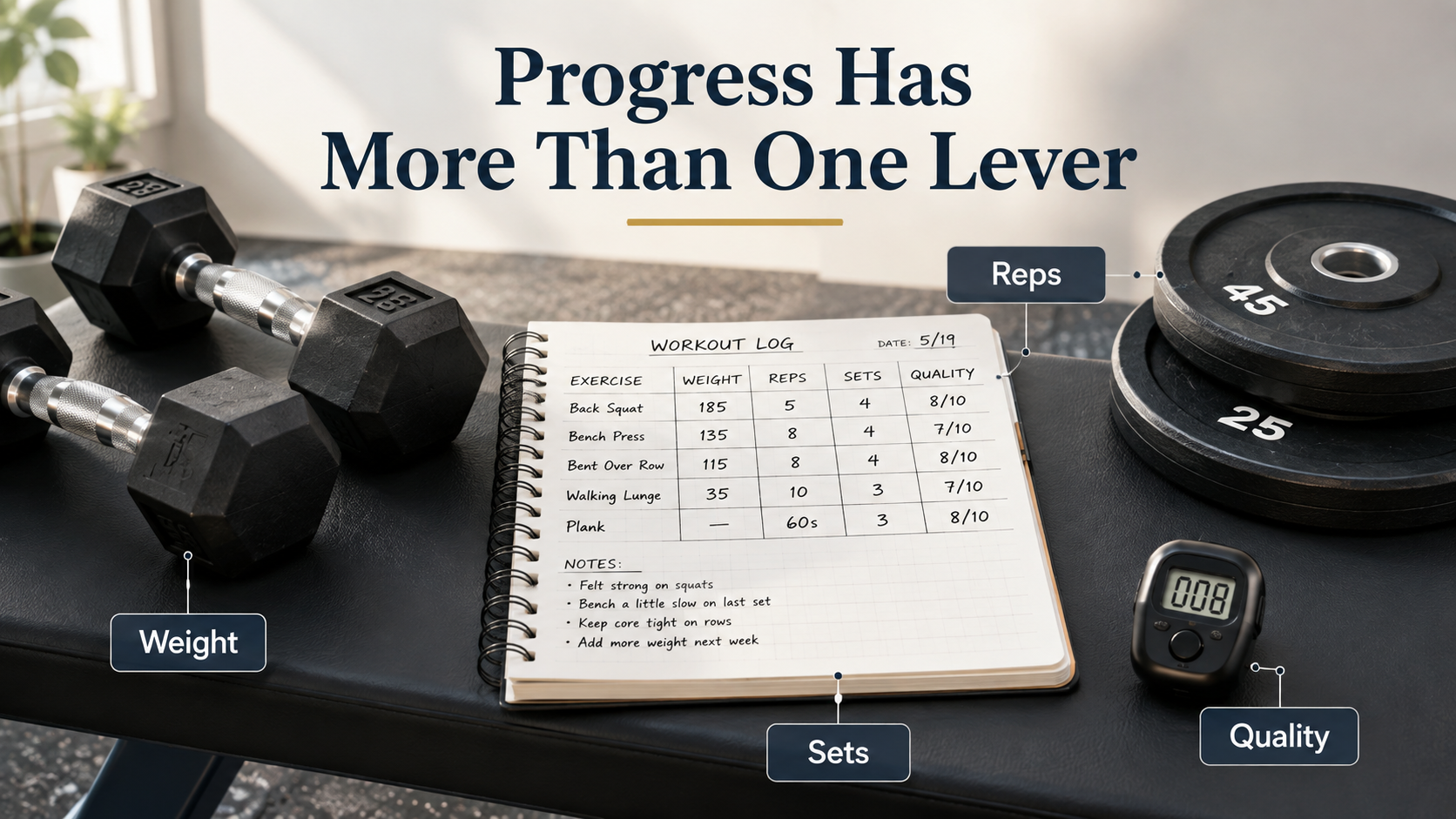
Alt text: Gym equipment and a workout log illustrating weight, repetitions, sets, and training quality as different ways exercise can progress.
Protein Can Become the Missing Piece
Training provides the stimulus.
Your body still needs the raw materials to respond.
Protein provides amino acids used to build and maintain muscle tissue.
A large meta-analysis of resistance-training studies found that protein supplementation improved gains in muscle size and strength when combined with resistance exercise, particularly when baseline intake was not already sufficient. (PubMed)
That does not mean more protein is endlessly better.
It means that someone training consistently while regularly under-eating protein may be making progress harder than necessary.
If you train regularly, it is worth asking:
Am I consistently eating enough protein across the day?
Not:
Did I drink a shake once this week?
Consistency matters here too.
Calories Matter When the Goal Is Building Muscle
Protein gets most of the attention, but total food intake matters.
Building new tissue requires resources.
Someone attempting to add significant muscle while aggressively restricting calories may find that the goals compete with each other.
That does not mean everyone needs to “bulk.”
It means your nutrition should make sense for what you are asking your body to do.
A fat-loss phase, muscle-gain phase, strength phase, and general fitness program may not all look identical.
Recovery Still Matters, but It Is Not the Whole Article
This is where our other guides come in.
You cannot separate performance completely from recovery.
If sleep is consistently poor, stress is high, and training fatigue keeps accumulating, performance can flatten even when the training program itself is reasonable.
But a plateau should not automatically be blamed on recovery either.
Sometimes the simpler answer is:
The program has stopped progressing.
For a deeper look at recovery itself, read:
Why Recovery Takes Longer Than It Used To
and
Rest Days Are Not All the Same
Strength Gains and Visible Changes Do Not Happen at the Same Speed
This can be frustrating.
You may get stronger before you look dramatically different.
Early strength improvements can come partly from neurological and technical adaptations.
You become better at:
Coordinating the movement
Recruiting muscle
Stabilizing the load
Performing the exercise efficiently
Muscle growth is a different adaptation and takes time.
So if your weights and repetitions are improving but your appearance seems slower to change, that does not necessarily mean the program is failing.
Performance itself is useful data.
Stop Changing the Program Every Week
There is another way people accidentally prevent themselves from seeing progress.
They never repeat anything long enough to measure it.
Monday is a new influencer workout.
Wednesday is a circuit.
Friday is a random machine routine.
Next week everything changes.
Variety can make exercise enjoyable.
But if your goal includes measurable improvement, you need enough consistency to know whether something actually worked.
A useful program usually contains some repeatable movements you can track over time.
You cannot progressively overload an exercise you never repeat.
When Should You Change an Exercise?
Not every movement deserves permanent loyalty.
Changing an exercise can make sense when:
It causes pain
Your equipment changes
Your goals change
Progress has genuinely stalled
The exercise no longer fits your program
You simply dislike it enough that you avoid doing it
But boredom alone does not always mean an exercise stopped working.
Sometimes boring is measurable.
And measurable can be very useful.
Where Peptide Research Fits Into Performance
Peptide hormones already play important roles in exercise physiology.
Growth hormone and insulin-like growth factor 1, or IGF-1, are examples of signaling systems involved in growth, metabolism, and tissue biology.
Because these pathways are connected with muscle and adaptation, they have also attracted interest in performance-oriented peptide research.
You may encounter discussions online about growth hormone secretagogues, including compounds designed to influence growth hormone signaling.
This is where mechanism and outcome can easily get blurred.
A compound affecting a growth-related pathway does not automatically mean that it has been shown to safely build muscle, increase strength, or improve gym performance in healthy people.
That distinction matters.
If the claim is:
“This peptide increases a hormone associated with growth.”
the next question should be:
“Has that actually translated into meaningful, well-established improvements in healthy humans, with an acceptable safety profile?”
Those are two very different claims.
For a foundation on evaluating peptide research, read:
and
What “Research Use Only” Actually Means
Five Reasons a Good Gym Member Can Still Plateau
If you are consistently showing up but progress has slowed, start here.
1. Nothing is progressing
The workout has become familiar and the training demand has stayed the same.
2. You are doing too much random work
More exercises can create fatigue without adding useful progression.
3. You are not tracking anything
You cannot see a plateau clearly if you do not know where you started.
4. Nutrition does not match the goal
Protein or overall food intake may not support the adaptation you are asking for.
5. Your performance is being limited outside the gym
Poor sleep, stress, illness, or accumulated fatigue may be keeping you from training well.
Most plateaus do not require changing everything.
They require identifying which variable has actually stopped moving.
One Practical Next Step
For your next four weeks, choose three important exercises.
Record:
Weight × Repetitions × Sets
Your goal is not to beat every number at every workout.
Look for gradual improvement across the month.
Maybe you add:
One repetition
Five pounds
A cleaner set
A better range of motion
One useful additional set
At the end of four weeks, compare the numbers.
Now you are making decisions from evidence rather than guessing based on how hard the workout felt.
When to Speak With a Healthcare or Fitness Professional
A normal training plateau is not a medical emergency.
But get appropriate guidance if progress is being limited by:
Persistent joint or tendon pain
Significant weakness
Loss of function
Recurrent injury
Unexplained major performance decline
Severe fatigue
Dizziness, fainting, chest pain, or unusual shortness of breath during exercise
A medical condition that affects safe exercise
A qualified trainer or strength professional may also help when you are healthy but unsure how to structure progression appropriately.
Frequently Asked Questions
Why have I stopped getting stronger even though I work out regularly?
Your body may have adapted to your current training program. If weight, repetitions, sets, exercise difficulty, or another meaningful training variable has not progressed for some time, the workout may no longer provide the same stimulus for improvement.
Do I need to lift heavier every week?
No.
Progress can also come from more repetitions, additional productive sets, better technique, greater range of motion, improved control, or eventually moving to a more difficult exercise.
Does being sore mean the workout worked?
Not necessarily.
Soreness can occur after unfamiliar or demanding exercise, but it is not a reliable measurement of whether you are getting stronger or building more muscle.
How long does a training plateau last?
There is no universal timeline. Short periods without obvious progress are normal. A persistent plateau is a reason to look at training progression, nutrition, recovery, and whether your program still matches your goal.
Do I need to change exercises when progress stalls?
Not automatically.
First look at whether the exercise can be progressed through weight, repetitions, sets, technique, or programming. Change it when there is a meaningful reason rather than changing simply because progress slowed for one week.
Are performance peptides a shortcut through a plateau?
That is not a useful way to interpret peptide research.
Some peptides influence biological pathways related to growth or metabolism, but influencing a pathway is not the same as proving meaningful, safe performance benefits in healthy people.
Choose Your Next Guide
If you want to understand why muscle itself matters:
Why Muscle Matters More Than Most People Realize
If you want to understand different types of physical performance:
Strength, Endurance, and Power Are Not the Same
If fatigue seems to be limiting your workouts:
Why Recovery Takes Longer Than It Used To
If you are curious about peptide science:
What Are Peptides, Really?
Explore the full topic:
Performance & Strength
The Most Important Takeaway
Showing up consistently matters.
But eventually your body needs something more specific than another identical workout.
Progress comes from giving it a reason to adapt.
Track a few important movements.
Progress them gradually.
Eat in a way that supports the goal.
Pay attention to performance instead of chasing exhaustion.
And when progress stalls, do not immediately throw out the entire program.
Ask a better question:
What has actually stopped progressing?
The answer may be much simpler than you think.
About Infinite Longevity
Infinite Longevity is an educational wellness platform focused on helping adults better understand the science, research, and practical factors connected to healthy aging, metabolic health, recovery, performance, and emerging peptide research.
Our Learning Center translates complex topics into clear, practical information using current government resources, peer-reviewed research, and recognized medical and scientific sources.
Our content is designed to support better questions and more informed conversations with qualified healthcare professionals. It is not intended to diagnose a condition, prescribe treatment, or replace personalized medical care.
Founded by Marcia Riner, Infinite Longevity was created to make complex wellness and longevity information easier to understand, evaluate, and use responsibly.
Sources
American College of Sports Medicine. Progression Models in Resistance Training for Healthy Adults.
PubMedSchoenfeld BJ, Ogborn D, Krieger JW. Dose-response relationship between weekly resistance training volume and increases in muscle mass.
PubMedMorton RW, et al. Effect of protein supplementation on resistance training-induced gains in muscle mass and strength in healthy adults.
PubMedSchoenfeld BJ, Grgic J, Van Every DW, Plotkin DL. Loading recommendations for muscle strength, hypertrophy, and local endurance.
PubMed
Important Notice
This guide is for general educational purposes only. It does not prescribe an exercise program, diagnose a medical condition, or recommend a peptide, drug, supplement, or other treatment.
Exercise needs vary based on training experience, health status, injuries, medications, and individual goals. Seek appropriate professional guidance when needed.