What “Research Use Only” Actually Means | infinite Longevity
What “Research Use Only” Actually Means
You see the phrase everywhere in the peptide world:
Research Use Only.
Sometimes it is followed by:
Not for human consumption.
At first glance, that can sound like a legal shield. Almost as if those words alone determine what a product is, how it can be sold, or whether the surrounding claims matter.
They do not.
“Research Use Only” is meant to describe products intended for laboratory or scientific research, not products intended to diagnose, treat, prevent, or affect disease or bodily function in people.
And just as important, FDA looks beyond the label itself.
If the surrounding website, product descriptions, social media, instructions, testimonials, or marketing make it clear that a product is really being promoted for human use, adding “Research Use Only” does not automatically change that intended use. FDA has repeatedly made this point in warning letters to peptide sellers.
“Research Use Only” describes intended use. It is not a shortcut around the rules that apply to products marketed for people.
The Quick Answer
“Research Use Only,” often shortened to RUO, means a product is represented as being intended for laboratory or scientific research rather than for use in humans. But FDA evaluates the product’s overall intended use, not just the words printed on the label. If marketing claims show that a product is being promoted to affect the body, treat disease, or produce human health outcomes, FDA may regulate it as a drug despite RUO language.
Alt text: Laboratory research materials beside a Research Use Only notice, emphasizing non-clinical scientific use.
What Does “Research Use Only” Mean in Practice?
At its core, RUO means the material is being represented for research rather than clinical use.
FDA explains that biological specimens used solely for basic scientific research or laboratory testing, and not intended to prevent, treat, diagnose, or cure disease in humans, may fall outside certain FDA product approval requirements because they are not being presented as drugs, devices, or biological products for human use.
That distinction is all about intended use.
A genuine research context may involve:
Laboratory analysis
Assay development
Chemical characterization
Cell-culture work
Animal research
Method development
Analytical comparisons
Scientific investigation
That is very different from selling a product while explaining how someone might use it for fat loss, muscle growth, recovery, sleep, cognition, sexual function, or another human outcome.
Once the marketing starts describing what a product is supposed to do to the human body, the regulatory picture can change.
The Label Is Not the Only Thing That Matters
This is probably the most important point in the entire guide.
FDA does not evaluate intended use by looking at one disclaimer in isolation.
The agency has repeatedly issued warning letters to companies selling peptides labeled with phrases such as:
“Research Use Only”
“Not for Human Consumption”
“Laboratory Research Purposes Only”
“Not Intended for Human Use”
while simultaneously finding that the companies’ websites or other marketing promoted the products for human health effects.
For example, in a 2026 warning letter to Gram Peptides, FDA said that despite “Research Use Only” and “not intended for human consumption” language, other website evidence established that the products were intended as drugs for human use.
FDA made the same kind of finding in warning letters to Summit Research Peptides and Prime Peptides, where products were labeled for research but marketed with claims tied to human physiological effects.
That tells us something important:
The disclaimer has to match the rest of the conduct.
Intended Use Is the Bigger Concept
Under the Federal Food, Drug, and Cosmetic Act, a product may be regulated as a drug when it is intended for use in diagnosing, curing, mitigating, treating, or preventing disease, or when it is intended to affect the structure or function of the body. FDA explains this same principle in its guidance on distinguishing cosmetics from drugs.
So when evaluating a peptide or research compound, ask:
What is the seller actually telling people this product is for?
The answer may appear in:
Product descriptions
Blog posts
FAQs
Social media
Videos
Testimonials
Suggested protocols
Before-and-after claims
Health-benefit statements
Dosing language
Statements about weight, hormones, recovery, cognition, or disease
Even when a label says “research only,” those surrounding messages may reveal a different intended use.
A disclaimer cannot say “research” while the rest of the marketing says “use this on your body.”
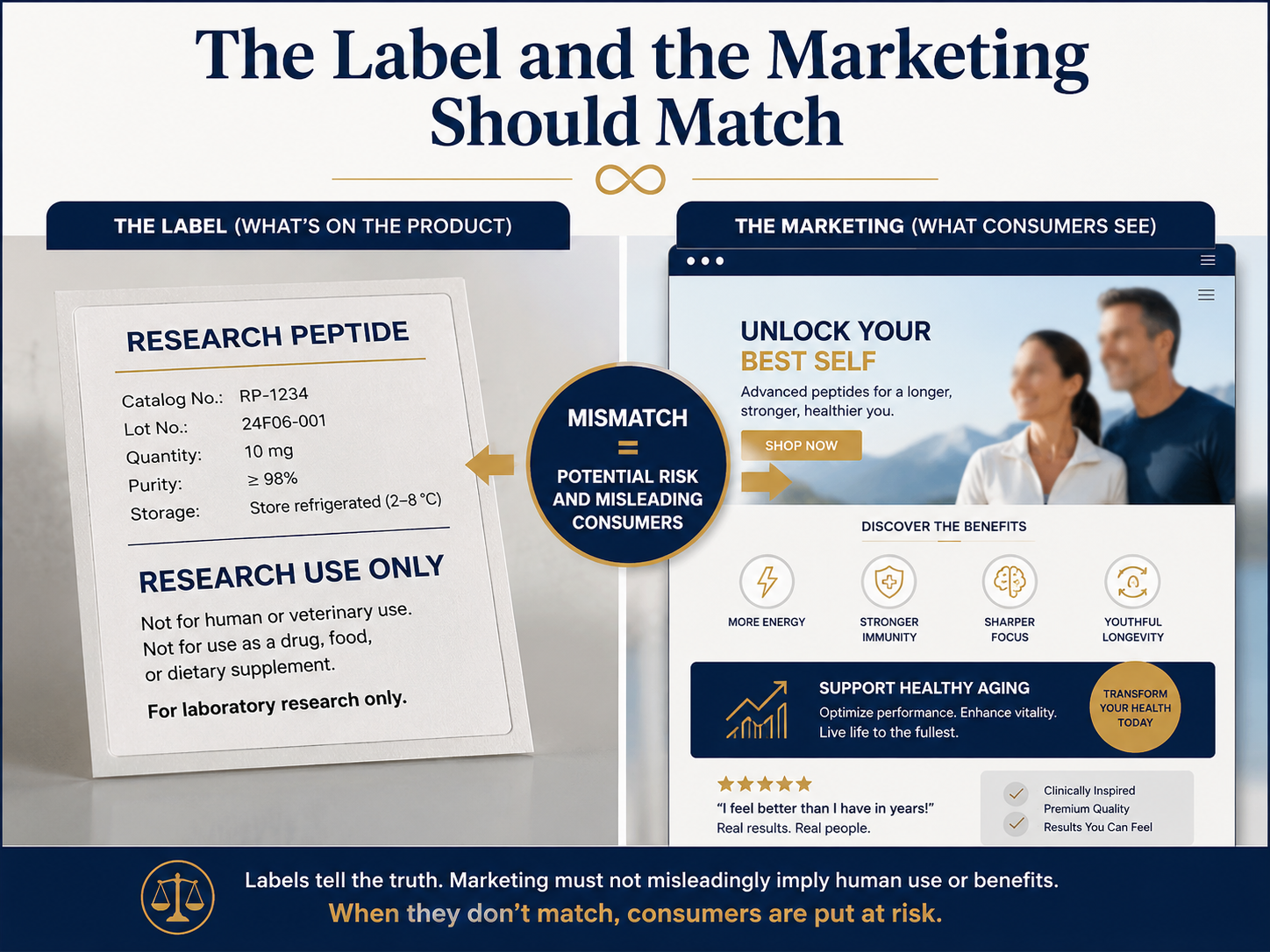
Alt text: Comparison between a Research Use Only label and human-use marketing claims, showing why intended use matters.
What “Research Use Only” Does Not Mean
RUO does not automatically mean:
The product is FDA-approved
The product has been reviewed for human safety
The product has been shown to work in people
The product is sterile
The product was made under pharmaceutical manufacturing standards
The product is appropriate for injection
The product is suitable for self-treatment
The product can legally be marketed with human health claims
The seller can ignore drug regulations
The product is equivalent to a compounded or approved medication
This is where consumers can get confused.
A research compound may have sophisticated laboratory documentation.
It may even test very well for identity or purity.
That still does not transform it into an approved drug or establish clinical safety.
Laboratory quality and clinical approval are separate questions.
“Research Use Only” Is Not the Same as “Investigational Drug”
These phrases can sound similar, but they are not interchangeable.
An investigational drug being studied in human clinical research generally exists within a formal drug-development pathway that includes regulatory oversight, protocols, safety monitoring, and an Investigational New Drug application when required.
A commercial product simply labeled “Research Use Only” does not automatically become part of that clinical research framework.
That is an important distinction.
The phrase research can refer to many kinds of work.
Some research happens in a laboratory.
Some happens in animals.
Some happens in formal human clinical trials.
Those levels should not be blended together.
It Is Also Different From Compounding
Compounded drugs occupy a different regulatory category.
Compounding generally involves licensed pharmacists or physicians preparing medications under specific federal and state requirements, often for identified patient needs or within outsourcing-facility frameworks.
Research-use products are not simply “another kind of compounded medication.”
That distinction deserves its own guide, which is why we will cover it in:
FDA-Approved, Compounded, and Research-Use Peptides: What Is the Difference?
Why Injectable Research Products Draw Extra Attention
FDA has repeatedly highlighted particular concerns with injectable unapproved products.
In several recent peptide warning letters, the agency noted that injectable products can pose serious risks because they bypass some of the body’s normal defenses against toxins and microorganisms.
That is one reason sterility, manufacturing quality, contamination, formulation, handling, and clinical evidence matter so much.
A purity percentage alone cannot answer all of those questions.
And a “Research Use Only” label does not eliminate them.
Some Peptides Have Very Limited Human Safety Information
Another reason RUO distinctions matter is that some compounds being sold online have limited or no meaningful human safety data.
FDA maintains information on bulk drug substances that may present significant safety risks when used in compounding. The agency has identified concerns or limited human safety information for substances including BPC-157, CJC-1295, MOTs-C, Semax, Epitalon, KPV, TB-500, and others.
That does not mean every compound on that list has the same risk profile.
It means the evidence may be incomplete, the characterization may be difficult, or safety questions remain unresolved.
This is exactly why it is important to separate:
Interesting research
from
established human treatment
A Research Label Should Change How You Read the Evidence
When you encounter a research-use compound, shift your questions.
Instead of beginning with:
“What can this do for me?”
Begin with:
What has actually been studied?
Was the research done in cells, animals, or humans?
How large were the human studies?
Was safety evaluated?
Was the exact compound and formulation studied?
Is there an approved human use?
Are marketing claims going beyond the published evidence?
That keeps the scientific evidence in the right lane.
A Simple RUO Reality Check
When you see a product labeled “Research Use Only,” ask:
Does the website stay focused on laboratory or scientific research?
Does it avoid human dosing instructions?
Does it avoid telling consumers what health outcomes to expect?
Does it avoid disease-treatment claims?
Does it avoid before-and-after marketing?
Does it clearly distinguish research findings from approved medical use?
Does the product's regulatory status match the way it is presented?
Are the citations describing actual research rather than being used as a substitute for approval?
The more the surrounding marketing starts to look like consumer treatment advice, the less meaningful the RUO disclaimer becomes.
One Practical Next Step: Read Beyond the Disclaimer
The next time you see:
Research Use Only. Not for Human Consumption.
Do not stop there.
Scroll.
Look at the rest of the page.
Ask:
What is this company actually inviting me to believe or do?
If the answer is clearly about personal health outcomes, body changes, dosing, or treatment, then the marketing may be telling a very different story from the label.
That is the distinction worth noticing.
Frequently Asked Questions
Does “Research Use Only” mean a product is illegal?
Not automatically. Legitimate materials can be sold for bona fide scientific or laboratory research. The regulatory issue depends heavily on what the product is, how it is marketed, its intended use, and other applicable laws and regulations. FDA has specifically acted where products labeled for research were nevertheless marketed as drugs for human use.
Can a research-use peptide still have human studies?
Yes. A compound can be the subject of human research while a particular commercial research-use product remains unapproved. Human studies of a molecule do not automatically validate every product sold under that molecule’s name.
Does a COA make a research-use product safer?
A COA may provide useful information about selected characteristics of a tested sample, such as identity or purity. It does not establish clinical safety, effectiveness, approval, sterility, or appropriate human use. See Why Certificates of Analysis Matter and What Laboratory Testing Can and Cannot Prove.
Related Reading
What Are Peptides, Really?
https://www.infinite-longevity.com/post/what-are-peptides-reallyWhat Laboratory Testing Can and Cannot Prove
https://www.infinite-longevity.com/post/what-laboratory-testing-can-and-cannot-proveWhy Certificates of Analysis Matter
https://www.infinite-longevity.com/post/why-certificates-of-analysis-matter
Explore Peptides & Emerging Science
The Most Important Takeaway
“Research Use Only” is not a magic phrase.
It should describe a genuine research purpose.
The label, website, claims, instructions, and overall marketing should all point in the same direction.
So when you see RUO, do not ask only:
“What does the label say?”
Ask:
“What is this product actually being represented for?”
That question tells you much more.
About Infinite Longevity
Infinite Longevity is an educational wellness platform focused on helping adults better understand the science, research, and practical factors connected to healthy aging, metabolic health, recovery, performance, and emerging peptide research.
Our Learning Center translates complex topics into clear, practical information using current government resources, peer-reviewed research, and recognized medical and scientific sources.
Our content is designed to support better questions and more informed conversations with qualified healthcare professionals. It is not intended to diagnose a condition, prescribe treatment, or replace personalized medical care.
Founded by Marcia Riner, Infinite Longevity was created to make complex wellness and longevity information easier to understand, evaluate, and use responsibly.
Sources
FDA: Certain Bulk Drug Substances That May Present Significant Safety Risks
FDA: How Can I Tell if My Product Is a Cosmetic, a Drug, or Both?
Important Notice
This guide is for general educational purposes only and is not legal or regulatory advice.
Whether a particular product, seller, marketing claim, or research activity complies with federal or state law depends on the specific facts and applicable regulations. “Research Use Only” labeling does not by itself determine regulatory status.
This guide also does not diagnose a medical condition, recommend a peptide or research compound, prescribe treatment, or replace care from a licensed healthcare professional.