
Rest Days Are Not All the Same
Rest Days Are Not All the Same
A rest day sounds simple.
You do not work out.
You rest.
But that does not always mean your body actually recovers.
You can skip the gym and still spend the day stressed, underslept, dehydrated, sitting for hours, eating poorly, and carrying the same fatigue into tomorrow.
Or you can take a lighter day, move gently, sleep well, eat enough, and come back feeling noticeably better.
Both technically count as “rest days.”
They are not the same.
Recovery is not just the absence of exercise. It is what gives your body enough space and resources to adapt to the exercise you already did.
The Quick Answer
A useful recovery day depends on what you are recovering from.
After a normal workout, gentle movement may feel better than complete inactivity. After unusually hard training, poor sleep, illness, injury, or accumulating fatigue, more complete rest may make more sense.
Research does not show that active recovery is universally better than passive rest. Results vary by the type of exercise, recovery method, and outcome being measured. (PubMed)
The better question is not:
Should I rest or move?
It is:
What does my body need to be ready for what comes next?
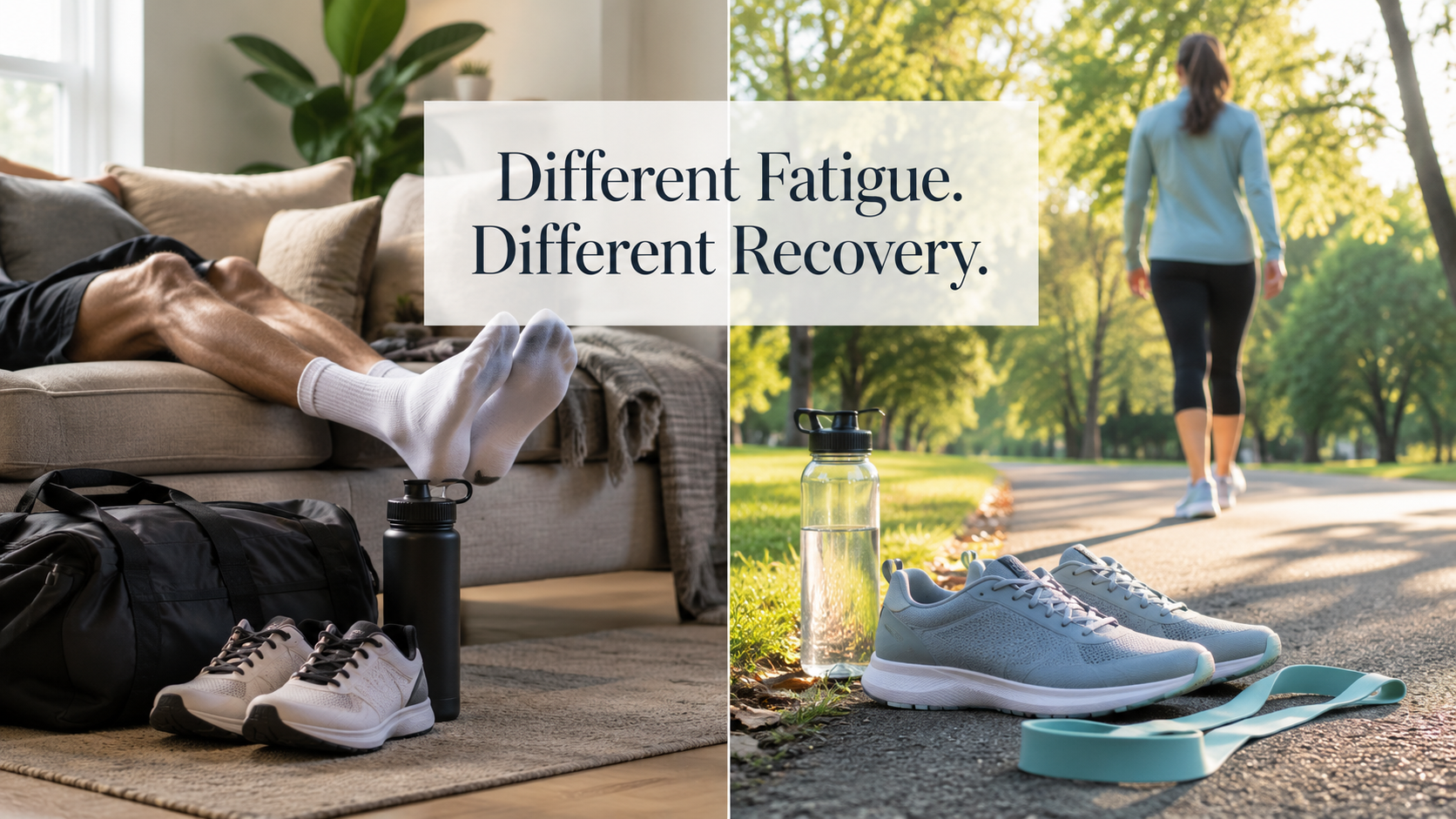
Alt text: Two different approaches to a recovery day showing complete rest after hard training and gentle movement during an active recovery day.
What Is a Rest Day Actually For?
Exercise creates stress.
That is part of why it works.
Resistance training challenges muscle.
Running and cycling challenge the cardiovascular system.
Higher-intensity exercise can create temporary fatigue and muscle soreness.
The body then adapts during the period that follows.
That means the workout and the recovery period are part of the same process.
If training keeps accumulating without enough recovery, performance can start to decline rather than improve.
Recovery gives you a chance to:
Restore energy
Repair stressed tissues
Reduce accumulated fatigue
Sleep
Rehydrate
Eat enough
Be ready for the next training session
That does not require lying on the couch every time.
But it does require respecting the workload you already created.
Active Recovery and Complete Rest Do Different Jobs
Active recovery usually means low-intensity movement that is easier than your normal training.
Examples might include:
Easy walking
Gentle cycling
Light swimming
Mobility work
Easy stretching
Very light recreational movement
Passive recovery means substantially reducing structured physical activity and allowing more complete rest.
Neither is automatically superior.
A systematic review of active recovery found some positive effects, but researchers also noted that findings varied considerably and that evidence for improved performance was limited. (PubMed)
Another systematic review comparing active and passive recovery during high-intensity exercise found that passive recovery sometimes better preserved subsequent performance. (PubMed)
So the popular idea that you should always keep moving to recover faster is too simple.
Sometimes movement helps.
Sometimes resting more is the better decision.
Soreness Is Only One Clue
Muscle soreness is easy to notice, so people often use it as their main recovery measure.
But soreness does not tell you everything.
You can be:
Not very sore but deeply fatigued
Sore but otherwise ready to exercise
Mentally exhausted
Sleeping poorly
Feeling unusually weak
Less coordinated than normal
Unmotivated because training load has simply become too high
Recovery is broader than whether your legs hurt.
A better check includes energy, sleep, performance, soreness, and how you feel overall.
Try This: What Kind of Recovery Day Do You Need?
This is not a medical test.
It is a quick decision tool.
Ask yourself these five questions:
1. How hard was my last workout?
Normal: about what I usually do.
High: unusually long, heavy, intense, or unfamiliar.
2. How did I sleep?
Good: normal duration and reasonably refreshed.
Poor: shorter than usual, restless, or still tired.
3. How does my body feel?
Mild: some stiffness or soreness but normal movement.
Significant: heavy fatigue, substantial soreness, unusual weakness, or pain.
4. How has the last week looked?
Balanced: hard and easy days have alternated.
Accumulated: several difficult sessions, travel, stress, or poor sleep have stacked up.
5. What happens when I start moving?
Better: an easy walk or warm-up makes you feel looser and more energetic.
Worse: movement makes fatigue, pain, weakness, or discomfort more noticeable.
Your likely direction
If most answers fall on the normal / good / mild / balanced / better side, an active recovery day may feel appropriate.
If several fall on the high / poor / significant / accumulated / worse side, a more complete rest day may make more sense.
The point is not to diagnose yourself.
It is to stop treating every rest day as though your body is recovering from the exact same thing.
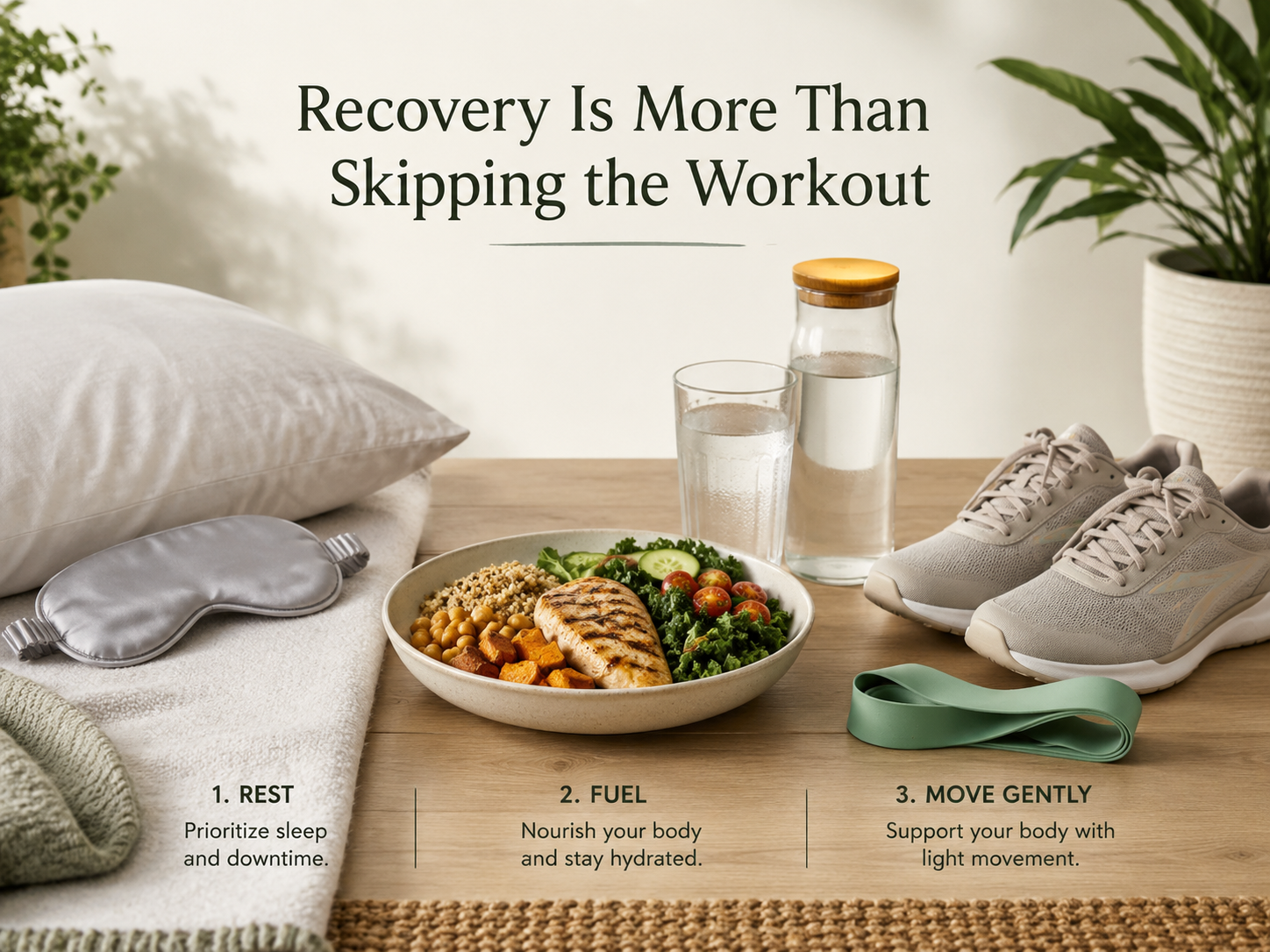
Alt text: Sleep, nutrition, hydration, and gentle movement shown as different parts of a useful recovery day.
Sleep May Matter More Than Your Recovery Gadget
Recovery has become a product category.
Compression boots.
Massage guns.
Cold plunges.
Special drinks.
Tracking devices.
Some recovery techniques may help certain outcomes, especially soreness. A large meta-analysis found that approaches including massage, compression, water immersion, and active recovery could reduce delayed-onset muscle soreness to varying degrees. (PubMed)
But none of those makes sleep optional.
Sleep is involved in physical and psychological recovery, and research continues to connect inadequate sleep with poorer physical performance and potentially greater injury risk when training loads are high. (PubMed)
Before adding another recovery tool, ask:
Am I actually giving myself enough time to sleep?
That may be less exciting.
It is also foundational.
Stress Counts Too
Your body does not experience training stress in isolation.
A hard workout may be manageable during a calm week.
The same workout can feel completely different when stacked on top of:
Poor sleep
Travel
Long workdays
Emotional stress
Illness
Calorie restriction
Dehydration
This is why a training plan that worked perfectly last month can suddenly feel harder even though the exercises have not changed.
The workout is only one part of the load.
Where Peptide Research Fits Into Recovery
Peptides and peptide-related signaling are involved in many normal processes connected with inflammation, tissue repair, immune activity, and recovery.
That is why compounds such as BPC-157 and TB-500-related peptides appear frequently in online recovery conversations.
They are also good examples of why research context matters.
Much of the interest around BPC-157 comes from preclinical research, including animal and laboratory studies. That is not the same as having strong clinical evidence showing that a product safely improves recovery in humans.
TB-500 is also commonly discussed online in connection with tissue repair and recovery, but online popularity should not be confused with established clinical evidence or FDA approval.
The useful question is not:
Which recovery peptide should I use?
It is:
What level of evidence actually supports the claim being made?
Interesting biological research can be worth following without turning a research compound into a personal-use recommendation.
Continue learning:
What Are Peptides, Really?
What “Research Use Only” Actually Means
A Recovery Day Should Make Tomorrow Better
This is a simple way to judge whether your recovery strategy is working.
You do not need to feel perfect the next day.
But over time, your recovery practices should generally help you return to training with:
Better energy
Less accumulated fatigue
Normal movement
Manageable soreness
Stable or improving performance
If every “recovery day” leaves you just as tired, it may be worth looking at what the day actually contains.
A recovery day filled with errands, poor food, four hours of sleep, and constant stress may not be much of a recovery day at all.
One Practical Next Step
Before your next scheduled rest day, decide what you are actually recovering from.
Use one of these three labels:
Light Recovery Day
For ordinary fatigue after normal training.
Think easy walking, mobility, normal daily activity, good food, and good sleep.
Full Rest Day
For accumulated fatigue, unusually hard training, poor sleep, or when your body clearly needs less activity.
Think fewer demands, more sleep, adequate nutrition, and minimal structured exercise.
Medical or Injury Check
For pain, swelling, weakness, loss of normal function, or symptoms that do not behave like ordinary exercise soreness.
That is no longer simply a recovery-planning question.
When to Speak With a Healthcare Professional
Exercise soreness and temporary fatigue are common.
Seek professional guidance when you have:
Sharp or severe pain
Significant swelling
Loss of strength or normal movement
Pain that is worsening instead of improving
Symptoms following a fall or acute injury
Extreme or persistent fatigue
Dark urine after unusually strenuous exercise
Chest pain, fainting, or unusual shortness of breath
Symptoms that repeatedly prevent normal training or daily activity
Rest days can help ordinary training fatigue.
They should not be used to repeatedly ignore a possible injury or health problem.
Frequently Asked Questions
Is active recovery better than doing nothing?
Not always.
Research suggests active recovery can help some recovery outcomes, but results vary. In some high-intensity exercise situations, passive recovery has actually preserved performance better. (PubMed)
Should I exercise if I am sore?
Mild soreness does not automatically mean you need complete rest. Gentle movement may feel comfortable for some people.
Severe pain, weakness, swelling, or altered movement deserves more caution.
How many rest days do I need?
There is no single number that fits everyone.
Training type, intensity, age, fitness level, sleep, stress, and overall workload all affect recovery needs. The American College of Sports Medicine also emphasizes balancing training with active recovery and full rest periods, particularly during periods of high training volume. (ACSM)
Does walking count as recovery?
It can.
Easy walking is one form of low-intensity activity that may fit an active recovery day when it feels comfortable and does not add meaningful fatigue.
Are BPC-157 or TB-500 proven recovery peptides?
No. They are frequently discussed in recovery communities, but online interest and preclinical research should not be treated as proof of established safety or effectiveness for human recovery.
Choose Your Next Guide
If recovery seems to take longer than it used to:
Why Recovery Takes Longer Than It Used To
If you want to better understand inflammation after exercise:
Inflammation Is Not Always the Enemy
If you want the peptide research foundation:
What Are Peptides, Really?
If you see “research use only” on a peptide product:
What “Research Use Only” Actually Means
Explore the full topic:
Inflammation & Recovery
The Most Important Takeaway
A rest day is not a formula.
Sometimes the body benefits from gentle movement.
Sometimes it benefits from doing much less.
And sometimes what feels like a recovery problem is really a sleep, stress, nutrition, workload, or injury problem.
Instead of automatically asking:
What should I do on my rest day?
Try asking:
What am I recovering from, and what would leave me better prepared for tomorrow?
That makes recovery more useful than simply crossing another workout off the calendar.
About Infinite Longevity
Infinite Longevity is an educational wellness platform focused on helping adults better understand the science, research, and practical factors connected to healthy aging, metabolic health, recovery, performance, and emerging peptide research.
Our Learning Center translates complex topics into clear, practical information using current government resources, peer-reviewed research, and recognized medical and scientific sources.
Our content is designed to support better questions and more informed conversations with qualified healthcare professionals. It is not intended to diagnose a condition, prescribe treatment, or replace personalized medical care.
Founded by Marcia Riner, Infinite Longevity was created to make complex wellness and longevity information easier to understand, evaluate, and use responsibly.
Sources
Dupuy O, et al. An Evidence-Based Approach for Choosing Post-exercise Recovery Techniques
Chennaoui M, et al. How does sleep help recovery from exercise-induced muscle injuries?
American College of Sports Medicine: Recovery That Keeps You in the Game
Important Notice
This guide is for general educational purposes only. It does not diagnose an injury, prescribe a training or recovery program, or recommend a peptide, drug, supplement, or other treatment.
Persistent pain, swelling, unusual weakness, severe fatigue, or significant changes in physical function should be discussed with an appropriate licensed healthcare professional.