What Are Peptides, Really?
What Are Peptides, Really?
The word peptide is showing up almost everywhere.
You may hear it in conversations about metabolism, recovery, skin care, hormones, athletic performance, or healthy aging. Some peptides are established medications. Others are being evaluated in human trials. Many are still limited to laboratory or animal research.
That wide range can make the entire subject feel more settled than it actually is.
Peptides are not one treatment category with one set of benefits, risks, or evidence. They are a large and diverse group of molecules. Each peptide has its own structure, purpose, research history, safety questions, and regulatory status.
Understanding that difference is the first step toward making sense of peptide science.
“Peptide” describes a type of molecule. It does not tell you whether a product is proven, approved, safe, or appropriate for a particular use.
The Quick Answer
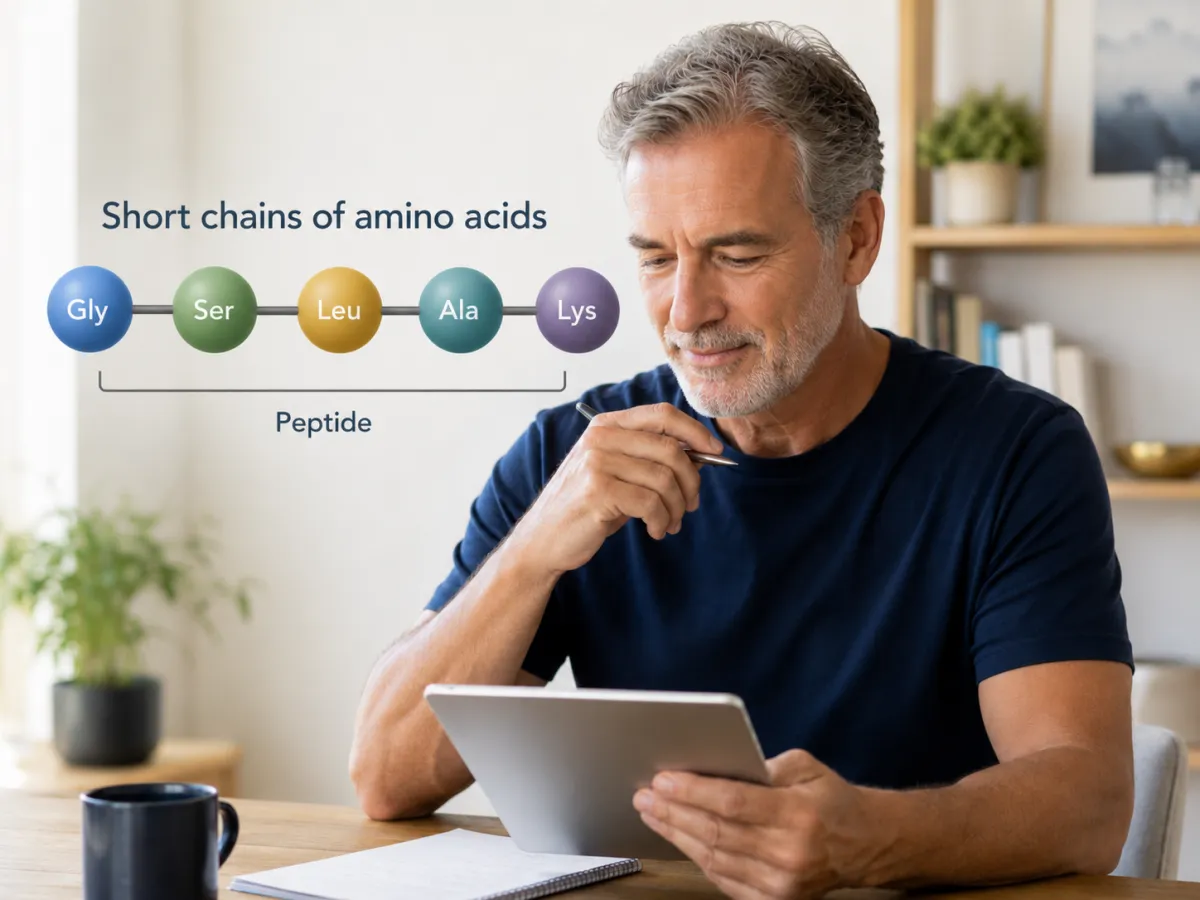
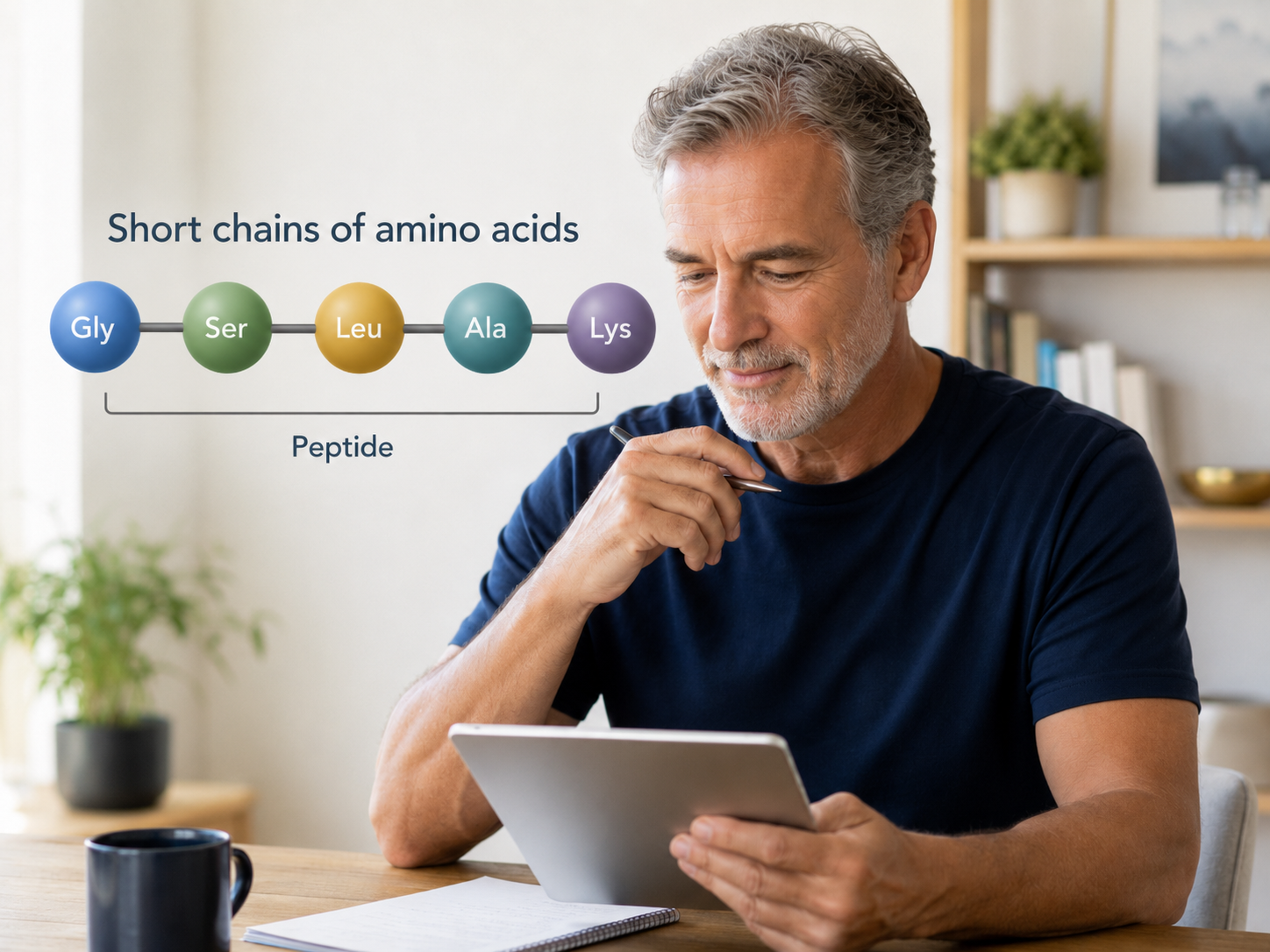
Peptides are short chains of amino acids, the same basic building blocks used to create proteins. The body naturally produces many peptides that act as hormones, chemical messengers, and signaling molecules.
Scientists can also manufacture or modify peptides for research and medical development. Some synthetic peptides have become FDA-approved drugs, while others remain investigational or have very limited human evidence. The word “peptide” alone does not establish what a compound does or whether its claims are supported.
Peptides Begin With Amino Acids
Amino acids are small organic compounds used by the body to build proteins and other important molecules.
When amino acids link together through chemical bonds called peptide bonds, they form a chain. Shorter chains are generally called peptides, while longer and more structurally complex chains are generally described as polypeptides or proteins.
Definitions vary somewhat by scientific and regulatory context. An overview in the NCBI Bookshelf describes a peptide as a chain of approximately two to 50 amino acids.
The order of the amino acids matters.
Think of amino acids as letters. Rearranging the same letters can create entirely different words. In the same way, changing the order, length, or chemical structure of a peptide can change how it behaves.
Two compounds may both be called peptides while having completely different effects in the body.
That is why broad statements such as “peptides improve recovery” or “peptides support longevity” are not specific enough to evaluate. The first question should always be:
Which peptide?
What Do Natural Peptides Do in the Body?
Many naturally occurring peptides work as messengers.
They may help cells communicate, influence hormone activity, participate in immune responses, regulate appetite, affect glucose balance, or support other physiological functions.
Peptide signaling molecules include peptide hormones, neuropeptides, and certain growth factors. Examples discussed in the NCBI Bookshelf’s overview of signaling molecules include insulin, glucagon, endorphins, and several hormones produced by the pituitary gland.
A peptide often works by interacting with a specific receptor on or near a cell.
The receptor acts somewhat like a lock, while the peptide acts like a key. When the peptide fits and binds to the receptor, it may trigger a signal inside the cell.
This analogy is useful, but the real biology is more complicated.
A peptide may:
Activate a receptor
Block or reduce a signal
Mimic a naturally occurring messenger
Influence more than one biological pathway
Break down quickly
Behave differently depending on dose, delivery method, or tissue
Natural does not automatically mean simple. The body’s signaling systems are tightly connected, and changing one signal may affect several others.
What Is a Synthetic Peptide?
A synthetic peptide is manufactured rather than directly produced by the human body.
Scientists can reproduce the amino-acid sequence of a naturally occurring peptide. They can also modify that sequence or structure to change how long the peptide lasts, how strongly it binds to a target, or how it moves through the body.
Synthetic peptides may be studied because researchers want to:
Replace or imitate a natural signal
Activate a specific receptor
Block an unwanted biological interaction
Deliver another molecule to a particular target
Improve stability or duration
Investigate how a biological pathway works
Some synthetic peptides are developed into regulated medicines. Others are used only as laboratory tools. Some enter clinical trials but never become approved drugs.
A 2025 peer-reviewed review, Therapeutic Peptides: Recent Advances in Discovery, Synthesis, and Clinical Translation, describes growing research across metabolic conditions, cancer, infectious diseases, and other areas. It also emphasizes that production, stability, delivery, and clinical translation remain important challenges.
This is an important distinction:
The ability to manufacture a peptide does not prove that it is safe or effective for human use.
Why Are Researchers So Interested in Peptides?
Peptides can often interact with biological targets more selectively than many traditional small-molecule compounds.
That selectivity can make them attractive for drug development. Researchers may be able to design a peptide to communicate with a particular receptor or pathway while limiting unrelated activity.
But peptides also present practical problems.
Many peptides are:
Broken down by digestive enzymes
Poorly absorbed when swallowed
Cleared from the body quickly
Sensitive to temperature or handling
Difficult to deliver to the intended tissue
Vulnerable to chemical or structural impurities
A review of peptide drug products found that injectable forms have historically been the most common because oral delivery and absorption are difficult for many peptide molecules.
Researchers continue to study modifications and delivery systems that may help peptides remain stable longer, reach their intended targets, or become easier to administer. More recent reviews still identify poor oral bioavailability, enzymatic breakdown, and short duration in the body as major challenges.
A promising biological idea is only the beginning. A useful medicine must also be manufactured consistently, delivered effectively, studied carefully, and shown to provide more benefit than risk.

Why Does the Evidence Differ So Much?
Peptide research exists on a spectrum.
At one end are peptides with years of laboratory work, controlled human trials, established manufacturing standards, and FDA-approved medical uses.
At the other end are compounds supported mainly by test-tube experiments, animal studies, theoretical mechanisms, anecdotes, or marketing claims.
Between those two ends are many stages of development.
A peptide may have:
Laboratory evidence only
Animal research
Small early-stage human studies
Larger controlled clinical trials
Evidence for one medical use but not another
FDA approval for a specific condition and formulation
No approval for the claims currently being promoted
The number of studies is not the only thing that matters.
Researchers also consider:
Whether the study involved humans
How many people participated
Whether there was a comparison or placebo group
How long the study lasted
Which dose and formulation were tested
Whether adverse events were measured
Whether the results were reproduced
Whether the study evaluated the same use being discussed
A peptide that produced an interesting result in mice should not be described as proven to do the same thing in humans.
Likewise, an FDA-approved peptide medication should not automatically be assumed safe or effective when obtained in a different form, concentration, formulation, or supply chain.
Does “Peptide” Mean It Is a Medication?
No.
Some peptides are active ingredients in FDA-approved drug products. Others may be legally compounded under specific circumstances. Others are investigational. Research-use products are not approved medications simply because they contain a peptide sequence.
The FDA has separate development and regulatory expectations for peptide drug products. Its clinical pharmacology guidance for peptide drug development discusses issues such as pharmacokinetics, drug interactions, organ impairment, heart-rhythm risk, immune reactions, safety, and effectiveness.
Those questions cannot be answered by the name of the peptide alone.
They depend on the actual product, including:
Identity
Purity
Strength
Formulation
Manufacturing process
Storage
Delivery method
Intended use
Human evidence
Regulatory oversight
The next two guides in this section will explain these distinctions more fully:
FDA-Approved, Compounded, and Research-Use Peptides: What Is the Difference?
What “Research Use Only” Actually Means
A Simple Way to Evaluate a Peptide Claim
When you encounter a claim about a peptide, ask:
☐ Which exact peptide is being discussed?
☐ Is the evidence from laboratory work, animals, or humans?
☐ Was the same formulation and intended use studied?
☐ Is the product FDA-approved, compounded, investigational, or labeled for research use?
☐ Are benefits being presented alongside limitations and risks?
☐ Is the source educational, scientific, medical, or primarily promotional?
☐ Can the important claims be traced to credible sources?
You do not need to become a peptide scientist.
You simply need enough context to recognize when a broad claim is hiding important details.
One Practical Next Step
The next time you see a peptide described as supporting weight loss, recovery, focus, skin, strength, or healthy aging, do not begin with the promised benefit.
Begin with the status of the evidence.
Write down:
The exact compound name
The claimed use
The type of research supporting it
Its regulatory status
This four-part check can quickly separate an established medical use from an emerging research idea or an unsupported marketing claim.
Frequently Asked Questions
Are peptides the same as proteins?
Both peptides and proteins are made from amino acids connected by peptide bonds. Peptides are generally shorter chains, while proteins are usually longer and may fold into more complex structures. The dividing line is not absolute and may vary by scientific context.
Are all peptides hormones?
No. Some hormones are peptides, but not every peptide is a hormone. Peptides can function as signaling molecules, neurotransmitters, structural components, research tools, drug ingredients, or other biologically active molecules.
Are synthetic peptides identical to natural peptides?
Some synthetic peptides are designed to reproduce a naturally occurring amino-acid sequence. Others are modified to improve stability, duration, receptor binding, or delivery. Even when the sequence is similar, manufacturing quality, formulation, impurities, and delivery can affect the finished product.
Choose Your Next Guide
To understand how peptide products differ:
Read FDA-Approved, Compounded, and Research-Use Peptides: What Is the Difference?
To understand research labeling:
Read What “Research Use Only” Actually Means.
To explore the broader category:
Return to Peptides and Emerging Science.
The Most Important Takeaway
Peptides are real biological molecules with important roles in the body and growing value in medical research.
But “peptide” is a category, not a guarantee.
One peptide may be an established medication. Another may be under clinical investigation. A third may have only laboratory evidence. A fourth may be promoted far beyond what current research supports.
The useful question is not:
“Do peptides work?”
It is:
“What do we know about this specific peptide, this specific product, and this specific use?”
That question leads to a much clearer answer.
Related Reading
What “Research Use Only” Actually Means
https://infinite-longevity.com/post/what-research-use-only-means
Where Do Peptide Brands Source From? Bulk vs. Retail Cost
https://infinite-longevity.com/post/where-do-peptide-brands-source-from-bulk-vs-retail-cost
What Laboratory Testing Can and Cannot Prove
https://infinite-longevity.com/post/what-laboratory-testing-can-and-cannot-prove
Explore Peptides & Emerging Science →
About Infinite Longevity
Infinite Longevity is an educational wellness platform focused on helping adults better understand the science, research, and practical factors connected to healthy aging, metabolic health, recovery, performance, and emerging peptide research.
Our Learning Center translates complex topics into clear, practical information using current government resources, peer-reviewed research, and recognized medical and scientific sources.
Our content is designed to support better questions and more informed conversations with qualified healthcare professionals. It is not intended to diagnose a condition, prescribe treatment, or replace personalized medical care.
Sources
FDA: Clinical Pharmacology Considerations for Peptide Drug Products
Therapeutic Peptides: Recent Advances in Discovery, Synthesis, and Clinical Translation
Just How Prevalent Are Peptide Therapeutic Products? A Critical Review
Therapeutic Peptides and Proteins: Status and Developments in Drug Delivery
Recent Advances in Formulations for Long-Acting Delivery of Therapeutic Peptides
Important Notice
This guide is for general educational purposes only. It does not diagnose a medical condition, provide individual medical advice, recommend treatment, prescribe a product, or replace care from a qualified healthcare professional.
The inclusion of a peptide or area of research does not indicate that a product is approved, safe, effective, or appropriate for personal use. Speak with a qualified licensed healthcare professional about medications, symptoms, treatment decisions, or health concerns.