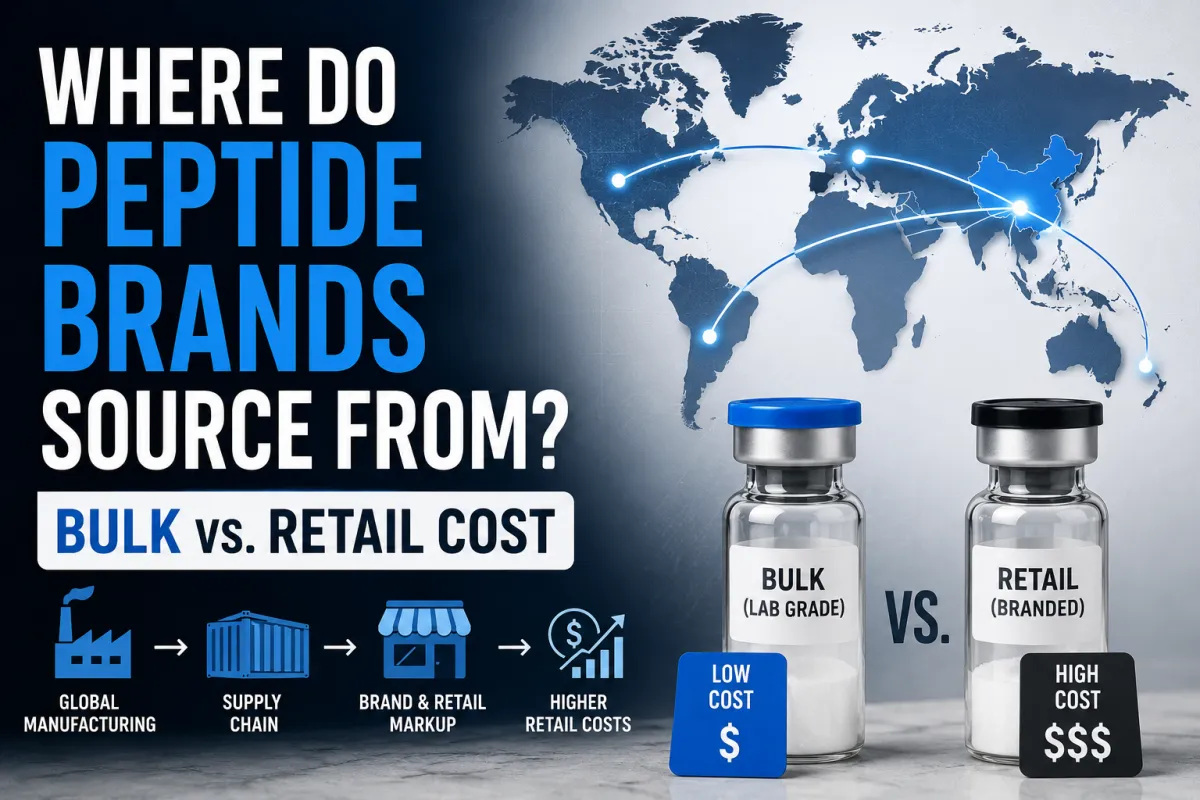
Where Do Peptide Brands Source From? Bulk vs. Retail Cost | Infinite Longevity
Peptides, Research Supply Chain
Where Do Peptide Brands Source From? Bulk vs. Retail Cost
Updated August 2026
When analyzing the modern scientific landscape, researchers often notice a massive discrepancy in the cost of analytical compounds, especially research peptides and related materials.
One online source may list a specific peptide sequence at a premium retail cost, while a direct distributor or bulk supplier lists a similar compound format at a fraction of that price.
Why does this massive cost variance exist? Do premium prices reflect a superior chemical synthesis? Or are laboratory budgets simply absorbing a large corporate markup on branding and retail services?
This guide focuses on how research peptide products move through the supply chain, why pricing can vary so widely, and what to look at besides price when evaluating a supplier.
Where Do Peptide Brands Source Their Products?

Most research peptide brands do not manufacture every compound themselves. The supply chain often begins with specialized peptide manufacturers, including large-scale facilities in established global manufacturing regions that focus on synthesis and purification. Published reviews describe how peptide manufacturing is typically organized around dedicated synthesis platforms and purification infrastructure rather than small, distributed labs, especially for solid-phase and related methods indexed by PubMed.
A retail brand may then handle sourcing, independent testing, documentation, packaging, storage, customer service, and fulfillment. In some cases, a company may control several of these steps; in other cases, they may rely on multiple outside partners and contract laboratories.
That is one reason the same compound and quantity can appear at very different retail prices. The raw material is only one part of the final cost, and the services layered on top of that material can vary significantly from one brand to another.
📌 Key Takeaway: Many brands may start with similar raw materials, but differ widely in how they test, package, document, store, and support those products.
How Does the Research Peptide Supply Chain Work?
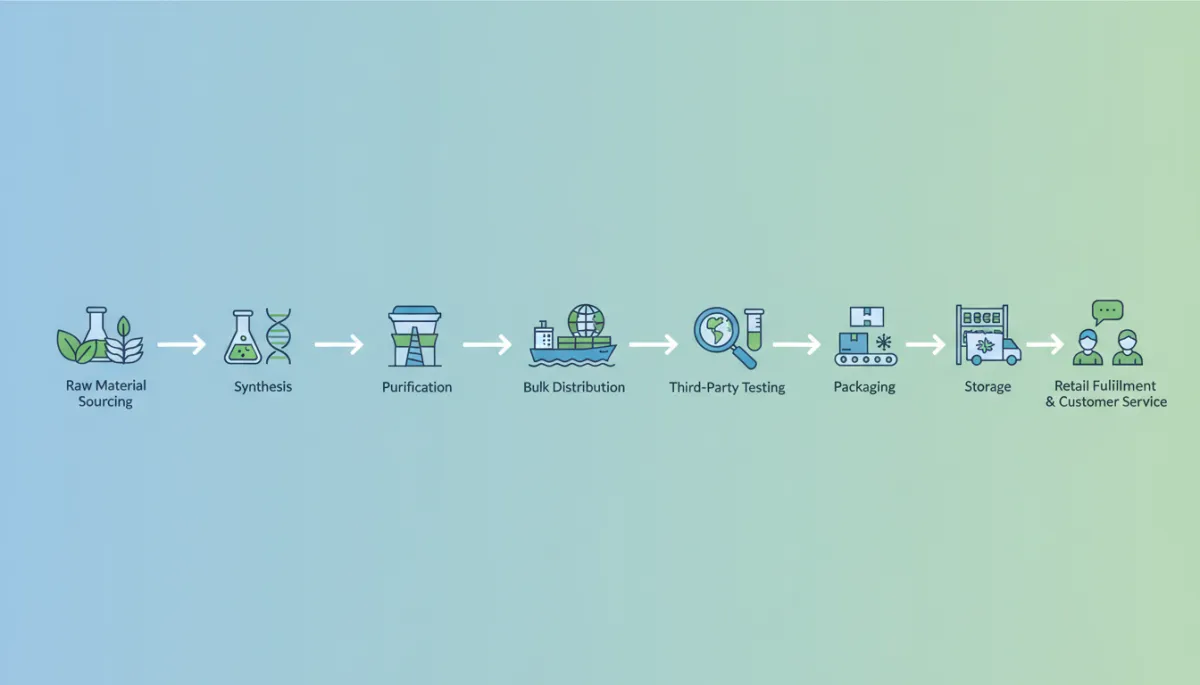
In plain English, the research peptide supply chain is a series of steps that turn raw starting materials into labeled, packaged products that can be ordered from a catalog. Different brands may control different parts of this process, or outsource them to specialized partners. Scientific reviews of peptide manufacturing describe a similar multi-stage process: synthesis, purification, isolation, and downstream handling, each contributing to overall cost and process complexity, as discussed in Process Mass Intensity: A Holistic Analysis of Current Peptide Manufacturing Processes.
Raw material and peptide synthesis: The process usually begins with amino acid starting materials and other reagents. Specialized facilities use established methods such as solid-phase peptide synthesis to build the desired sequence, a widely used approach described in detail in Solid Phase Protein Chemical Synthesis and related reviews indexed by PubMed.
Manufacturing and purification: After synthesis, the crude peptide mixture is purified and processed to remove impurities as much as practical for the intended research specification. This can involve chromatography and other purification steps, which are recognized as major contributors to manufacturing effort and cost in peptide process analyses such as Process Mass Intensity.
Bulk purchasing or wholesale distribution: The purified material may then be sold in bulk to distributors, wholesalers, or brands that specialize in research-use products. These buyers may purchase larger lots at negotiated prices based on volume and long-term relationships.
Third-party laboratory testing: Some manufacturers and brands submit material for independent testing to verify aspects such as identity and purity. Testing can be performed by in-house quality control laboratories or external contract labs, and the results may be summarized in a Certificate of Analysis (COA). Reference standards and impurity-focused characterization tools, such as those described in USP Peptide Standards, are often used to support this type of analytical work.
Lyophilization, filling, labeling, or packaging: Where applicable, the peptide may be lyophilized (freeze-dried), filled into vials or containers, labeled with compound and batch information, and packaged for distribution. Some brands perform these steps themselves; others work with contract manufacturers or packagers.
Storage and inventory management: Finished lots are stored under defined conditions and tracked in inventory systems. Storage requirements, stability data, and inventory practices can influence how long a product is held before it is sold or replaced.
Retail fulfillment and customer support: Finally, the product is listed in a catalog or online storefront. The retailer or distributor handles ordering, payment processing, shipping, replacement policies, and customer inquiries about documentation and product details.
💡 Pro Tip: When comparing suppliers, it can be useful to ask which parts of this process they control directly, and which parts are handled by third parties.
Where Are Peptides Commonly Manufactured?
Peptide manufacturing is a global activity. Facilities that synthesize, purify, and process peptides can be found in the United States, Europe, China, and other parts of Asia, as well as in additional regions with established pharmaceutical and chemical manufacturing infrastructure. Reviews of modern peptide synthesis technologies note that solid-phase, solution-phase, and biosynthetic approaches are used across academic, clinical, and industrial settings worldwide, rather than being confined to any single geography, as summarized in Peptide Synthesis: A Review of Classical and Emerging Technologies.
Some manufacturers focus on custom synthesis for research, while others produce larger lots that may be used as reference standards, intermediates, or components in regulated products. The level of regulatory oversight and quality system requirements can differ based on the intended use of the material and the markets being served. For example, pharmacopeial organizations describe peptide reference standards and associated quality attributes for use in regulated environments, as outlined by the U.S. Pharmacopeia.
The country of origin is not a substitute for testing, documentation, manufacturing controls, or supplier qualification. A responsible buyer evaluates the available data and quality systems rather than relying only on geographic assumptions. Regulatory enforcement actions against individual peptide sellers have emphasized that how a product is manufactured, labeled, and marketed is more important than broad geographic claims, as seen in specific warning letters issued by the U.S. Food and Drug Administration.
The Supply Chain Reality: Centralized Manufacturing Hubs
A common misconception in the laboratory supply market is that every retail brand operates its own independent chemical synthesis facility. In reality, establishing a pharmaceutical-grade peptide manufacturing plant requires millions of dollars in capital expenditure and strict international regulatory oversight. Reviews of large-scale Fmoc solid-phase peptide synthesis highlight the specialized equipment, process control, and validation required to operate at commercial manufacturing scale, as discussed in Advances in Fmoc Solid-Phase Peptide Synthesis.
Because of these steep barriers to entry, the vast majority of retail peptide brands globally source their bulk raw materials from the exact same centralized manufacturing hubs overseas or from a relatively small number of specialized producers.
From a purely chemical perspective, the raw molecule remains identical when produced to the same specification. The variance in cost is introduced primarily after the compound leaves the synthesis floor, as it moves through testing, packaging, storage, and retail operations. Analyses of peptide process mass intensity and lifecycle costs support the idea that downstream purification, isolation, and handling steps can significantly influence overall cost beyond the initial synthesis reaction, as described in Process Mass Intensity.
[Centralized Synthesis Hub] ──► Premium Retailer ──► Custom Packaging & Marketing ──► High Cost
└──► Direct Distributor ──► Streamlined Laboratory Supply ──► Base Cost
Why Can the Same Peptide Cost So Much More From One Brand?
When two brands list what appears to be the same peptide at very different prices, it is usually because they are not offering the exact same bundle of services. The underlying compound may be similar, but the way it is sourced, tested, packaged, stored, and supported can differ substantially. Manufacturing analyses emphasize that synthesis, purification, and isolation are only part of the total cost structure, with additional overhead arising from quality control, documentation, and logistics, as noted in Process Mass Intensity.
Purchase volume: Larger buyers may negotiate lower prices per unit when purchasing bulk lots, while smaller brands may pay more per gram or per vial.
Supplier relationships: Long-term relationships and qualification processes with manufacturers can influence pricing, lead times, and access to specific formats or documentation.
Testing costs: Identity testing, purity profiling, and other analytical work add real cost. Some brands perform minimal testing; others may run multiple assays or repeat testing on each batch or fill lot. The use of peptide reference standards and impurity-focused methods, such as those described by the U.S. Pharmacopeia, can further increase analytical depth and expense.
Packaging: Simple laboratory packaging is less expensive than custom vials, branded boxes, inserts, and other cosmetic elements designed for a premium retail presentation.
Storage: Controlled storage conditions, monitoring, and inventory rotation can add overhead, particularly for products with specific temperature or stability requirements.
Shipping and fulfillment: Packaging materials, carrier costs, tracking, and handling of lost or damaged shipments all contribute to the final retail price.
Customer service: Responding to documentation requests, questions about labeling, and replacement policies requires staff time and systems, which are reflected in pricing structures.
Marketing expenses: Website development, educational content, advertising, and promotional campaigns can significantly increase operating costs for consumer-facing brands.
Affiliate commissions: When a brand uses affiliate programs or referral networks, a portion of each sale may be paid out as commission, which can raise the advertised retail price.
Payment processing: Fees for credit card processing, chargeback risk, and other financial services are often built into retail pricing.
Business overhead: Rent, staffing, insurance, information systems, and compliance programs all contribute to the overall cost structure of a company.
Retail margin: Finally, each brand selects a margin that supports its business model and risk tolerance, which can vary widely across the market.
A higher price does not automatically prove higher quality, and a lower price does not automatically mean poor quality. Instead, price should be considered alongside documentation, testing, transparency, and how clearly the supplier explains what is included in that cost.
Does a Higher Peptide Price Mean Better Quality?
Not necessarily. Price alone cannot establish the identity, purity, quality, or suitability of a research product.
A thoughtful evaluation looks at multiple factors together. These may include how clearly the product is labeled, what batch documentation is available, what testing has been performed, and how transparent the company is about the limitations of its data and its intended use statements.
Labeling: Clear compound names, quantities, and research-use statements help distinguish a structured laboratory product from a vague or ambiguous listing. Regulatory enforcement actions have shown that simply labeling a product “research use only” does not override other evidence of intended human use when marketing, testimonials, or instructions suggest otherwise, as discussed in specific warning letters from the U.S. Food and Drug Administration.
Batch documentation: Batch identifiers and production dates, where available, can support traceability and clarify which lot a Certificate of Analysis is associated with.
Available testing: Identity and purity testing, often summarized in a COA, can provide useful information about how the material was characterized. For more detail, see the discussion in Why Certificates of Analysis Matter and What Laboratory Testing Can and Cannot Prove. Pharmacopeial peptide standards and impurity reference materials, such as those described by the U.S. Pharmacopeia, illustrate how structured analytical frameworks can be used to evaluate peptide quality.
Company transparency: A supplier that explains its sourcing model, testing practices, and policies in clear language gives buyers more information to work with than one that relies only on marketing terms or implied claims.
📌 Key Takeaway: A Certificate of Analysis and other documentation can support an informed decision, but no single document or price point can fully prove every aspect of product quality or suitability.
Why Is Bulk Peptide Pricing So Different From Retail Pricing?
Bulk suppliers often focus on larger quantities, fewer packaging formats, and streamlined logistics. Because they are not providing the same range of retail services, they may be able to offer much lower per-unit prices than a brand that sells small vials to many individual customers. Analyses of peptide manufacturing efficiency emphasize that larger-scale processes can distribute fixed synthesis and purification costs across greater output, while small, highly packaged units carry proportionally higher overhead, as discussed in Process Mass Intensity.
By contrast, retail pricing may include costs for testing, packaging, inventory risk, smaller-quantity fulfillment, payment processing, customer support, and other operating expenses that are not reflected in a bulk quote. A retail brand may also hold inventory for longer periods, absorb losses from expired or unsold lots, and provide more extensive educational content or support materials.
Comparing a bulk manufacturing quote directly with the price of one finished retail vial is not an apples-to-apples comparison. They represent different points in the supply chain and include different responsibilities and risks for the seller.
Understanding the Factors Driving Up Research Costs
When a laboratory allocates funds to a high-priced retail vendor, those resources are rarely funding advanced chemical innovations alone. Instead, the premium cost is typically driven by non-scientific corporate overhead layered on top of the underlying material and testing.
Aggressive Marketing Campaigns: Heavy expenditures on social media promotions, affiliate networks, and digital brand placement can increase the final retail price without changing the compound itself.
Aesthetic Retail Packaging: Custom-molded glass vials, luxury presentation boxes, and elaborate cosmetic branding contribute to a premium look and feel but do not alter the molecular structure of the product.
Intermediary Re-Testing Markups: In multi-layered distribution chains, each intermediary may add its own testing, handling, and margin, passing those compounding costs down to the final buyer.
While these elements can create a polished retail experience, they do not inherently change the identity or purity of the compound. For a strict laboratory environment, a luxury cardboard box adds zero analytical value compared with clear labeling, documentation, and appropriate handling.
What Should You Look At Besides Price?
Because price alone cannot answer every question, it can be helpful to review the information a supplier provides about each product and batch. Several practical elements can make it easier to evaluate what is actually being offered for research use.
Accurate compound and quantity labeling: Clear names, sequence identifiers where applicable, and stated quantities or concentrations help avoid confusion and support consistent record-keeping.
Batch identification where available: Batch or lot numbers allow a specific unit to be linked to its corresponding documentation and testing results.
Certificate of Analysis documentation: A COA can summarize identity testing, purity assessment, and other analytical details. For more on how to interpret these documents, see Why Certificates of Analysis Matter. Pharmacopeial peptide standards and impurity reference materials, such as those described by the U.S. Pharmacopeia, illustrate how reference materials can support more structured quality evaluation.
Identity testing: Techniques such as mass spectrometry or chromatography are often used to help confirm whether the material matches the intended compound. As discussed in What Laboratory Testing Can and Cannot Prove, these tests have defined scopes and limitations.
Purity testing: Reported purity values are based on specific analytical methods and conditions. They can provide useful context but do not describe every possible impurity or attribute of a material. Studies of peptide-related impurities, including stereochemical variants, highlight that “purity” can involve multiple dimensions such as enantiomeric composition, as examined in Enantiomeric Purity of Synthetic Therapeutic Peptides.
Laboratory information: Knowing which laboratory performed the testing, and what methods were used, can help place the data in context and support internal quality assessments.
Transparent research-use labeling: Clear statements such as “for research use only” and similar designations help clarify the intended context and limitations of the product. For more detail on this topic, see What “Research Use Only” Actually Means. FDA warning letters to individual peptide sellers have emphasized that research-use labeling must be consistent with overall marketing and intended use, rather than used as a blanket disclaimer, as seen in actions against specific firms such as Gram Peptides and Wholesale Peptide.
Clear company contact information: A supplier that provides verifiable contact details and support channels makes it easier to request documentation, ask clarifying questions, or address shipment issues.
Shipping and replacement policies: Documented policies around shipping conditions, breakage, and replacement help set expectations and may factor into how a buyer evaluates overall value.
A Certificate of Analysis can provide useful information, but it does not prove every aspect of product safety, effectiveness, sterility, or suitability for any particular application. It is one piece of a broader set of information that buyers may consider when evaluating research-use materials.
The Alternative: The Direct Distributor Framework
To optimize research efficiency, Infinite Longevity operates under a direct-to-consumer distributor framework for research-use products.
By eliminating consumer-facing retail branding and sourcing directly from established global manufacturing hubs, we reduce unnecessary administrative and marketing overhead. This model allows the base structural savings to be transferred directly to the laboratory budget while still providing documentation and domestic logistics support.
This approach balances cost efficiency with standard domestic operational benefits:
Direct Manufacturer Documentation: We provide the exact, unedited Certificates of Analysis (CoAs) generated straight from the primary synthesis floor, so qualified research buyers can review the same technical data referenced by the manufacturer.
Expedited Domestic Transit: All materials are logged and dispatched from our logistics location in Las Vegas, Nevada, reaching domestic facilities within 3 to 5 business days to help avoid international customs delays.
Secure Laboratory Handling: Materials are dispatched in discreetly packaged protective envelopes to support structural integrity and research privacy during transit.
Review the Material Documentation
An analytical budget is often best preserved for active research development, rather than funding purely cosmetic branding. Legitimate scientific researchers can evaluate compound specifications, formats, and primary factory documentation through our secure verification gate.
👉 Access the Infinite Longevity Research Catalog Gateway
What This Means
Peptide pricing reflects more than the cost of the raw compound. Manufacturing methods, purchasing volume, testing, packaging, fulfillment, overhead, and retail margin can all influence the final price listed in a catalog or online store. Reviews of peptide manufacturing emphasize that synthesis technology, purification strategy, and process intensity all interact with business decisions about scale and distribution to shape final costs, as discussed in Peptide Synthesis: A Review of Classical and Emerging Technologies and Process Mass Intensity.
A high price is not automatic proof of quality, and a low price should not automatically be treated as evidence of poor quality. The more useful question is whether the supplier provides enough information and documentation to evaluate what is actually being offered for research use, and how that offer aligns with the needs and standards of the intended laboratory environment.
Related Reading
What Are Peptides, Really?
https://infinite-longevity.com/post/what-are-peptides-really
What “Research Use Only” Actually Means
https://infinite-longevity.com/post/what-research-use-only-means
What Laboratory Testing Can and Cannot Prove
https://infinite-longevity.com/post/what-laboratory-testing-can-and-cannot-prove
Why Certificates of Analysis Matter
https://infinite-longevity.com/post/why-certificates-of-analysis-matter
Explore Peptides & Emerging Science →
Sources and Further Reading
Gram Peptides Warning Letter, March 31, 2026 – U.S. Food and Drug Administration – https://www.fda.gov/inspections-compliance-enforcement-and-criminal-investigations/warning-letters/gram-peptides-721806-03312026
Wholesale Peptide Warning Letter, June 17, 2026 – U.S. Food and Drug Administration – https://www.fda.gov/inspections-compliance-enforcement-and-criminal-investigations/warning-letters/wholesale-peptide-729447-06172026
USP Peptide Standards – U.S. Pharmacopeia – https://www.usp.org/biologics/peptides
Solid Phase Protein Chemical Synthesis – PubMed – https://pubmed.ncbi.nlm.nih.gov/25791484/
Peptide Synthesis: A Review of Classical and Emerging Technologies – PubMed – https://pubmed.ncbi.nlm.nih.gov/41191975/
Advances in Fmoc Solid-Phase Peptide Synthesis – PubMed – https://pubmed.ncbi.nlm.nih.gov/26785684/
Process Mass Intensity: A Holistic Analysis of Current Peptide Manufacturing Processes – PubMed – https://pubmed.ncbi.nlm.nih.gov/38508870/
Enantiomeric Purity of Synthetic Therapeutic Peptides – PubMed – https://pubmed.ncbi.nlm.nih.gov/38448043/
Continue Learning
Why Certificates of Analysis Matter
Learn what a COA may verify, what it cannot prove, and what to look for when reviewing laboratory documentation.
What Laboratory Testing Can and Cannot Prove
Understand the difference between identity, purity, quality, safety, and other laboratory claims, and how those concepts relate to research-use materials.