What Laboratory Testing Can and Cannot Prove
What Laboratory Testing Can and Cannot Prove
Laboratory testing sounds definitive.
A sample goes to a lab. Instruments analyze it. Numbers come back. The report says “pass.”
It feels like the question has been answered.
But laboratory testing is more limited than that.
A test can tell you something important about the specific sample that was analyzed, using the specific methods that were performed.
It cannot automatically tell you everything about the product, how it was made, how it was handled, whether every batch is identical, whether it is safe for human use, or whether it will produce a particular health outcome.
That distinction is especially important when evaluating research compounds, peptides, supplements, or other products where laboratory reports are used heavily in marketing.
Testing can answer a question. It cannot answer questions that were never tested.
The Quick Answer
Laboratory testing can help confirm selected characteristics of a sample, such as identity, assay, purity, impurities, or microbial quality, depending on the methods used. FDA itself evaluates drug quality using multiple separate attributes rather than one universal test. Testing does not by itself establish safety, effectiveness, proper manufacturing, correct handling, or consistency across every batch.
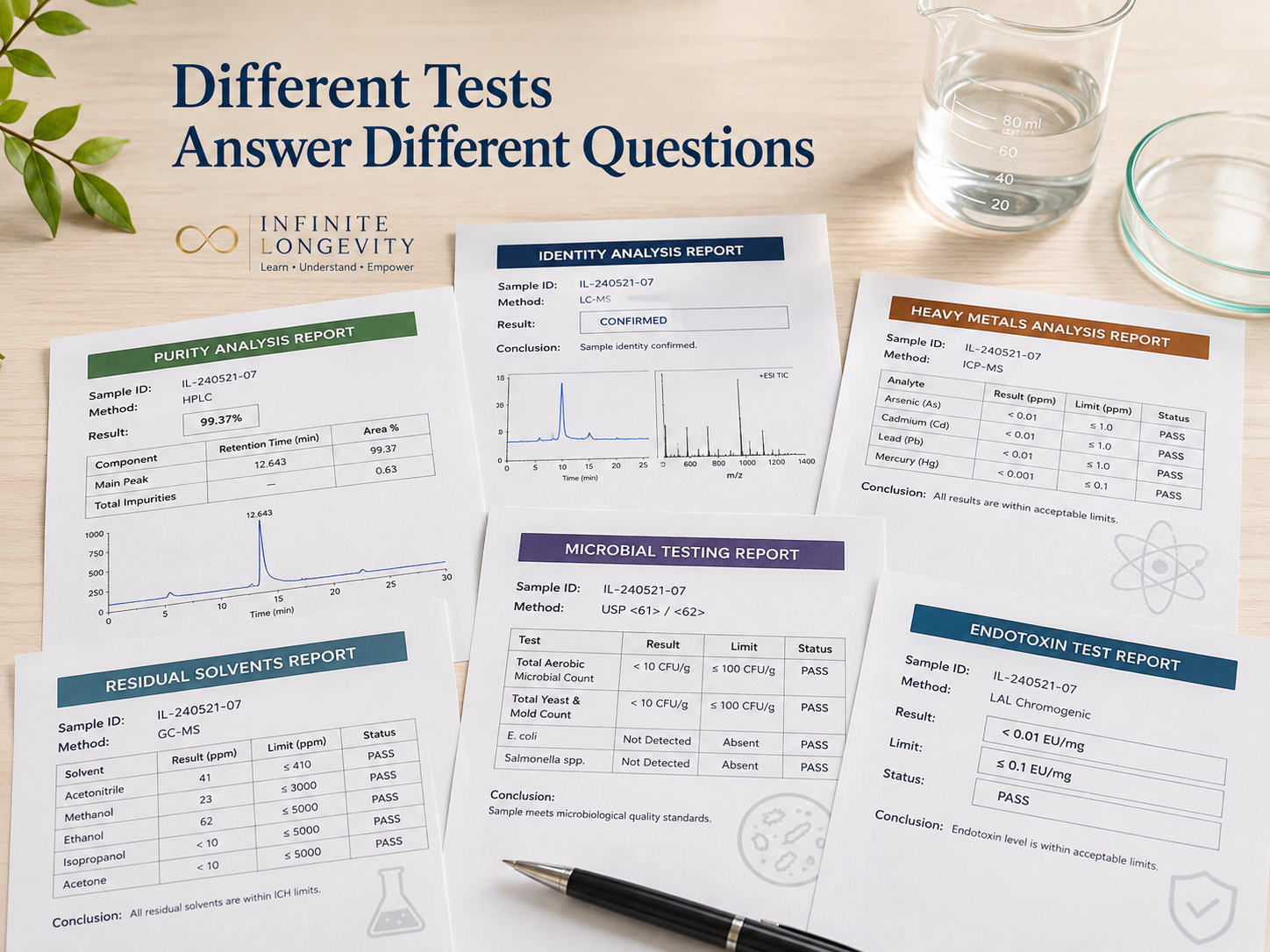
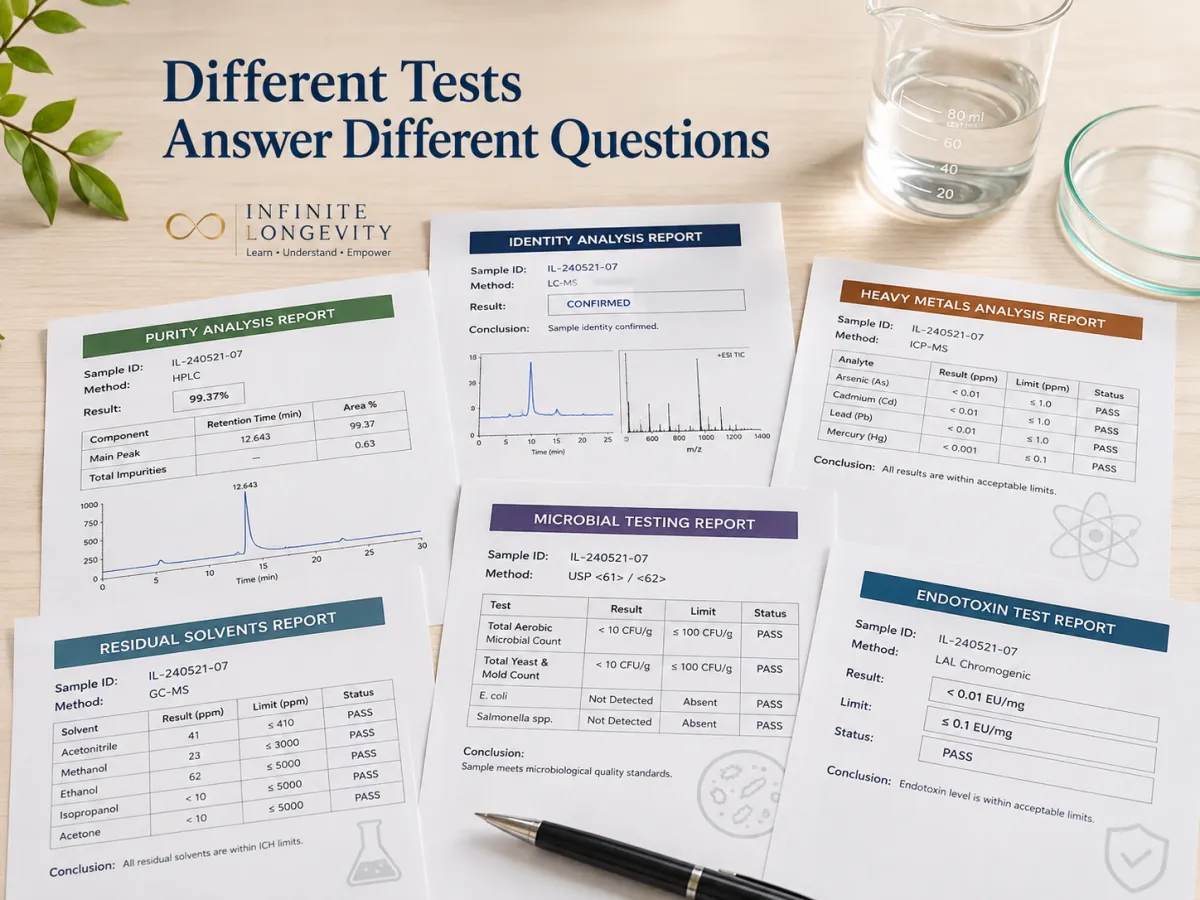
Alt text: Multiple laboratory reports showing that identity, purity, contaminants, and microbial quality require different types of testing.
One Test Does Not Tell You Everything
A laboratory result is only meaningful when you understand the question the test was designed to answer.
FDA’s own drug-quality testing program separates quality into attributes such as:
Identity
Assay
Impurities
Dissolution
Microbial quality
Sterility, when appropriate
These are not interchangeable measurements.
For example:
An identity test asks whether the sample appears to be the compound it claims to be.
An assay asks how much of the active substance is present.
A purity test may evaluate how much of the detected material is the desired compound relative to certain detected impurities.
A heavy-metals test looks for specific elemental contaminants.
A microbial test looks for selected microorganisms or microbial load.
A sterility test addresses whether viable microorganisms are detected under the conditions of that test.
Passing one does not mean the others were tested.
This is why a report that shows:
Purity: 99.4%
does not automatically mean:
Everything about this sample is 99.4% safe or correct.
Those are completely different claims.
Identity and Purity Are Not the Same
This is one of the easiest laboratory concepts to misunderstand.
Imagine a report shows very high purity.
The next question should be:
Purity of what?
A purity method can show that one major component dominates the sample.
But another method may be needed to establish that the dominant component is actually the intended compound.
FDA laboratory programs treat identity, assay, and impurities as separate quality attributes for exactly this reason.
A strong testing package therefore may use multiple analytical methods because each one contributes a different piece of information.
For peptide-related materials, that can include methods such as chromatography and mass spectrometry.
The exact testing needed depends on the compound, intended question, and laboratory context.
A high purity number is useful information. It is not a substitute for confirming identity.
The Method Matters
Two laboratories can analyze similar samples and produce different levels of confidence depending on:
The equipment used
The analytical method
Sample preparation
Calibration
Reference standards
Detection limits
Validation
Analyst competence
Interpretation of the results
FDA guidance on analytical methods emphasizes that procedures used to support drug identity, strength, quality, purity, and potency should be appropriately validated.
In plain language, a method should be shown to perform reliably for the purpose for which it is being used.
That is different from simply owning an expensive instrument.
A laboratory report becomes more useful when it clearly identifies:
What method was used
What specification was applied
What result was obtained
Whether the method is appropriate for the question
Testing Is About a Sample
This is another important limitation.
The laboratory does not test an entire factory.
It does not test every unit sold.
It tests the sample it receives.
That creates an obvious question:
Was the submitted sample truly representative of the batch being sold?
If one vial, bottle, or container is sent for testing, the result describes that submitted material.
It does not automatically establish that:
Every vial in the batch is identical
Every batch produced later will match
The sample was selected randomly
The sample was not handled differently
The seller submitted the same product being shipped to customers
This does not make testing meaningless.
It simply means sampling and traceability matter.
That is why batch numbers, chain of custody, manufacturing controls, and repeated testing can add important context.
A Passing Test Has Boundaries
“Pass” sounds absolute.
Usually, it means something more specific:
The sample met the defined acceptance criterion for the test that was performed.
That is very different from saying:
The entire product has been proven safe.
FDA’s quality surveillance program does not rely on laboratory testing alone. It combines testing with inspections, post-market quality reports, signal detection, and data analysis.
That tells us something important.
Even in highly regulated pharmaceutical systems, testing is one part of quality oversight, not the whole thing.
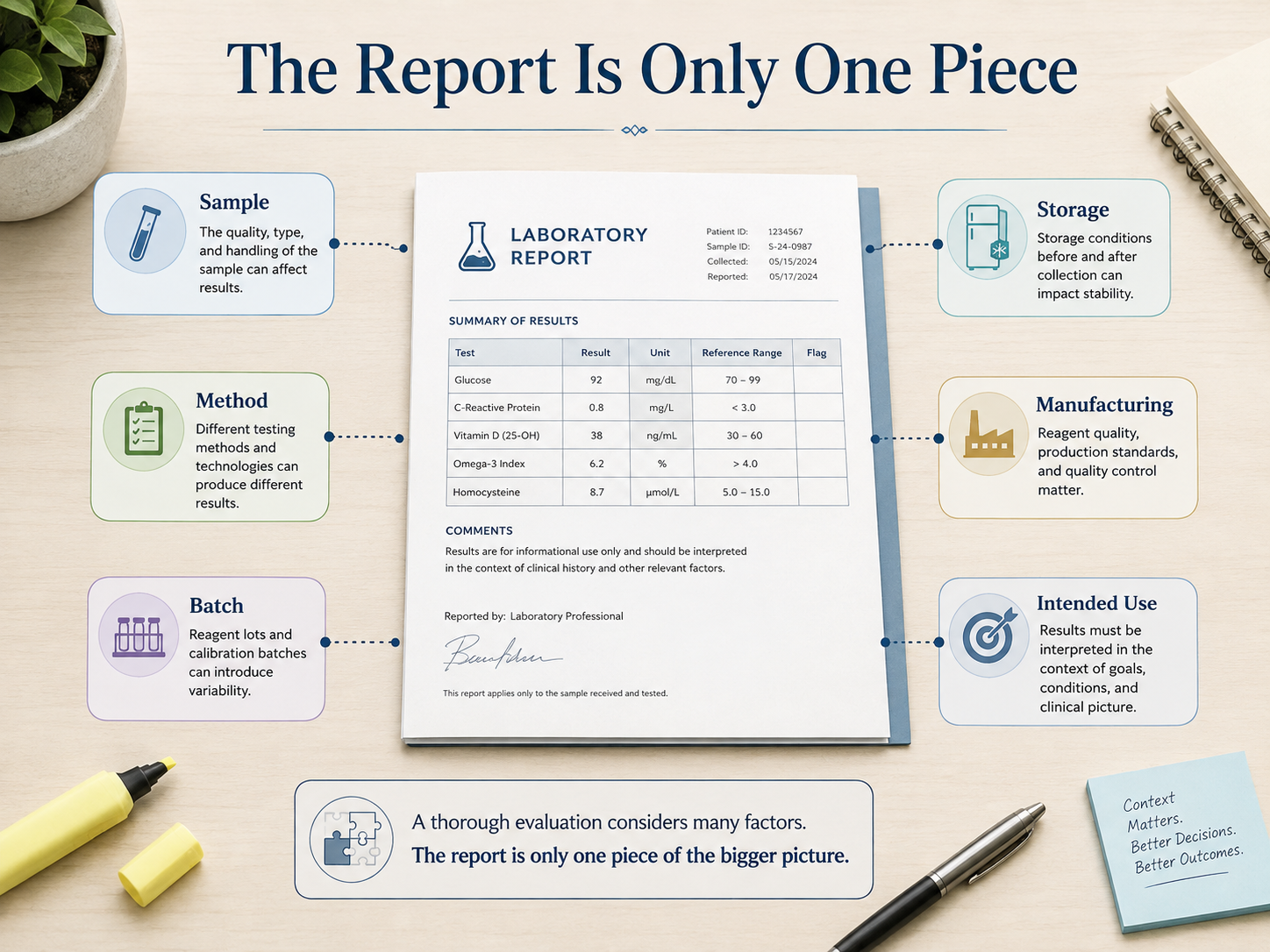
Alt text: Laboratory report surrounded by factors such as sampling, manufacturing, storage, batch traceability, method, and intended use.
Testing Cannot Recreate the Manufacturing Process
A finished-sample test cannot tell you everything that happened before the sample reached the laboratory.
It may not reveal:
Whether equipment was cleaned properly
Whether raw materials were stored correctly
Whether staff followed procedures
Whether temperature controls were maintained
Whether labels were accurate
Whether cross-contamination occurred earlier
Whether records were complete
Whether every production step followed good manufacturing practices
This is why manufacturing quality systems exist.
Testing can detect some problems.
It cannot reconstruct everything that happened during production.
Testing Cannot Prove Proper Storage and Handling
Some compounds are sensitive to:
Temperature
Light
Moisture
Time
Repeated handling
A product may test within specification when it leaves a laboratory and later degrade if it is stored improperly.
A report generated before shipment cannot automatically prove what happened afterward.
Likewise, a COA does not tell you whether a product sat in a hot warehouse, froze during shipping, was repeatedly exposed to humidity, or was stored improperly by an intermediary.
This becomes more important when dealing with products that may be unstable.
Testing Does Not Establish Safety
This deserves to be stated clearly.
Analytical testing and clinical safety research are different things.
A laboratory can confirm selected chemical characteristics of a sample.
That does not establish:
Appropriate human dosage
Adverse effects
Drug interactions
Long-term safety
Contraindications
Effects in pregnancy
Effects in people with specific medical conditions
Safe administration
Those questions require appropriate biological, toxicological, and clinical evidence.
FDA approval standards require manufacturers to demonstrate quality, safety, and effectiveness before approval, not merely provide a purity report.
So when you see a statement like:
“Tested at 99% purity, therefore safe.”
the conclusion goes beyond what the test can establish.
Testing Does Not Prove Effectiveness
The same principle applies to benefit claims.
A laboratory can confirm that a sample contains a particular compound.
It cannot prove that the compound:
Causes weight loss
Improves recovery
Enhances cognition
Improves longevity
Builds muscle
Improves skin
Prevents disease
Those are clinical questions.
They require evidence involving appropriate human populations, controlled research, meaningful outcomes, adequate duration, and proper analysis.
Chemical identity is not clinical effectiveness.
Laboratory Credentials Matter
Not all testing laboratories operate under the same standards.
One recognized benchmark is ISO/IEC 17025, the international standard that addresses laboratory competence, impartiality, and consistent operation.
That does not mean ISO accreditation makes every result perfect.
And it does not mean a laboratory without that accreditation is necessarily incapable.
But laboratory credentials can provide useful context when evaluating whether the testing organization has demonstrated technical competence.
Ask:
Who performed the test?
Can the laboratory be identified?
Is it accredited?
Is the relevant method within its accredited scope?
Is the report complete?
Does the laboratory provide enough information to understand the result?
An anonymous PDF provides less assurance than a traceable report from a credible testing organization.
What Laboratory Testing Can Reasonably Tell You
Depending on the methods used, testing may help answer:
Is the expected compound present?
How much of it appears to be present?
What level of selected impurities was detected?
Were selected heavy metals detected?
Was microbial contamination detected under the chosen test?
Did the sample meet a defined specification?
Does this specific sample match the expected analytical profile?
These are useful questions.
They simply should not be stretched into larger claims.
What Laboratory Testing Cannot Automatically Tell You
Testing alone does not prove:
The product is FDA-approved
The product is safe for human use
The product is effective
Every batch is identical
Every unit within the batch is identical
Manufacturing was performed correctly
Storage conditions were maintained
Shipping did not affect stability
Every possible contaminant was tested
The sample submitted was representative
The seller's health claims are supported by clinical evidence
That is why context matters.
One Practical Next Step: Ask Three Questions
When you see laboratory results, ask:
1. What was tested?
Identity?
Purity?
Heavy metals?
Microbial contamination?
Something else?
2. What sample was tested?
Look for:
Batch number
Sample ID
Date
Product description
3. What is someone claiming the result proves?
Then compare the claim with the test.
If the laboratory measured purity but the marketing claims safety, there is a gap.
If it confirmed identity but the seller claims effectiveness, there is a gap.
If it tested one batch but claims every batch is identical, there is a gap.
That simple comparison can make laboratory reports much easier to interpret.
Frequently Asked Questions
Does third-party testing guarantee quality?
No. Third-party testing can provide useful independent information, but it still reflects the sample submitted, tests performed, methods used, and competence of the laboratory. It should be viewed as one element of quality evaluation.
If a product passes heavy-metal testing, does that mean it is contaminant-free?
No. It means the selected metals tested were within the stated limits, assuming the report and methods are valid. Other contaminants may require completely different analytical methods.
Does ISO/IEC 17025 accreditation mean a laboratory is reliable?
ISO/IEC 17025 establishes requirements for laboratory competence, impartiality, and consistent operation. Accreditation provides meaningful evidence of laboratory quality, but it does not mean every possible test is within scope or that a particular product is automatically safe or effective.
Choose Your Next Guide
Why Certificates of Analysis Matter
https://infinite-longevity.com/post/why-certificates-of-analysis-matter
What “Research Use Only” Actually Means
https://infinite-longevity.com/post/what-research-use-only-means
Where Do Peptide Brands Source From? Bulk vs. Retail Cost
https://infinite-longevity.com/post/where-do-peptide-brands-source-from-bulk-vs-retail-cost
Explore Safety & Standards
https://infinite-longevity.com/learning-center
The Most Important Takeaway
Laboratory testing matters.
But the right question is not simply:
“Was it tested?”
Ask:
What was tested?
Which method was used?
Which batch was sampled?
Who performed the analysis?
And what does that result actually support?
Good testing gives you useful evidence.
Good judgment keeps that evidence in the right context.
About Infinite Longevity
Infinite Longevity is an educational wellness platform focused on helping adults better understand the science, research, and practical factors connected to healthy aging, metabolic health, recovery, performance, and emerging peptide research.
Our Learning Center translates complex topics into clear, practical information using current government resources, peer-reviewed research, and recognized medical and scientific sources.
Our content is designed to support better questions and more informed conversations with qualified healthcare professionals. It is not intended to diagnose a condition, prescribe treatment, or replace personalized medical care.
Founded by Marcia Riner, Infinite Longevity was created to make complex wellness and longevity information easier to understand, evaluate, and use responsibly.
Sources
FDA: Analytical Procedures and Methods Validation for Drugs and Biologics
ISO: ISO/IEC 17025 General Requirements for Testing and Calibration Laboratories
Important Notice
This guide is for general educational purposes only. It does not certify or validate any laboratory, product, manufacturer, test result, Certificate of Analysis, supplier, or seller.
Laboratory testing does not by itself establish that a product is safe, effective, FDA-approved, suitable for human use, or appropriate for any individual purpose. Results should be interpreted within the context of the sample, batch, analytical methods, laboratory competence, manufacturing controls, regulatory status, and intended use.