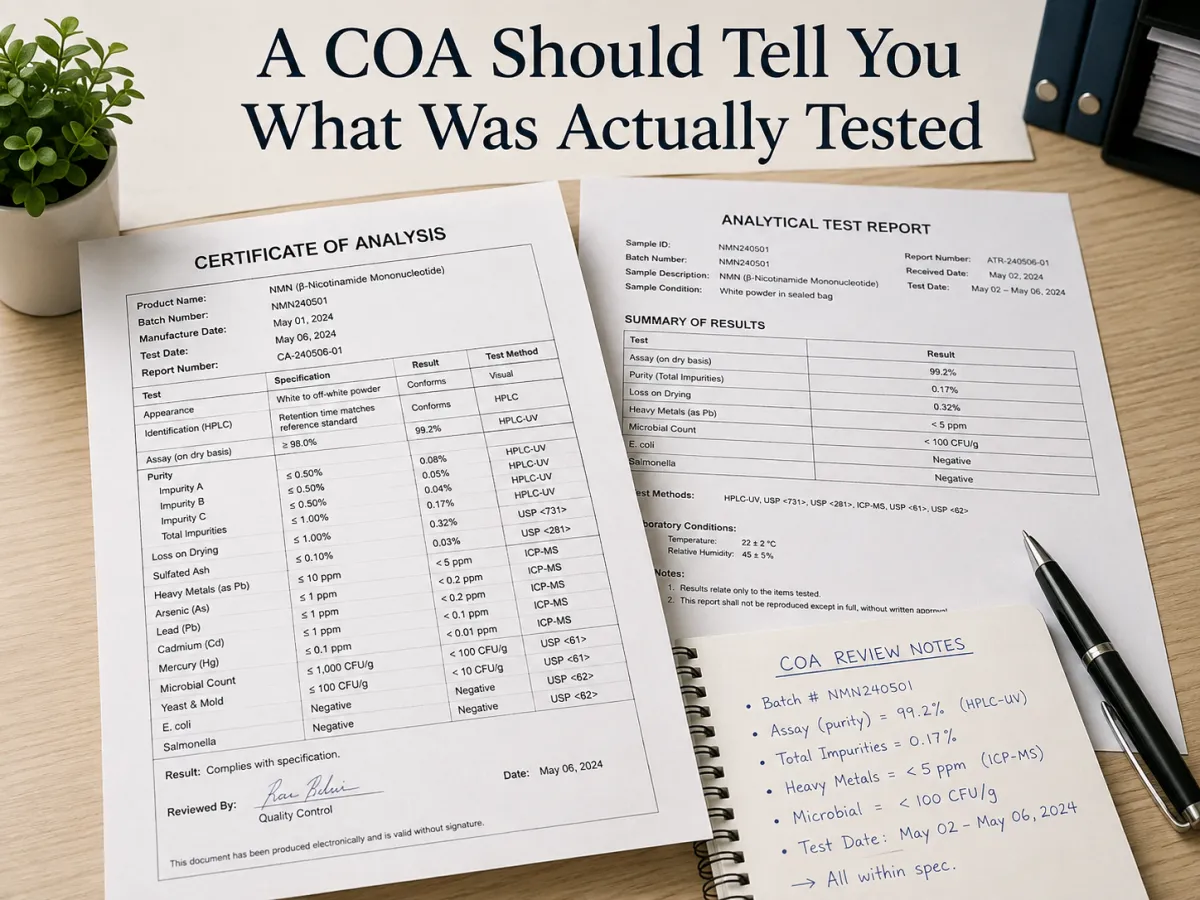
Why Certificates of Analysis Matter | Infinite Longevity
Why Certificates of Analysis Matter
A product can look professional.
The label can be clean. The website can be polished. The company can make confident claims about purity, quality, and testing.
But none of that tells you what was actually measured in a specific batch.
That is where a Certificate of Analysis, often shortened to COA, becomes useful.
A COA is a laboratory document that reports selected test results for a particular material or batch. Depending on what was tested, it may provide information about identity, purity, strength, impurities, or other characteristics.
But a COA is not a magic stamp of approval.
It is only as useful as the sample tested, the laboratory that performed the work, the methods used, and the information actually included in the report.
A COA can provide evidence about a sample. It should never be treated as proof of everything about a product.
The Quick Answer
A Certificate of Analysis is a document reporting laboratory test results for a specific batch or sample. A useful COA should clearly identify the material and batch, show which tests were performed, include specifications or acceptance limits when applicable, report the actual results, and identify who performed the testing. FDA manufacturing guidance describes authentic COAs as batch-specific documents that list tests, acceptance limits, and numerical results where appropriate.
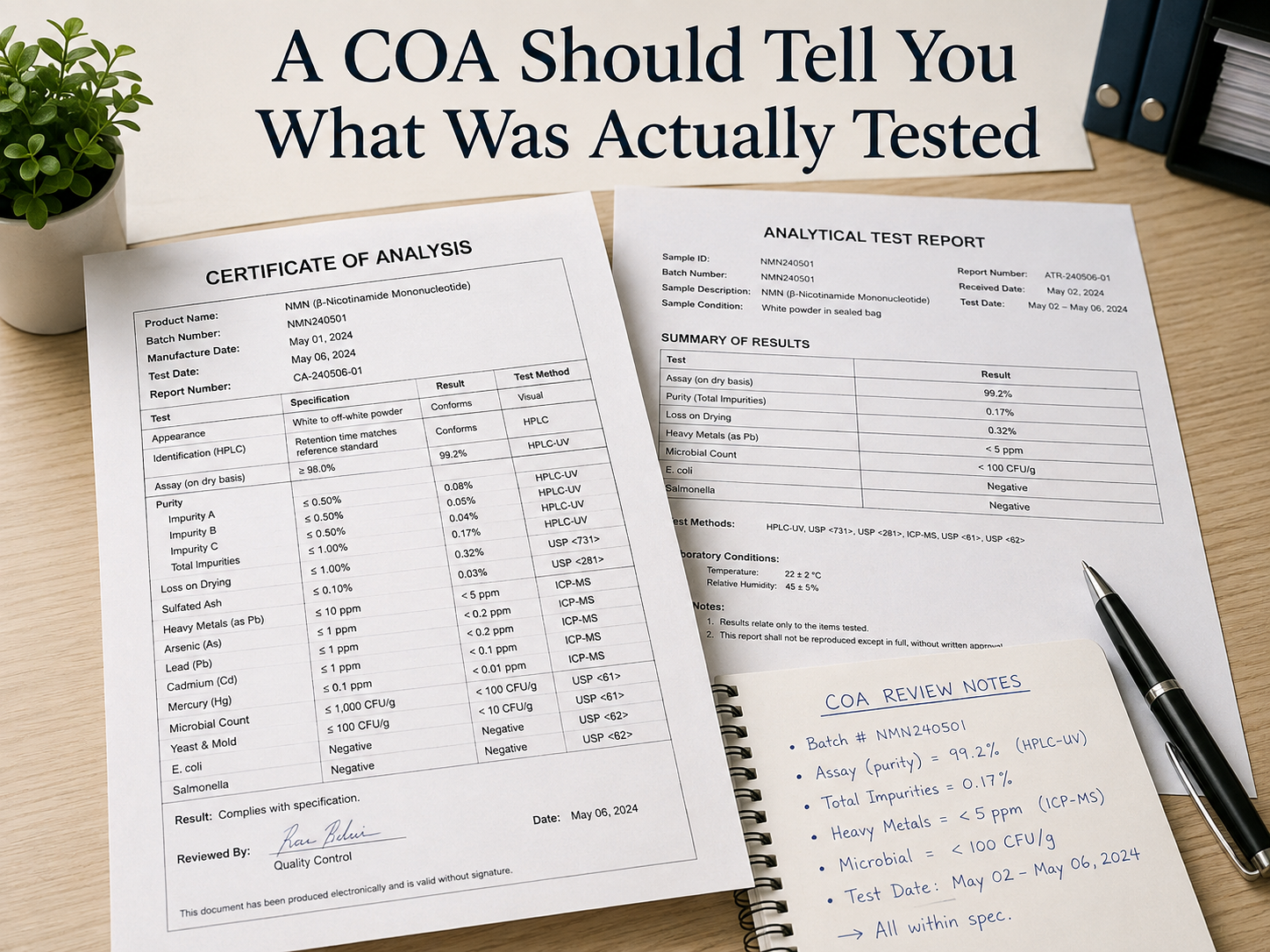
Alt text: Certificate of Analysis and laboratory test reports showing batch-specific analytical results.
What Is a Certificate of Analysis?
At its simplest, a COA documents the results of testing performed on a particular material.
In pharmaceutical manufacturing, FDA guidance says a COA should identify the material, include the batch number and release information, list the tests performed, show acceptance limits, and provide numerical results when the test produces them. The certificate should also identify the organization responsible for the analysis.
That basic structure matters because it gives the reader something concrete to evaluate.
A useful COA may answer questions such as:
What material was tested?
Which batch or lot did it come from?
When was it tested?
Which laboratory performed the analysis?
What testing methods were used?
What characteristics were measured?
What were the actual results?
What specifications were used for comparison?
Without that information, a document labeled “COA” may look reassuring while providing very little meaningful evidence.
Why Batch-Specific Documentation Matters
Products are manufactured in batches.
That means a test result from one batch does not automatically describe every batch produced before or after it.
Manufacturing conditions can vary.
Raw materials can vary.
Storage and shipping can vary.
Equipment, processes, and suppliers can change.
FDA Good Manufacturing Practice guidance specifically calls for authentic COAs to be associated with individual batches of active pharmaceutical ingredients or intermediates.
That gives us one of the simplest questions to ask when reviewing a COA:
Does the batch number on the document match the batch being represented?
If a company displays one COA online for a product that has been sold across many different lots, you do not know whether the report corresponds to the specific material you are looking at.
A COA from last year may still tell you something about the company’s past testing practices.
It does not automatically tell you what is in a different batch today.
What Can a Laboratory Actually Test?
Different analytical methods answer different questions.
For example, FDA describes laboratory testing of drug quality using attributes such as:
Identity
Assay or amount
Impurities
Dissolution for certain drug products
For investigational drug materials, FDA also describes analytical methods used to support identity, strength, quality, and purity, and specifically mentions techniques such as spectroscopy and high-performance liquid chromatography.
For peptide-related materials, you may encounter reports using terms such as:
HPLC
LC-MS or mass spectrometry
Purity
Identity
Peptide content
Residual solvents
Heavy metals
Endotoxin
Microbial testing
These tests do not all answer the same question.
For example, a purity result does not necessarily tell you the exact amount of peptide present.
A mass spectrum used to support identity does not automatically establish sterility.
A test for heavy metals does not tell you whether the material contains microorganisms.
This is one reason a single large number such as 99.5% purity should never be treated as the entire quality story.
The first question is not “Did it pass?” The first question is “What did they actually test?”
Purity and Identity Are Different Questions
This distinction is especially important.
Imagine a laboratory reports that a sample is 99 percent pure based on a particular analytical method.
That sounds excellent.
But purity and identity are not interchangeable.
One question is:
How much of the measured sample appears to consist of the primary component rather than detected impurities?
Another question is:
Is that primary component actually the compound it is claimed to be?
Those are different analytical questions and may require different methods.
FDA laboratory programs similarly distinguish between identity, assay, impurities, and other quality attributes instead of treating them as a single measurement.
So when reviewing a COA, look beyond the biggest percentage on the page.
Ask whether identity was evaluated separately.
The Testing Method Matters
A result is only meaningful in the context of how it was obtained.
FDA guidance on analytical procedures emphasizes validated methods used to support the identity, strength, quality, purity, and potency of drug substances and products.
That does not mean every research laboratory must operate under pharmaceutical manufacturing rules.
It does mean that the method itself matters.
A report is more informative when it tells you:
Which analytical technique was used
Whether the method was validated or established
What specification was applied
What result was obtained
A COA that simply says:
Purity: PASS
provides less useful information than one that identifies the analytical method, acceptance criterion, and actual result.
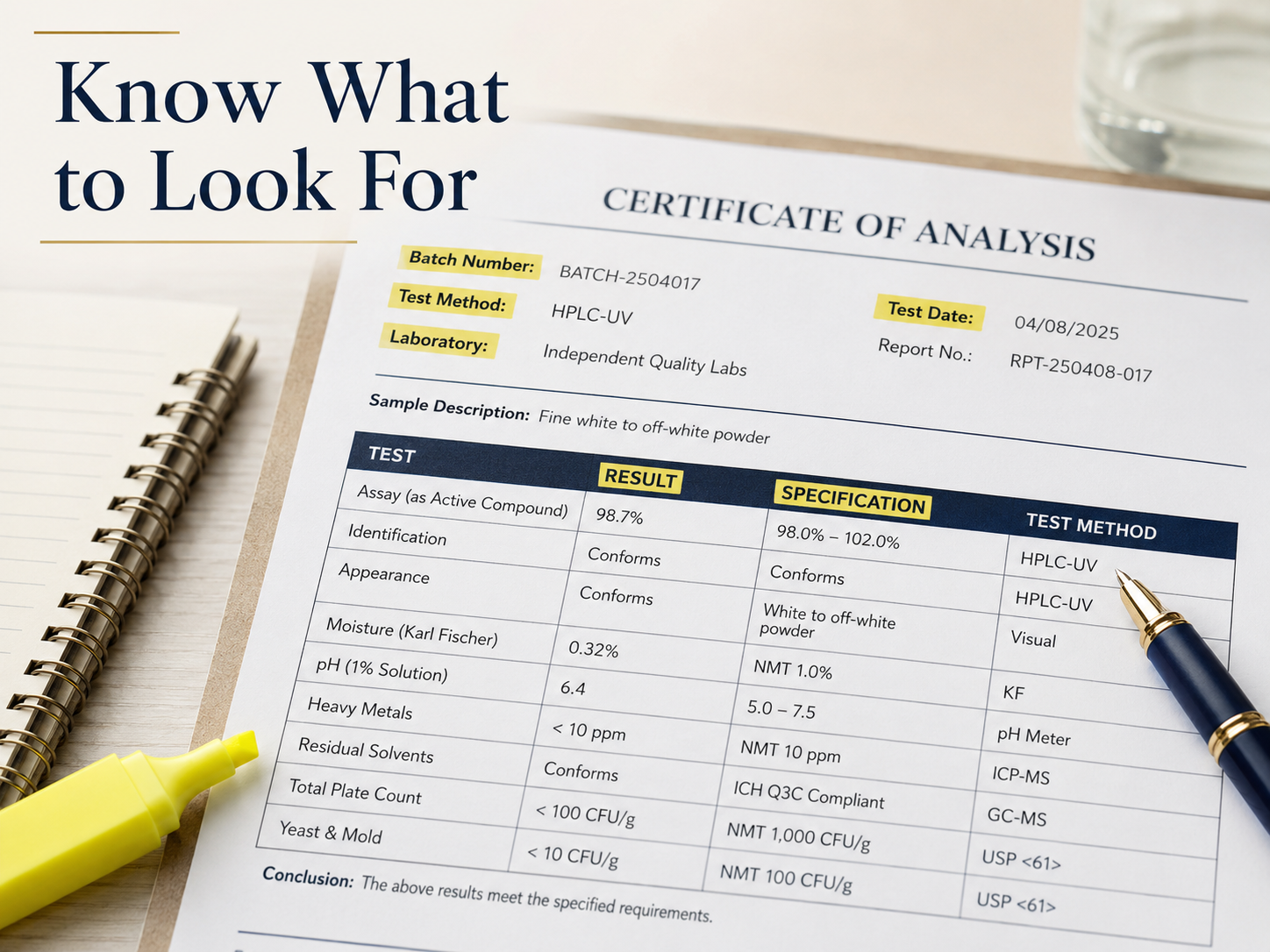
Alt text: Laboratory report highlighting key information to review on a Certificate of Analysis.
Who Performed the Test?
The laboratory matters too.
Was the testing performed:
By the manufacturer?
By the seller?
By an independent third-party laboratory?
By a contract testing organization?
Third-party testing can provide another layer of separation between the seller and the result, but “third-party tested” is not enough information by itself.
You still want to know who the laboratory is and whether it has appropriate competence for the specific testing performed.
One recognized laboratory standard is ISO/IEC 17025, which sets requirements for the competence, impartiality, and consistent operation of testing and calibration laboratories.
Accreditation alone does not guarantee that every possible test was performed or that every product claim is correct.
But knowing the laboratory, its credentials, and its scope of testing gives you more context than an anonymous document.
What a COA Does Not Prove
This may be the most important section of this guide.
A COA does not automatically prove:
That a product is FDA-approved
That it is safe for human use
That it is effective
That it was manufactured under appropriate conditions
That it remained stable during shipping or storage
That every possible contaminant was tested
That every batch is identical
That the sample submitted to the lab represents everything being sold
That claims made about the product are medically valid
Laboratory testing is one piece of a much larger quality system.
FDA’s own drug-quality program combines laboratory testing with inspections, post-market reports, signal detection, and other surveillance tools. Testing alone is not treated as the entire quality picture.
FDA has also warned manufacturers that relying entirely on a supplier’s COA without independently establishing the reliability of those results can be inadequate. In enforcement actions, FDA has specifically cited firms for using supplier COAs without appropriate identity verification or validation of supplier testing.
That reinforces an important principle:
A document is evidence. It is not a substitute for an entire quality system.
A COA Does Not Change Regulatory Status
A product can have a COA and still be an unapproved product.
Those are separate questions.
FDA has issued warning letters to peptide sellers whose products were marketed as “research use only” while the agency found that the surrounding claims established intended human drug use. FDA treated those products as unapproved drugs despite the research labeling.
A laboratory report does not convert an investigational or research-use compound into an approved medication.
Likewise, a high purity result does not establish that a compound has been shown to be safe or effective for a particular health outcome.
This is why documentation, regulatory status, and clinical evidence should be evaluated separately.
A Simple COA Review Checklist
Before accepting a COA at face value, look for:
Product or material name: Is the compound clearly identified?
Batch or lot number: Does it match the material being represented?
Testing date: Is the report reasonably current for that batch?
Laboratory name: Can you identify who performed the testing?
Test method: Does the report say how the sample was analyzed?
Specification: Does it show what result was considered acceptable?
Actual result: Are numerical results shown where appropriate?
Identity testing: Is identity addressed separately from purity?
Additional testing: Were contaminants or other relevant characteristics evaluated?
Documentation integrity: Does the report look complete rather than cropped or selectively displayed?
You do not need to become a laboratory scientist to ask these questions.
You are simply looking for enough information to understand what the document actually supports.
One Practical Next Step: Match the Claim to the Test
The next time you see a COA, choose one claim being made about the product.
Then ask:
Which test on this document actually supports that claim?
For example:
If the claim is “99% pure,” find the purity test.
If the claim is “identity confirmed,” find the identity method.
If the claim is “tested for heavy metals,” look for the actual heavy-metal results.
If the claim is “sterile,” look for the testing that specifically addresses sterility or microbial quality.
If you cannot connect the claim to a test result, the COA may not support as much as the marketing suggests.
Frequently Asked Questions
Is a Certificate of Analysis the same as FDA approval?
No. A COA reports selected laboratory findings for a sample or batch. FDA approval involves a much broader review of safety, effectiveness, labeling, manufacturing, and quality controls.
Does 99% purity mean the product is safe?
No. A high purity result may describe one analytical characteristic of the tested sample. It does not automatically establish identity, sterility, appropriate dosage, absence of all contaminants, effectiveness, or safety.
Is third-party testing always better?
Independent testing can reduce some conflicts of interest, but you still need to evaluate the laboratory, methods, batch information, and scope of testing. ISO/IEC 17025 accreditation can provide evidence of laboratory competence, but it does not mean every conceivable quality question was tested.
Choose Your Next Guide
What Laboratory Testing Can and Cannot Prove
https://www.infinite-longevity.com/post/what-laboratory-testing-can-and-cannot-prove
What “Research Use Only” Actually Means
https://www.infinite-longevity.com/post/what-research-use-only-means
Where Do Peptide Brands Source From? Bulk vs. Retail Cost
https://www.infinite-longevity.com/post/where-do-peptide-brands-source-from-bulk-vs-retail-cost)
Explore Safety & Standards
https://infinite-longevity.com/learning-center
The Most Important Takeaway
A Certificate of Analysis can be valuable.
But its value comes from the details.
Which batch?
Which laboratory?
Which test?
Which result?
Which specification?
And most importantly:
What does that result actually prove?
A good COA gives you evidence to evaluate.
It should never ask you to stop asking questions.
About Infinite Longevity
Infinite Longevity is an educational wellness platform focused on helping adults better understand the science, research, and practical factors connected to healthy aging, metabolic health, recovery, performance, and emerging peptide research.
Our Learning Center translates complex topics into clear, practical information using current government resources, peer-reviewed research, and recognized medical and scientific sources.
Our content is designed to support better questions and more informed conversations with qualified healthcare professionals. It is not intended to diagnose a condition, prescribe treatment, or replace personalized medical care.
Founded by Marcia Riner, Infinite Longevity was created to make complex wellness and longevity information easier to understand, evaluate, and use responsibly.
Sources
FDA: Q7A Good Manufacturing Practice Guidance for Active Pharmaceutical Ingredients
FDA: Analytical Procedures and Methods Validation for Drugs and Biologics
FDA: Chemistry, Manufacturing, and Control Information for Investigational Drugs
Important Notice
This guide is for general educational purposes only. It does not certify or validate any individual laboratory, Certificate of Analysis, product, manufacturer, supplier, or seller.
A COA does not by itself establish that a product is safe, effective, FDA-approved, appropriate for human use, or suitable for any individual purpose. Laboratory testing should be interpreted within the context of the specific sample, methods, specifications, regulatory status, and intended use.