What Comes After GLP-1? Multi-Hormone Peptide Research Explained | Infinite Longevity
What Comes After GLP-1? Why Researchers Are Studying Multi-Hormone Peptides
GLP-1 changed the conversation around weight management.
But researchers are already asking the next question:
What happens if one hormone pathway is not the whole story?
That has led to a new generation of metabolic therapies designed to influence more than one signaling system at the same time.
Some target GLP-1 plus GIP.
Others combine GLP-1 with glucagon.
Some add amylin.
And investigational compounds such as retatrutide target three receptor systems at once.
This does not mean “more targets” automatically means a better drug.
It means researchers are trying to understand whether coordinating several metabolic signals can produce different effects on appetite, glucose regulation, body weight, liver fat, visceral fat, and other metabolic outcomes.
The next phase of peptide research is not simply about making GLP-1 stronger. It is about understanding how several metabolic signals work together.
The Quick Answer
GLP-1 is only one of several hormone systems involved in appetite, digestion, glucose regulation, and energy balance.
Researchers are now studying medications that combine activity at GLP-1, GIP, glucagon, and amylin receptors because these pathways influence different parts of metabolic regulation.
Some multi-hormone approaches are already established. Tirzepatide, for example, activates both GIP and GLP-1 receptors and is FDA-approved for specific indications. Other approaches, including retatrutide and cagrilintide-based combinations, remain investigational or in clinical development.
The important point:
Being further along in research is not the same as being FDA-approved.
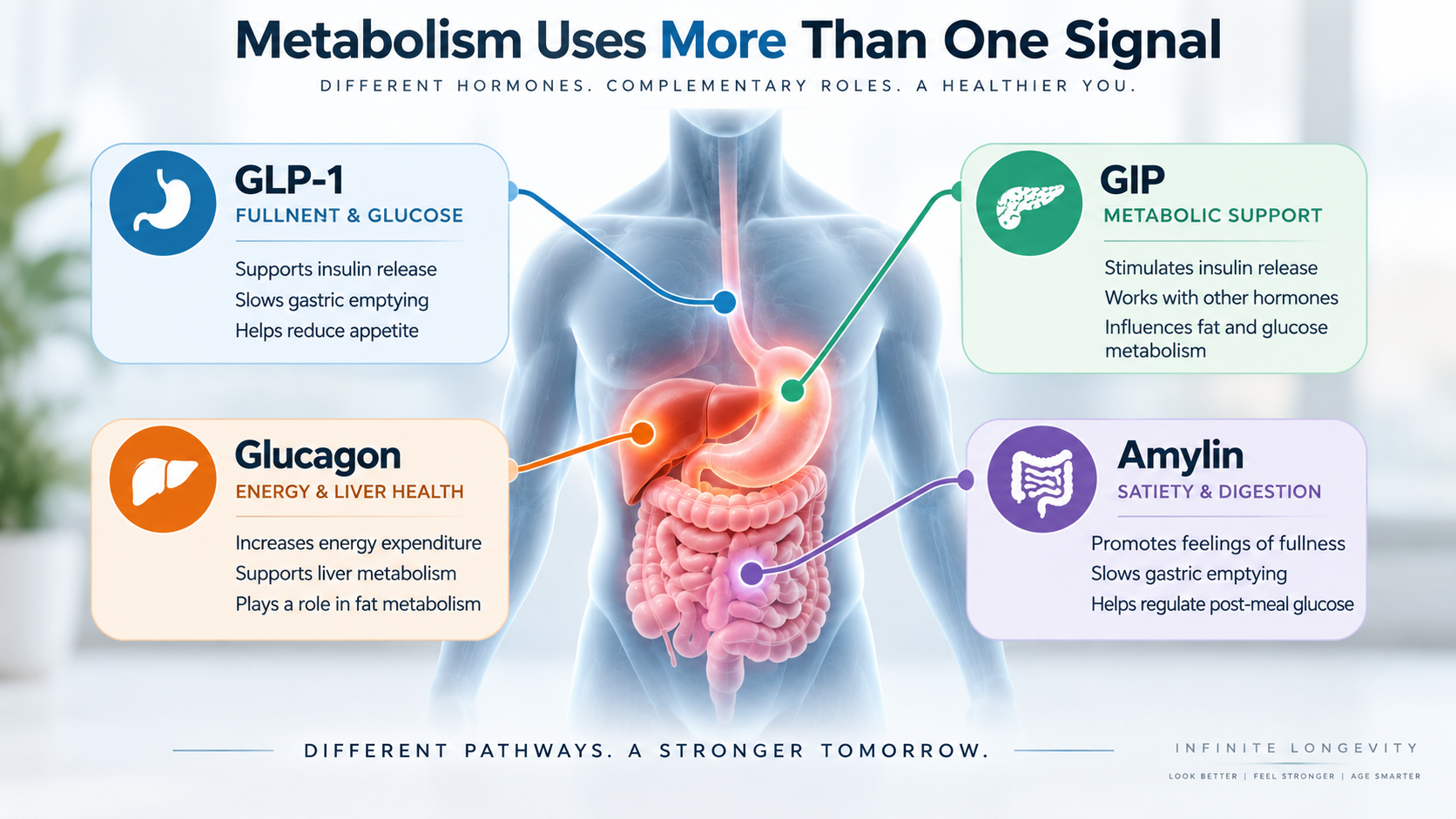
Alt text: Educational diagram showing GLP-1, GIP, glucagon, and amylin as different hormone pathways involved in metabolic regulation.
First, What Is GLP-1?
GLP-1 stands for glucagon-like peptide-1.
It is a naturally occurring peptide hormone released primarily from the intestine after eating.
Among its normal physiological roles, GLP-1 helps:
Stimulate insulin release when glucose is elevated
Reduce glucagon secretion in certain settings
Slow gastric emptying
Influence appetite and fullness
Those effects made the GLP-1 receptor an important target in diabetes and obesity treatment.
Semaglutide is one example of a medication that acts at the GLP-1 receptor.
But GLP-1 does not operate alone.
That is where the newer research starts.
What Does GIP Add?
GIP stands for glucose-dependent insulinotropic polypeptide.
Like GLP-1, it is an incretin hormone released in response to nutrients.
It participates in insulin signaling and has effects in several tissues.
Tirzepatide was developed to activate both GIP and GLP-1 receptors.
That makes it different from a GLP-1-only medication such as semaglutide.
FDA approved tirzepatide for chronic weight management in 2023 under the brand name Zepbound for qualifying adults, in addition to diet and physical activity.
The success of this dual-receptor approach helped accelerate interest in targeting even more pathways.
Why Would Researchers Add Glucagon?
This can sound strange at first.
Glucagon is often taught as the hormone that raises blood glucose.
So why would researchers deliberately stimulate a glucagon receptor in a metabolic drug?
Because glucagon biology is more complicated than one effect.
Glucagon signaling is also connected with:
Energy expenditure
Lipid metabolism
Liver metabolism
Nutrient handling
The research challenge is finding a useful balance.
Too much glucagon activity could create unwanted effects.
But combining glucagon signaling with GLP-1 or other pathways may produce a different overall metabolic response.
That is one reason compounds such as retatrutide, which targets GIP, GLP-1, and glucagon receptors, have attracted so much research attention. Recent reviews identify retatrutide as one of the major late-stage multi-receptor obesity therapies being studied.
What Is Amylin?
Amylin is another peptide hormone involved in meal-related signaling.
It is normally released from pancreatic beta cells along with insulin.
Amylin contributes to:
Satiety
Slowing gastric emptying
Regulation of post-meal glucose
That makes amylin a logical target for obesity research.
Cagrilintide is a long-acting amylin analogue being studied alone and in combination with semaglutide.
That combination is commonly called CagriSema.
Human randomized trials and recent systematic reviews have reported meaningful effects on body weight and metabolic measures, but cagrilintide and CagriSema should still be distinguished from FDA-approved therapies.
FDA currently states that cagrilintide and retatrutide are not components of FDA-approved drugs and cannot be used in compounding under federal law.
What Researchers Are Actually Trying to Improve
The obvious outcome is weight loss.
But modern metabolic research is looking beyond one number on the scale.
Researchers are studying whether newer therapies can improve:
Total body weight
Waist circumference
Visceral fat
Liver fat
Blood glucose
Insulin sensitivity
Blood pressure
Cardiovascular outcomes
Metabolic disease risk
Tolerability
Lean-mass preservation
Long-term weight maintenance
A 2026 review in Nature Reviews Drug Discovery describes the field as moving from GLP-1 alone toward multi-receptor peptide therapies targeting GLP-1, GIP, glucagon, and amylin, while also paying increasing attention to the quality of weight loss and broader metabolic outcomes.
That is an important shift.
The question is becoming less:
How much weight came off?
and more:
What changed metabolically, and what kind of weight was lost?
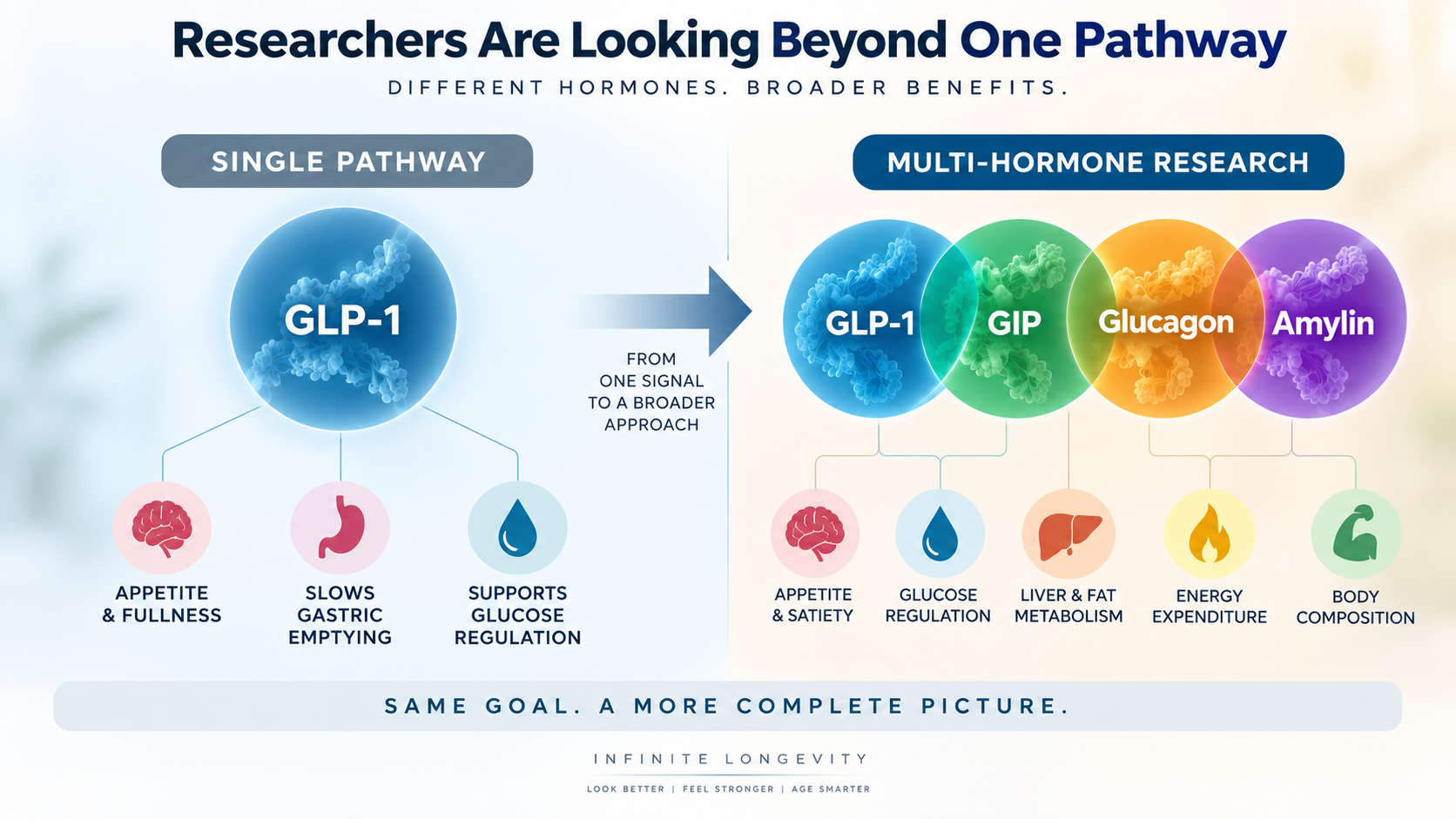
Alt text: Comparison of single GLP-1 signaling with newer research approaches combining GLP-1 with GIP, glucagon, or amylin pathways.
Evidence Snapshot
Here is the distinction that matters most.
Established FDA-approved therapy
Semaglutide
Acts primarily at the GLP-1 receptor and is FDA-approved in several formulations for specific medical indications. In March 2026, FDA also approved a higher-dose Wegovy formulation for certain adults with obesity or overweight plus a weight-related condition.
Established dual-receptor therapy
Tirzepatide
Targets both GIP and GLP-1 receptors and has FDA approvals for specific indications, including chronic weight management.
Advanced investigational research
Retatrutide
Targets:
GIP + GLP-1 + glucagon
It has produced substantial weight-loss results in clinical research and remains an important late-stage investigational compound.
It is not FDA-approved.
Amylin-based research
Cagrilintide / CagriSema
Cagrilintide targets the amylin pathway and has been studied both alone and in combination with semaglutide.
Phase 3 human data are now available, but cagrilintide remains distinct from currently FDA-approved obesity medications.
Why Retatrutide Is Getting So Much Attention
Retatrutide is frequently called a triple agonist.
That simply means one molecule has been engineered to activate three receptor systems:
GIP + GLP-1 + glucagon
That is scientifically interesting because those pathways influence different aspects of metabolic regulation.
It does not mean:
Three targets = three times better.
Multi-receptor design creates additional questions about:
Receptor balance
Dosing
Side effects
Long-term outcomes
Cardiovascular effects
Lean mass
Durability of weight loss
That is exactly why clinical trials matter.
A compound can have an elegant biological theory and still need large human studies before its benefits and risks are understood well enough for approval.
What About Tirzepatide?
Tirzepatide is useful for understanding how quickly the field has changed.
It is sometimes casually described as “a GLP-1.”
That is incomplete.
Tirzepatide acts at both the GIP and GLP-1 receptors.
So it already represents a move beyond the single-receptor model.
That distinction is useful when comparing compounds online.
Semaglutide, tirzepatide, retatrutide, and cagrilintide combinations are not simply different brand names for the same thing.
They involve different biological targets and have different levels of evidence and regulatory status.
What This Research Does Not Mean
Multi-hormone therapies are exciting.
But there are several conclusions we should not jump to.
It does not mean:
More receptors automatically produce better outcomes
Every investigational compound will eventually be approved
Phase 2 results guarantee Phase 3 success
Weight loss alone tells us everything about health
Similar-sounding peptides are interchangeable
A research-use product is equivalent to a clinical-trial drug
Compounding converts an investigational molecule into an approved medication
That last distinction is especially important right now.
FDA specifically warns about unapproved GLP-1-related products and says compounded drugs are not FDA-approved and are not reviewed by FDA for safety, effectiveness, or quality before marketing.
Try This: The Evidence Check
When a new metabolic peptide starts appearing online, ask six questions.
1. What receptors does it target?
GLP-1 alone?
GLP-1 + GIP?
GLP-1 + glucagon?
Three pathways?
2. Has it been studied in humans?
Animal research and human clinical trials are very different levels of evidence.
3. What phase is the research in?
Phase 1 tells us something different from Phase 3.
4. What outcome was measured?
Weight?
Blood sugar?
Liver fat?
Cardiovascular outcomes?
Lean mass?
5. How long was the study?
A short trial cannot answer every long-term question.
6. What is its regulatory status?
FDA-approved?
Investigational?
Compounded?
Research use only?
Those labels are not interchangeable.
For more on that distinction, read:
What “Research Use Only” Actually Means
Frequently Asked Questions
Is tirzepatide a GLP-1 medication?
Tirzepatide includes GLP-1 receptor activity, but it is more accurately described as a dual GIP/GLP-1 receptor agonist.
What makes retatrutide different from tirzepatide?
Tirzepatide targets GIP and GLP-1 receptors.
Retatrutide is designed to target GIP, GLP-1, and glucagon receptors.
Retatrutide remains investigational and is not FDA-approved.
What is CagriSema?
CagriSema combines cagrilintide, an amylin analogue, with semaglutide, a GLP-1 receptor agonist.
The combination has been evaluated in phase 3 clinical research.
Why are researchers interested in amylin?
Amylin participates in meal-related satiety, gastric emptying, and glucose regulation. Researchers are studying whether targeting amylin alongside other metabolic pathways can produce complementary effects.
Is Retatrutide FDA-approved?
No.
FDA currently states that retatrutide is not a component of an FDA-approved drug and has not been found safe and effective for any condition.
Does targeting more hormones automatically mean more weight loss?
No.
Multi-receptor therapies may create complementary effects, but receptor balance, dose, tolerability, and long-term safety all matter. Each compound has to be evaluated on its own evidence.
Choose Your Next Guide
Start with the peptide foundation:
What Are Peptides, Really?
Understand research labeling:
What “Research Use Only” Actually Means
Understand what laboratory results actually establish:
What Laboratory Testing Can and Cannot Prove
Explore Weight & Metabolic Health:
Weight & Metabolic Health
I would add Appetite Is More Than Willpower and Why Weight Feels Different Over Time here once their live buttons are repaired. Right now, both featured links on the live category page are redirecting incorrectly, so I would not publish broken internal URLs.
The Most Important Takeaway
GLP-1 was not the end of metabolic peptide research.
It opened a much larger conversation.
Researchers are now studying how GLP-1, GIP, glucagon, amylin, and other metabolic signals interact, and whether combining pathways can improve outcomes beyond what one receptor can accomplish alone.
That makes compounds such as tirzepatide, retatrutide, and cagrilintide scientifically interesting.
But they are not interchangeable.
And they do not all have the same regulatory status.
When you hear about the “next GLP-1,” do not ask only:
How much weight did people lose?
Ask:
What does it target, what has actually been studied in humans, and where does the evidence stand today?
That is a much better way to follow this rapidly changing field.
About Infinite Longevity
Infinite Longevity is an educational wellness platform focused on helping adults better understand the science, research, and practical factors connected to healthy aging, metabolic health, recovery, performance, and emerging peptide research.
Our Learning Center translates complex topics into clear, practical information using current government resources, peer-reviewed research, and recognized medical and scientific sources.
Our content is designed to support better questions and more informed conversations with qualified healthcare professionals. It is not intended to diagnose a condition, prescribe treatment, or replace personalized medical care.
Founded by Marcia Riner, Infinite Longevity was created to make complex wellness and longevity information easier to understand, evaluate, and use responsibly.
Sources
Beyond Weight Loss: Multisystem Benefits of Obesity Medications | PubMed
Novel GLP-1-Based Medications for Type 2 Diabetes and Obesity | PubMed
Cagrilintide and CagriSema Systematic Review and Meta-Analysis | PubMed
FDA: Concerns With Unapproved GLP-1 Drugs Used for Weight Loss
Important Notice
This guide is for general educational purposes only. It does not recommend semaglutide, tirzepatide, retatrutide, cagrilintide, CagriSema, or any other medication, peptide, compounded product, or research compound.
FDA-approved medications should be used only for appropriate indications under the care of a qualified healthcare professional. Investigational and research-use compounds should not be treated as approved therapies.