What Helps Skin Look Healthy, Not Perfect | Infinite Longevity
What Helps Skin Look Healthy, Not Perfect
Healthy skin does not mean poreless skin.
It does not mean having no lines, no texture, no sun spots, and no visible signs that you have actually lived your life.
Skin is supposed to have texture.
It changes with time.
It responds to hormones, weather, sleep, sun exposure, medications, stress, skin-care products, and the environment around you.
The problem is that much of the beauty industry gives us a very different measuring stick.
Smooth everything.
Tighten everything.
Erase everything.
And when the promised result does not happen, the natural assumption is that we need another product.
A better goal is simpler:
Skin that is protected, comfortable, functioning well, and healthy for you.
Good skin care does not need to make you look like a different person. It should help your skin do its job well.
The Quick Answer
Healthy-looking skin is supported by a few fundamentals: regular sun protection, appropriate moisturizer, gentle cleansing, avoiding smoking, adequate nutrition and hydration, and treating specific skin concerns when necessary. Dermatologists recommend starting with sunscreen and moisturizer rather than building an increasingly complicated routine.
There is no skin-care routine that can stop biological aging, and expensive products are not automatically more effective.
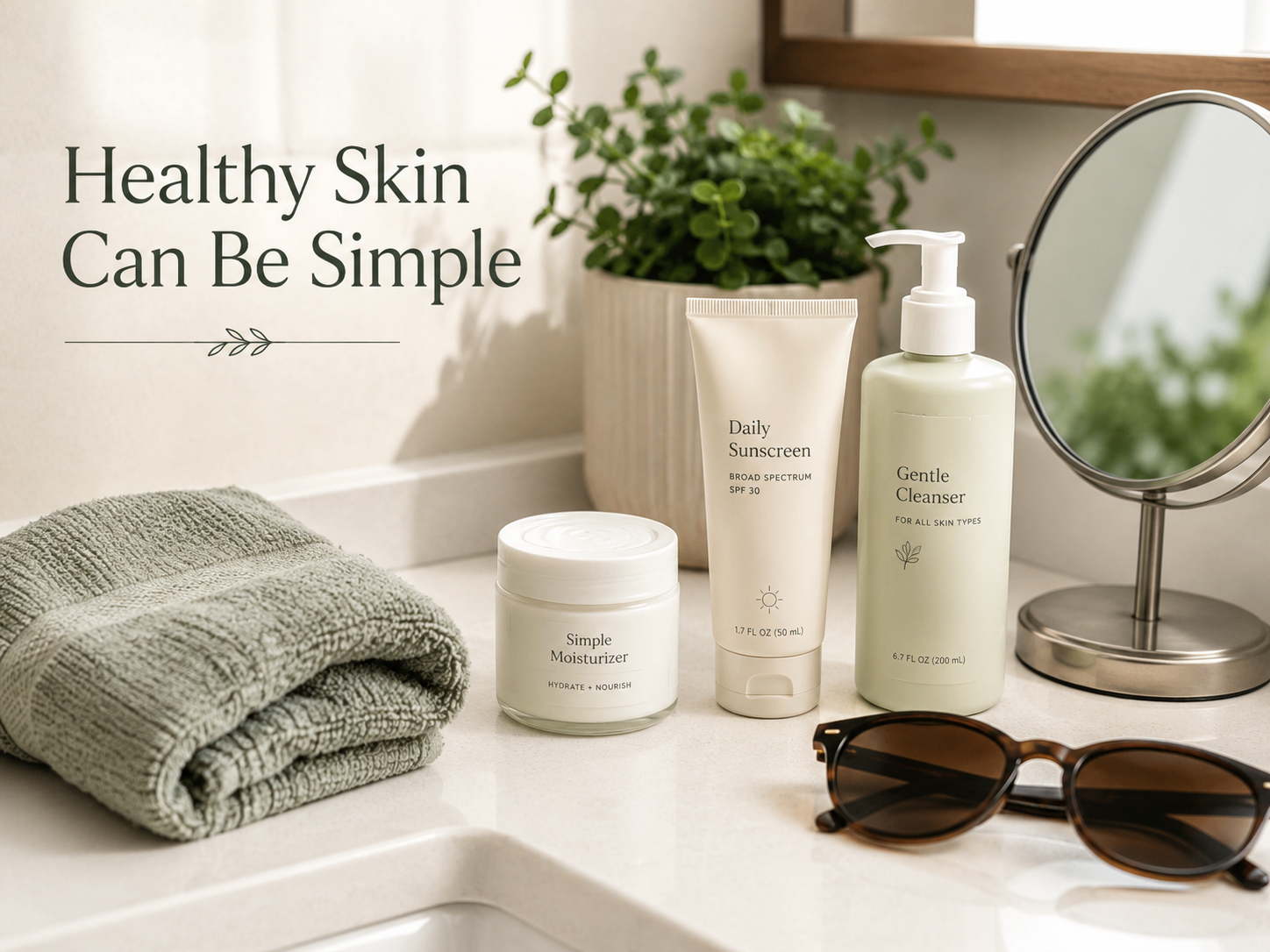
Alt text: A simple skin-care routine with cleanser, moisturizer, sunscreen, and sun protection representing basic healthy-skin habits.
Start With Protection, Not Correction
If you are concerned about how your skin is aging, the most useful product may also be the least exciting:
Sunscreen.
Ultraviolet radiation contributes to:
Wrinkles
Uneven pigmentation
Changes in texture
Loss of elasticity
Premature skin aging
Skin cancer
The National Institute on Aging describes accumulated UV exposure as a major contributor to skin aging and skin damage.
The American Academy of Dermatology recommends a broad-spectrum, water-resistant sunscreen with SPF 30 or higher for exposed skin.
That recommendation applies to men too.
Skin does not become less vulnerable to UV exposure because someone does not consider themselves a “skin-care person.”
And sun protection is not only about the face.
Think about:
Ears
Neck
Chest
Hands
Forearms
Scalp if hair is thinning
Protective clothing, sunglasses, hats, and shade can also reduce UV exposure.
Moisturizer Does More Than Make Skin Feel Nice
Moisturizer gets dismissed because it sounds basic.
But basic does not mean ineffective.
Moisturizers help reduce water loss from the skin and can improve dryness, roughness, and the temporary appearance of fine lines.
AAD specifically identifies sunscreen and moisturizer as two of the most useful starting points for aging skin.
And NIA recommends regular moisturizer as part of managing skin that becomes drier over time.
You do not necessarily need a $200 jar.
A moisturizer that:
Feels comfortable
Does not irritate you
Fits your skin type
Is affordable enough to use consistently
may be more useful than an expensive product you are afraid to finish.
More Products Can Create More Problems
There is a point where a skin-care routine can become its own source of irritation.
Cleanser.
Toner.
Acid.
Retinol.
Vitamin C.
Scrub.
Peel.
Serum.
Another serum.
Another acid.
Then suddenly:
Why is my skin red and stinging?
AAD warns that using several anti-aging products at the same time can irritate the skin and actually make signs of aging appear more noticeable.
That is especially relevant as skin becomes drier or more sensitive over time.
Your skin may tolerate less than it once did.
That is not failure.
It may simply mean the routine needs to change.
If your skin-care routine hurts more than it helps, adding another active ingredient is probably not the first move.
Gentle Cleansing Is Usually Enough
Clean skin does not need to feel squeaky.
That tight feeling after washing may actually indicate that the cleanser is stripping too much oil from the surface.
NIA recommends mild soap or cleansers and warm rather than hot water for skin that becomes drier over time.
Hot water and harsh cleansers can make dryness worse.
A reasonable cleansing goal is simply:
Remove sweat, dirt, sunscreen, and whatever needs to come off without making your skin feel punished afterward.
For some people, that means cleansing twice daily.
For others, especially those with dry or sensitive skin, less may be enough.
Skin type matters.
Retinoids Have Evidence, but They Are Not for Everyone
Retinoids are vitamin A derivatives used for several skin concerns.
Prescription retinoids have long been used in dermatology, and retinol is available in many over-the-counter products.
AAD notes that retinoids can improve mild fine lines, pigmentation irregularities, texture, and acne by affecting skin-cell turnover and collagen.
But stronger does not mean better.
Retinoids can cause:
Dryness
Peeling
Irritation
Redness
Increased sensitivity
AAD recommends starting with a lower-strength product when appropriate and introducing it gradually. Retinoids are not appropriate for everyone and should not be used during pregnancy.
If your skin is already irritated, inflamed, or extremely dry, stabilizing the skin barrier may make more sense before adding one.
Where Peptides Fit Into Skin Care
Peptides now appear in many topical and oral skin products, and researchers are studying whether certain formulations may influence hydration, collagen-related signaling, texture, or wrinkle appearance.
Some human trials are promising, but the evidence is not equally strong for every peptide or product. Recent systematic reviews continue to call for larger, better-standardized studies.
So peptides can be an interesting skin-care ingredient, but they are not a replacement for the basics.
Sunscreen, moisturizer, gentle care, and consistency still matter more than chasing the newest label claim.
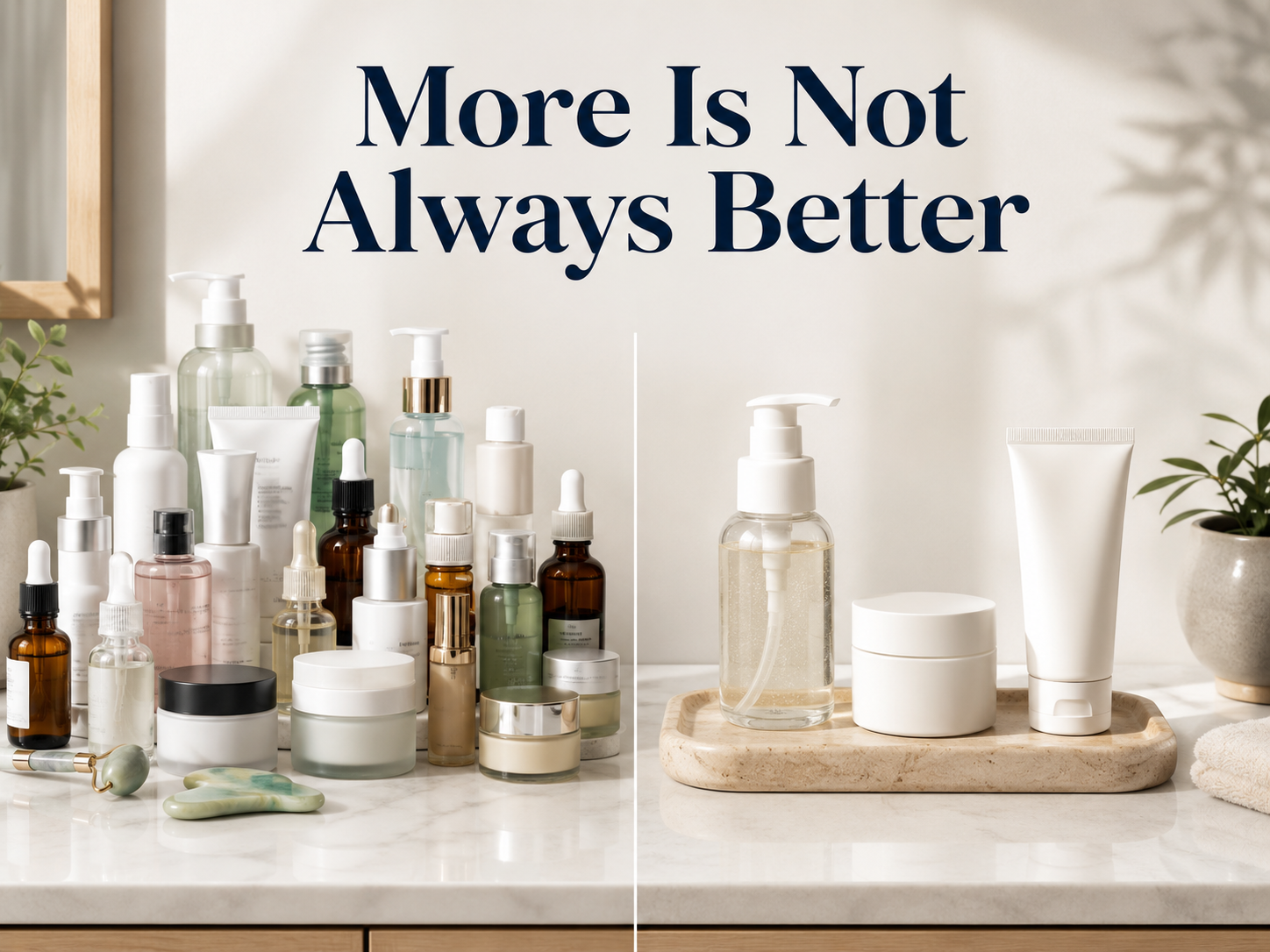
Alt text: A crowded skin-care routine compared with a simple routine using cleanser, moisturizer, and sunscreen.
Skin Texture Is Normal
This deserves its own section.
Real skin has:
Pores
Fine lines
Hair follicles
Pigment differences
Creases
Texture
Lighting, filters, editing, makeup, and image processing can remove many of those features from the images we see online.
Your skin cannot compete with software.
And it should not have to.
The goal of skin care is not to make your skin look airbrushed at six inches away.
The better questions are:
Is it comfortable?
Is the barrier functioning?
Is irritation controlled?
Are concerning lesions being evaluated?
Am I protecting it from unnecessary damage?
Am I addressing the concern that actually matters to me?
That is a healthier benchmark.
Treat One Concern at a Time
AAD recommends identifying your number-one concern after establishing sunscreen and moisturizer rather than attempting to treat every sign of aging simultaneously.
This approach makes sense.
If your main concern is:
Dryness
then improving hydration and barrier support may be enough.
If it is:
Uneven pigmentation
you may choose an evidence-based ingredient or see a dermatologist.
If it is:
Acne
that requires a different plan.
If it is:
A changing mole
that is not a cosmetic problem at all.
It needs evaluation.
Trying to solve six problems at the same time makes it difficult to tell what is working and what is irritating your skin.
Consistency Usually Beats Constant Experimenting
Skin-care marketing is built around novelty.
New ingredient.
New technology.
New peptide.
New serum.
New miracle.
Your skin may prefer boring consistency.
AAD notes that many products need at least several weeks to show results and that some can take a few months.
Changing products every week makes it difficult to know:
What helped
What irritated you
What did nothing
What simply needed more time
If a routine is comfortable and sensible, give it a chance to work.
Expensive Does Not Mean Better
AAD specifically cautions against assuming that a higher price means better results.
Effective products exist at many price points.
That is important because skin care can turn into an expensive cycle of:
Maybe the next one will finally work.
You are paying for more than ingredients.
You may also be paying for:
Packaging
Advertising
Celebrity endorsements
Fragrance
Branding
Retail positioning
None of those automatically improve skin.
“Clinically Proven” May Not Mean What You Think
Skin-care claims can sound scientific without meaning what consumers assume.
AAD points out that a cosmetic product described as “clinically proven” may simply have been tested with consumers. That phrase does not mean the product went through the same type of FDA approval process required for a drug.
That does not automatically mean the product is bad.
It means:
Read the claim carefully.
Ask:
What was actually studied?
How many people?
For how long?
Was there a comparison group?
What outcome improved?
Who funded the research?
Scientific-sounding language should not end the conversation.
It should start a better question.
Smoking Shows Up in the Skin Too
If appearance is part of your motivation, smoking deserves attention.
NIA and AAD both identify smoking as a contributor to premature skin aging.
Smoking affects much more than skin, of course.
But reducing or stopping tobacco exposure can support overall health while removing one factor known to accelerate visible skin aging.
That is a much more meaningful intervention than another jar of cream.
Hydration Helps Overall Health, but Water Is Not a Moisturizer
Drinking adequate fluids matters.
But there is a common oversimplification in skin advice:
“Just drink more water and your wrinkles will disappear.”
That is not how skin works.
NIA includes adequate hydration among general healthy-skin habits, but skin dryness also depends on oil production, barrier function, environmental humidity, bathing habits, sun damage, medications, and medical conditions.
Drink appropriately for your health.
But if your skin is dry, you may still need moisturizer.
Men and Women May Approach Skin Differently, but the Basics Still Apply
Skin structure, facial-hair practices, hormone patterns, oil production, sun exposure, and product habits can differ between individuals.
Men may also be more likely to ignore skin changes because traditional skin-care marketing has been aimed heavily at women.
But the major fundamentals are not gender-specific.
Everyone benefits from:
UV protection
Avoiding smoking
Gentle skin care
Managing persistent irritation
Monitoring changing skin lesions
Seeing a dermatologist when something looks concerning
Healthy skin is not a beauty goal reserved for women.
It is part of taking care of your body.
What Does Your Skin Actually Need?
Check what sounds most like your current skin:
It feels dry or tight.
Products sting more than they used to.
I rarely use sunscreen.
I use several strong products at once.
I change products constantly.
I am mostly concerned about one specific issue.
I have a spot or lesion that has changed.
My skin is comfortable, but I feel pressured to “fix” normal texture.
I do not really have a routine at all.
Now choose one area.
That is enough to start.
One Practical Next Step: Try the Three-Product Baseline
For two weeks, simplify.
Morning
1. Gentle cleanse if needed
2. Moisturizer if your skin needs it
3. Broad-spectrum SPF 30+ sunscreen
Evening
1. Gentle cleanse
2. Moisturizer
If you already use a dermatologist-recommended treatment or a product your skin tolerates well, you do not automatically need to stop it.
The point is to identify what your skin actually needs before adding more.
At the end of two weeks, ask:
Is my skin more comfortable?
Is it less irritated?
Is dryness improving?
Do I still have one specific concern I want to address?
Then add only what has a clear job.
When to Speak With a Dermatologist
Skin care stops being purely cosmetic when something changes unexpectedly.
NIA recommends paying attention to new or changing skin lesions and seeking professional evaluation when needed.
See a dermatologist about:
A new or changing mole
A sore that does not heal
A growth that bleeds repeatedly
Persistent itching
Severe dryness
Ongoing redness
Painful or inflamed skin
Sudden pigment changes
A rash that does not resolve
Acne or other conditions that are affecting quality of life
Do not try to exfoliate, bleach, or scrub away something that may need medical evaluation.
Frequently Asked Questions
What is the simplest effective skin-care routine?
For many adults, a reasonable basic routine is gentle cleansing, moisturizer as needed, and daily broad-spectrum SPF 30 or higher. Additional products should address a specific concern rather than being added automatically.
Do I need expensive skin-care products?
No. AAD notes that effective products are available across many price ranges and that expensive does not automatically mean better.
Is retinol necessary for healthy skin?
No. Retinoids can help certain concerns, including fine lines, pigmentation, acne, and texture, but they are not required for healthy skin and can irritate some people.
Choose Your Next Guide
Why Skin Feels Different Over Time
https://infinite-longevity.com/post/why-skin-feels-different-over-time
Hair Shedding, Breakage, and Thinning Are Not the Same
https://infinite-longevity.com/post/hair-shedding-breakage-and-thinning
What Does Healthy Aging Really Mean?
https://infinite-longevity.com/post/what-does-healthy-aging-mean
Explore Skin, Hair & Appearance
https://infinite-longevity.com/skin-hair-and-appearance
The Most Important Takeaway
Healthy-looking skin does not require perfection.
It does not require twenty products.
And it does not require pretending your skin has not changed.
Protect it from unnecessary damage.
Keep it comfortable.
Support the barrier.
Treat actual concerns.
Pay attention when something changes.
Then let skin be skin.
The question does not need to be:
“How do I make my skin look younger?”
A better one may be:
“What would help my skin look and feel healthy right now?”
That is a goal you can actually work with.
About Infinite Longevity
Infinite Longevity is an educational wellness platform focused on helping adults better understand the science, research, and practical factors connected to healthy aging, metabolic health, recovery, performance, and emerging peptide research.
Our Learning Center translates complex topics into clear, practical information using current government resources, peer-reviewed research, and recognized medical and scientific sources.
Our content is designed to support better questions and more informed conversations with qualified healthcare professionals. It is not intended to diagnose a condition, prescribe treatment, or replace personalized medical care.
Founded by Marcia Riner, Infinite Longevity was created to make complex wellness and longevity information easier to understand, evaluate, and use responsibly.
Sources
American Academy of Dermatology: How to Select Anti-Aging Skin Care Products
American Academy of Dermatology: 10 Skin Care Secrets for Healthier-Looking Skin
American Academy of Dermatology: How to Maximize Results From Anti-Aging Skin Care
National Institute on Aging: Tips for Healthier Skin as You Age
Important Notice
This guide is for general educational purposes only. It does not diagnose a skin condition, recommend individualized cosmetic or medical treatment, or replace care from a dermatologist or other qualified healthcare professional.
Speak with an appropriate licensed healthcare professional about new or changing skin lesions, persistent irritation, severe dryness, medications, cosmetic procedures, or significant changes in your skin.