Hair Shedding, Breakage, and Thinning Are Not the Same | Infinite Longevity
Hair Shedding, Breakage, and Thinning Are Not the Same
You notice more hair in the shower.
Your ponytail feels smaller.
Short pieces seem to be sticking out around your head.
Your part looks wider than it used to.
It is easy to put all of that into one category:
My hair is falling out.
But those changes can come from very different processes.
Hair can shed from the root.
It can break somewhere along the strand.
Or the hair growing from the scalp can gradually become finer or less dense.
Sometimes more than one is happening at the same time.
That distinction matters because the next step depends on what is actually changing.
Before trying to “fix hair loss,” figure out whether the hair is shedding, breaking, thinning, or doing more than one.
The Quick Answer
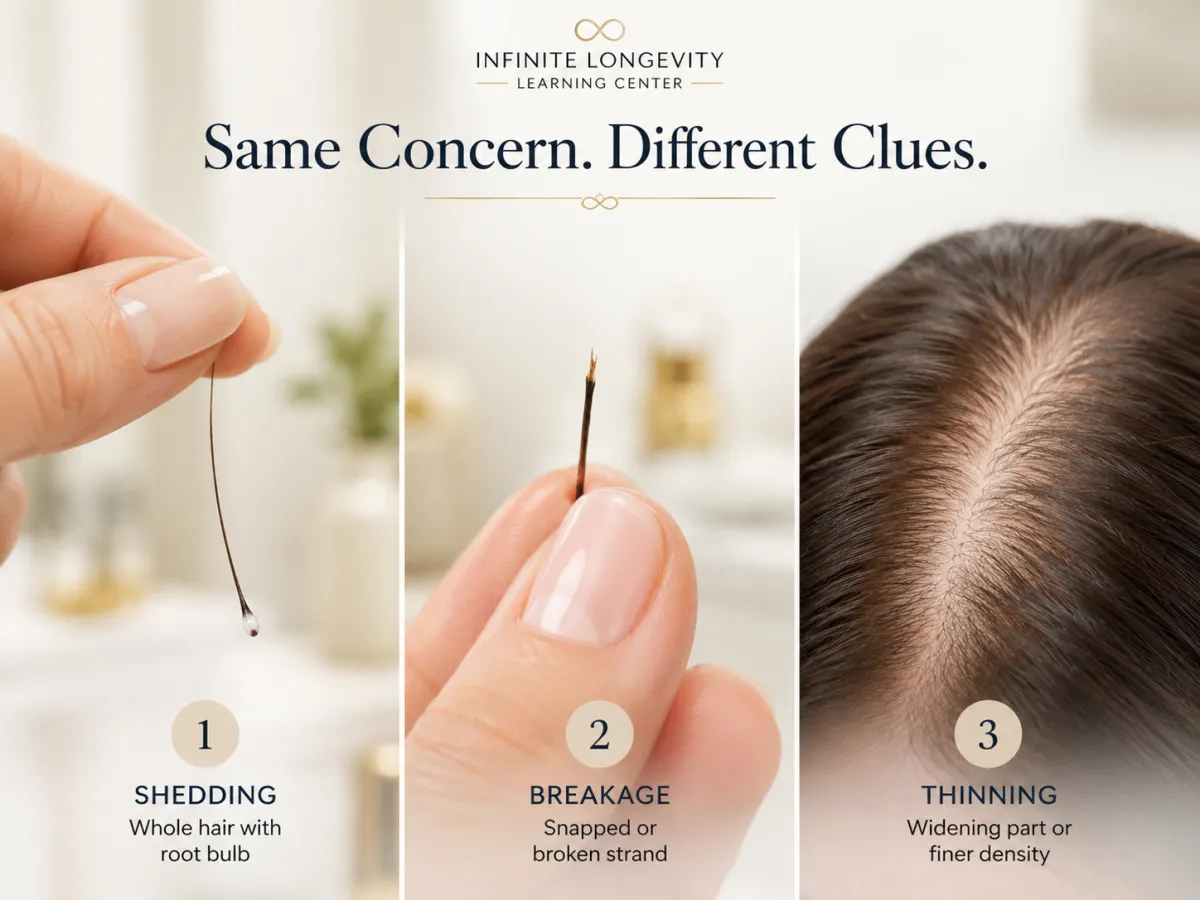
Hair shedding, breakage, and thinning are different.
Shedding usually means whole hairs are being released from the follicle. Excessive shedding can occur with telogen effluvium, often after illness, major stress, rapid weight loss, childbirth, hormonal change, or certain medications.
Breakage happens when the hair shaft snaps before the hair naturally sheds.
Thinning usually refers to a gradual reduction in visible density or progressively finer hairs, which can occur with conditions such as female or male pattern hair loss.
The American Academy of Dermatology emphasizes that excessive shedding and hair loss are not the same and that some people can experience both.
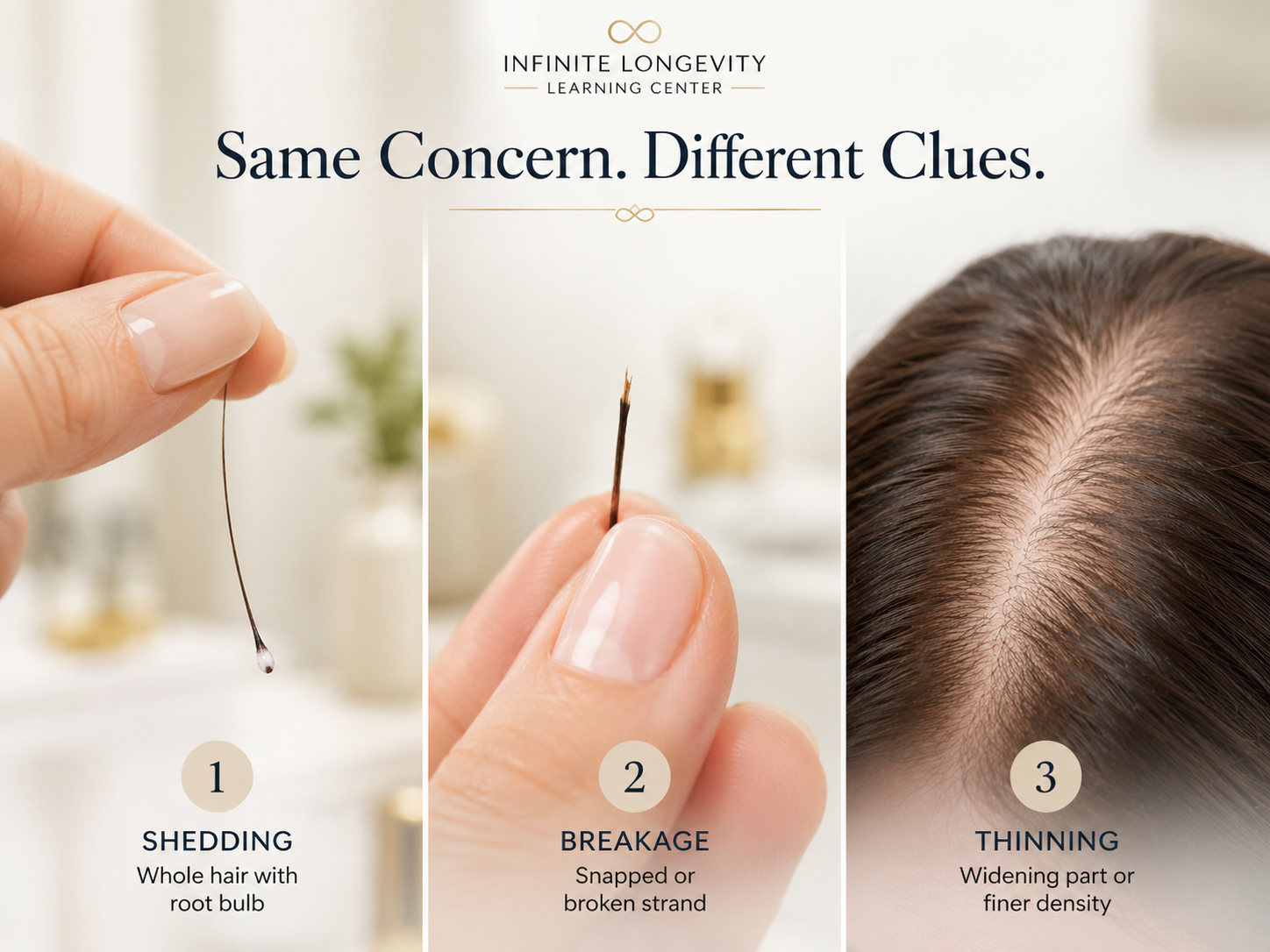
Alt text: Three examples showing whole-hair shedding, broken hair strands, and gradual thinning in hair density.
Shedding Usually Starts at the Follicle
A hair strand naturally moves through a growth cycle.
At any given time, most scalp hairs are actively growing while a smaller percentage are resting and eventually shed.
The American Academy of Dermatology says it is normal to lose roughly 50 to 100 hairs per day. When substantially more hairs move into the shedding phase, the condition is often called telogen effluvium.
Telogen effluvium is a form of diffuse, nonscarring hair shedding that may occur after a physiological or emotional stressor. Reviews describe common triggers including illness, childbirth, metabolic stress, sudden weight loss, medications, and hormonal changes.
One frustrating part is the timing.
The shedding may not start immediately after the trigger.
AAD notes that excessive shedding often becomes noticeable a few months after the event that disrupted the hair cycle.
So if you suddenly notice handfuls of hair in October, the more useful question may be:
What happened several months ago?
Maybe:
You were very ill
You had surgery
You experienced prolonged stress
You lost a significant amount of weight
Your hormones changed
A medication changed
You went through childbirth
Your nutritional intake changed considerably
The trigger and the shedding may feel disconnected because of that delay.
What Shedding Can Look Like
Excessive shedding often looks diffuse.
Instead of one clearly bald patch, you may notice:
More whole hairs in the shower
Hair collecting on clothing
More strands in your brush
Hair coming away while washing or styling
An overall reduction in fullness
AAD notes that telogen effluvium commonly improves after the body readjusts and that hair often regains normal fullness over time when the trigger resolves.
That does not mean every episode should simply be ignored.
Persistent shedding can have multiple causes, and a dermatologist can help distinguish telogen effluvium from other forms of hair loss.
Breakage Happens Along the Hair Shaft
Breakage is different.
The follicle may still be growing hair perfectly well.
The strand simply does not remain intact.
Instead of finding a complete hair that has naturally released from the scalp, you may notice:
Shorter pieces of hair
Uneven lengths
Frizz or flyaways concentrated in damaged areas
Split ends
Hair that snaps while brushing
Ends that look progressively thinner
More breakage near areas exposed to heat or tension
Hair is a fiber.
Repeated chemical, thermal, mechanical, and styling stress can weaken that fiber.
Common contributors can include:
Frequent heat styling
Bleaching
Chemical straightening
Repeated coloring
Tight hairstyles
Rough brushing
Aggressive towel drying
Extensions
Friction
Hair that has become dry or weathered
This means someone can say:
“My hair is getting shorter and thinner.”
without actually losing more hairs from the scalp.
The strands may simply be breaking faster than they can retain length.
If the follicle is growing hair but the strand keeps snapping, treating the scalp alone may not solve the problem.
One Simple Clue: Look at What Is Coming Out
You do not need to become a hair scientist.
But take a closer look at what you are seeing.
Whole-length hairs
These may suggest shedding from the follicle.
Short pieces of different lengths
These are more consistent with breakage.
Fewer obvious hairs falling, but a gradually widening part
That may point more toward progressive thinning.
This is not a diagnosis.
It is simply a way to describe the pattern more accurately when you speak with a dermatologist.
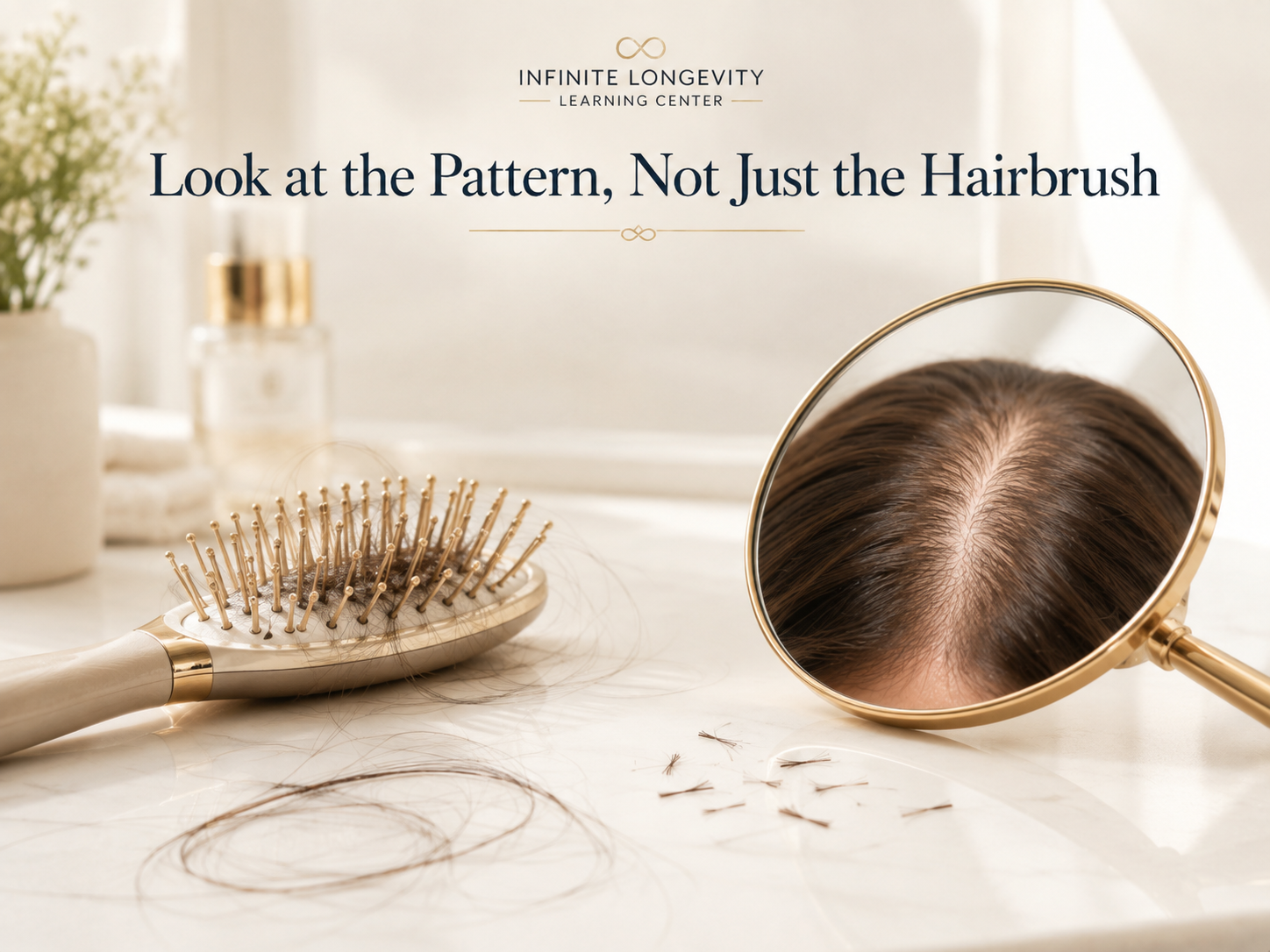
Alt text: Hairbrush and mirror showing different clues associated with shedding, strand breakage, and gradual thinning.
Thinning Is Usually About Density
When people describe thinning, they are often talking about what they see on the scalp rather than how many hairs are in the shower.
Examples include:
A widening part
More visible scalp
A smaller ponytail
Reduced density at the crown
Recession near the temples
Individual hairs becoming finer
Female pattern hair loss is the most common cause of hair loss in women.
AAD notes that it frequently begins in midlife and may first show up as a widening part or overall thinning. It is progressive, which means density can continue to decline without treatment.
In hereditary pattern hair loss, follicles gradually shrink.
The hairs they produce can become progressively finer and shorter.
That is different from a sudden shedding event where many otherwise normal hairs enter the resting phase at once.
Menopause Can Add Another Layer
Hair changes around menopause are common.
AAD notes that women may notice thinning on the scalp during menopause, including a widening part or changes near the hairline. Hormones may contribute to female pattern hair loss, although many other causes can produce a similar appearance.
That last part is important.
It is tempting to say:
“It is just menopause.”
But new hair changes can also overlap with:
Pattern hair loss
Telogen effluvium
Thyroid disorders
Nutritional deficiencies
Medication effects
Autoimmune conditions
Scalp disease
Hair-shaft damage
A hormonal transition may be part of the picture without being the entire explanation.
You Can Have Shedding and Thinning at the Same Time
This is where the categories become less tidy.
Someone with underlying female pattern hair loss may also experience telogen effluvium after illness, major stress, or rapid weight loss.
Suddenly, a gradual thinning process becomes much more obvious because additional hairs are shedding.
A 2023 systematic review noted that some cases labeled chronic telogen effluvium may actually overlap with early female pattern hair loss or other unidentified triggers.
So the answer is not always:
Shedding OR thinning.
Sometimes it is:
Both.
This is one reason diagnosing hair changes from photos, social media posts, or the number of hairs in a drain can be difficult.
Rapid Weight Loss Can Matter
This deserves attention because hair and weight changes sometimes appear months apart.
AAD lists losing 20 pounds or more among the stressors commonly associated with excessive hair shedding.
Telogen effluvium can also occur after metabolic or nutritional stress.
That does not mean weight loss automatically causes hair shedding.
But if shedding begins after:
Significant calorie restriction
Rapid weight loss
Major dietary changes
Illness
Surgery
Reduced protein or nutrient intake
that timeline is useful information for your healthcare professional.
The solution should not be to randomly add a collection of hair supplements.
First identify what changed.
Hair Supplements Are Not a Universal Answer
Hair concerns create an enormous market for vitamins, powders, gummies, collagen, biotin, and specialty formulas.
But supplementation only makes sense when it addresses an actual need.
Too much of certain nutrients can also cause problems.
And a supplement cannot correct:
Female pattern hair loss
Alopecia areata
Significant hair-shaft damage
Traction from tight styles
A medication side effect
An untreated thyroid disorder
If a deficiency is suspected, appropriate testing and clinical evaluation are more useful than guessing.
This is especially true if you are already taking multiple supplements, since ingredients can overlap.
Do Not Assume Every Hair Problem Needs the Same Treatment
This is the practical reason we are separating these categories.
If the issue is breakage, changing heat, chemical processing, tension, and hair-care habits may matter.
If the issue is telogen effluvium, identifying and correcting the trigger may matter most.
If the issue is pattern hair loss, earlier diagnosis can be important because it is typically progressive. AAD notes that treatment for female pattern hair loss tends to work best when started at the first signs.
If the issue is a scalp condition or autoimmune disorder, yet another approach may be needed.
One bottle cannot reasonably solve every possible cause.
What Kind of Change Are You Seeing?
Check the pattern that sounds most familiar.
More likely shedding clues
I am seeing many more full-length hairs than usual.
The change seemed fairly sudden.
I had illness, major stress, rapid weight loss, surgery, childbirth, or another major change several months earlier.
The loss seems diffuse rather than concentrated in one area.
More likely breakage clues
I see lots of short pieces.
My ends look thin or frayed.
Hair snaps when brushing or styling.
I regularly bleach, straighten, color, heat-style, or wear high-tension styles.
More likely thinning clues
My part is gradually getting wider.
My ponytail feels progressively smaller.
I see more scalp at the crown.
The change has happened slowly over months or years.
You may check boxes in more than one section.
That is useful information too.
One Practical Next Step: Take Three Reference Photos
Instead of checking your hair twenty times a day, create a baseline.
Take three photos in consistent lighting:
1. Center part
Photograph straight down the part.
2. Hairline and temples
Use the same angle on both sides.
3. Crown
Take one photo from above.
Then leave them alone.
Repeat them in about a month using similar lighting, hairstyle, and camera distance.
This gives you something more useful than memory.
You can also write down:
When you first noticed the change
Recent illnesses
Significant weight changes
Hormonal changes
New medications
Major stress
Dietary changes
New hair treatments or styling practices
Bring that information to a dermatologist if the issue persists.
When to Speak With a Dermatologist
Hair changes deserve professional evaluation when you notice:
Rapid or unexplained shedding
Visible scalp becoming progressively more noticeable
A widening part
Bald patches
Receding areas
Scalp pain, burning, itching, scaling, or inflammation
Broken hairs concentrated in one area
Loss of eyebrows or eyelashes
Hair loss after beginning medication
Shedding that persists for months
Hair changes accompanied by fatigue, weight changes, menstrual changes, or other systemic symptoms
AAD emphasizes that dermatologists can distinguish excessive shedding from true hair loss and identify causes that require different treatment.
Earlier evaluation is particularly useful for progressive types of hair loss.
Frequently Asked Questions
How can I tell if my hair is shedding or breaking?
Shedding usually involves whole hairs released from the scalp. Breakage typically produces shorter pieces because the strand snaps somewhere along its length. Both can occur together.
Is increased shedding always permanent hair loss?
No. Telogen effluvium is often temporary, particularly when a specific trigger resolves. AAD notes that many people regain normal fullness after excessive shedding stops.
Does a widening part mean I have female pattern hair loss?
It can be an early sign, but other conditions may cause similar changes. A dermatologist can determine whether the pattern represents female pattern hair loss, shedding, another type of alopecia, or more than one process.
Choose Your Next Guide
Why Skin Feels Different Over Time
https://infinite-longevity.com/post/why-skin-feels-different-over-time
What Helps Skin Look Healthy, Not Perfect
https://infinite-longevity.com/post/what-helps-skin-look-healthy
What Does Healthy Aging Really Mean?
https://infinite-longevity.com/post/what-does-healthy-aging-mean
Explore Skin, Hair & Appearance
https://infinite-longevity.com/skin-hair-and-appearance
The Most Important Takeaway
“Hair loss” is not one thing.
Your hair can:
Shed from the root.
Break along the strand.
Become progressively finer or less dense.
And sometimes those processes overlap.
So before buying another product, asking:
“What can I take for hair loss?”
try asking:
“What exactly is happening to my hair?”
That is the question that points toward the right next step.
About Infinite Longevity
Infinite Longevity is an educational wellness platform focused on helping adults better understand the science, research, and practical factors connected to healthy aging, metabolic health, recovery, performance, and emerging peptide research.
Our Learning Center translates complex topics into clear, practical information using current government resources, peer-reviewed research, and recognized medical and scientific sources.
Our content is designed to support better questions and more informed conversations with qualified healthcare professionals. It is not intended to diagnose a condition, prescribe treatment, or replace personalized medical care.
Founded by Marcia Riner, Infinite Longevity was created to make complex wellness and longevity information easier to understand, evaluate, and use responsibly.
Sources
American Academy of Dermatology: Do You Have Hair Loss or Hair Shedding?
American Academy of Dermatology: Caring for Your Skin in Menopause
Important Notice
This guide is for general educational purposes only. It does not diagnose telogen effluvium, pattern hair loss, nutritional deficiency, thyroid disease, alopecia, hormonal disorders, or other causes of hair change.
Do not stop prescribed medications or begin supplements or hair-loss treatments based solely on this guide. Speak with a dermatologist or other qualified healthcare professional about persistent shedding, thinning, breakage, scalp symptoms, or unexplained changes in hair density.