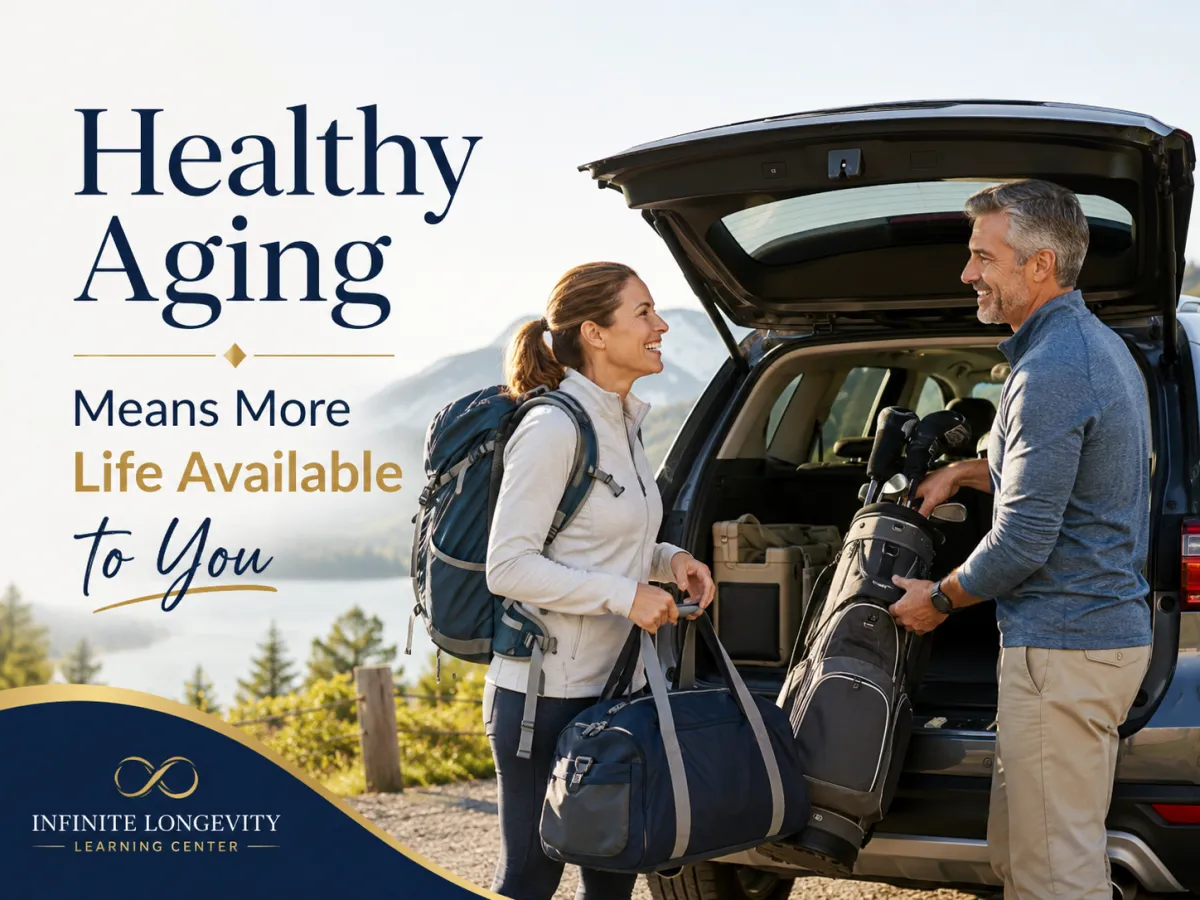
What Does Healthy Aging Really Mean? | Infinite Longevity
What Does Healthy Aging Really Mean?
Healthy aging is often pictured in extremes.
On one side, there is the promise of looking decades younger.
On the other, there is the assumption that getting older automatically means slowing down, giving things up, and accepting less.
Neither picture is especially useful.
Healthy aging is not about pretending age does not exist. It is about preserving as much physical ability, mental engagement, independence, connection, and quality of life as possible as life moves forward.
That can look different for every person.
For one person, it may mean hiking, traveling, and running a business. For another, it may mean staying strong enough to garden, dance, care for grandchildren, or live independently.
The goal is not perfection.
The goal is capability.
Healthy aging is less about trying to stay young and more about protecting your ability to keep doing what matters to you.
The Quick Answer
The World Health Organization defines healthy aging around functional ability, meaning the capabilities that allow people to be and do the things they value. That includes mobility, learning and decision-making, relationships, meeting everyday needs, and participating in society. Importantly, healthy aging does not require being completely free of disease.
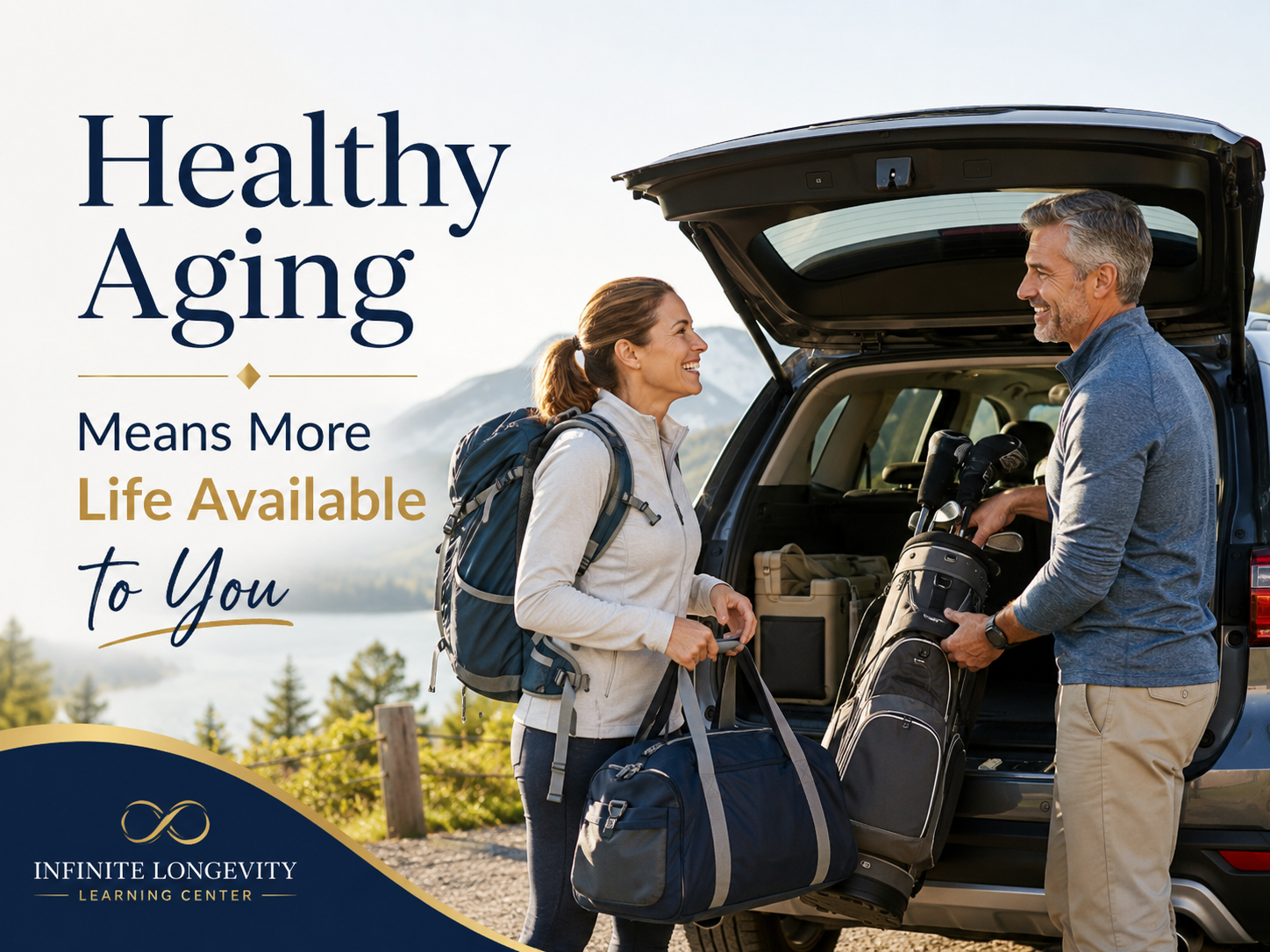
Alt text: Active adults preparing for an outdoor activity, showing healthy aging as maintaining capability and freedom.
Healthy Aging Is Not the Same as Having No Health Problems
This distinction matters.
It is easy to assume that healthy aging means avoiding every diagnosis, medication, ache, or physical change.
That is not how the World Health Organization frames it.
WHO specifically notes that being free of disease is not required for healthy aging. Many people live with one or more health conditions that, when managed well, may have relatively little effect on their well-being or ability to do what they value.
That changes the conversation.
Instead of asking:
“How do I avoid getting older?”
A more useful question may be:
“How do I protect what I want to keep doing?”
That shifts attention toward:
Strength
Mobility
Energy
Cognitive engagement
Social connection
Resilience
Independence
Purpose
Quality of life
A diagnosis may be part of your health story without becoming the entire story.
Capability Is a Better Measure Than Age Alone
Two people can be the same chronological age and have very different levels of physical and mental capability.
WHO emphasizes that there is no single “typical” older person. Some people maintain high levels of physical and mental function much later in life, while others experience significant limitations sooner.
That means your birth certificate gives only part of the information.
What can you actually do?
Can you:
Walk comfortably?
Carry your own bags?
Make decisions confidently?
Learn something new?
Maintain relationships?
Participate in activities you enjoy?
Manage daily responsibilities?
Get where you need to go?
WHO includes these kinds of abilities in its healthy-aging framework, including mobility, learning, decision-making, relationships, meeting basic needs, and contributing to society.
This is why healthy aging deserves a broader scorecard than weight, wrinkles, or the number of candles on a birthday cake.
Movement Protects More Than Fitness
Regular physical activity supports several pieces of the healthy-aging picture at once.
The National Institute on Aging describes physical activity as an important part of healthy aging and notes benefits related to sleep, anxiety, blood pressure, cardiovascular health, diabetes risk, strength, and physical function.
The CDC similarly emphasizes that regular activity can help adults remain independent, support quality of life, and prevent or manage chronic disease.
And movement does not have to mean training for a race.
It can include:
Walking
Cycling
Dancing
Hiking
Strength training
Swimming
Gardening
Recreational sports
Household activity
Different kinds of movement support different abilities.
Aerobic activity helps endurance.
Resistance exercise supports strength.
Balance work supports stability.
Mobility work helps maintain usable range of motion.
A well-rounded approach gives you more ways to stay capable.
The goal of exercise changes over time. It becomes less about what you can prove in a workout and more about what your body lets you keep doing outside of it.
Strength Gives You Options
Strength deserves special attention because it shows up in so many ordinary moments.
Carrying luggage.
Getting out of a low seat.
Climbing stairs.
Moving a piece of furniture.
Stepping onto a boat.
Playing on the floor.
Maintaining enough strength gives you options.
Losing it tends to remove them.
This does not mean everyone needs to become a serious weightlifter.
It means giving muscles a reason to remain useful.
The CDC recommends muscle-strengthening activity at least two days each week for adults 65 and older, along with aerobic and balance activities.
The earlier you build and maintain that capacity, the more reserve you may have available later.

Alt text: Adults enjoying an active social gathering, representing connection and engagement as part of healthy aging.
Brain Health Is Part of the Picture Too
Healthy aging is not only physical.
WHO includes the ability to learn, grow, make decisions, maintain relationships, and contribute to society within its definition of functional ability.
That means cognitive engagement matters.
Your brain benefits from continuing to use it.
That might include:
Learning a new skill
Reading
Playing music
Solving problems
Having meaningful conversations
Learning technology
Traveling
Taking classes
Working
Volunteering
Pursuing hobbies that require attention or coordination
Healthy aging does not require becoming obsessed with brain-training apps.
A rich, engaged life naturally asks the brain to keep participating.
Sleep, physical activity, cardiovascular health, nutrition, hearing, social connection, stress, and medical conditions may all affect cognitive health as well.
The next Brain Health and Focus guides explore these connections more deeply.
Where Emerging Peptide Science Fits
Peptide biology is one of many areas researchers are exploring in aging science, including pathways connected with metabolism, muscle, inflammation, and cell signaling.
That research is interesting, but healthy aging is much broader than any single compound or pathway.
The strongest foundation still comes from protecting physical capability, managing health conditions, staying active and engaged, sleeping well, and maintaining meaningful relationships.
Peptide research belongs in the emerging science layer of this conversation, not in place of those fundamentals.
Continue learning: Read What Are Peptides, Really?
Social Connection Is Not an Extra
It can be tempting to put social life in a different category from health.
The healthy-aging framework does not.
WHO specifically includes the ability to build and maintain relationships and contribute to society as components of functional ability.
That might mean:
Close friendships
Family relationships
Community involvement
Faith communities
Professional relationships
Clubs
Volunteer work
Sports
Travel groups
Regular social activities
Connection creates more than entertainment.
It gives life structure, stimulation, accountability, and meaning.
A healthy body matters.
Having a reason to use it matters too.
Independence Is Not the Same as Doing Everything Alone
Healthy aging often includes maintaining independence, but independence should not be confused with refusing help.
Real independence is having as much choice and control as possible.
Sometimes that means:
Using technology
Asking someone to help with a heavy task
Modifying your home
Wearing hearing aids
Using physical therapy
Changing transportation
Taking medication appropriately
Adjusting exercise
The CDC's MyMobility planning tools, for example, focus on helping people remain safe, mobile, and independent by thinking ahead about health, the home environment, and community mobility.
Support can preserve independence rather than take it away.
Your Environment Matters More Than You May Think
Healthy aging is not determined only by what happens inside your body.
WHO describes functional ability as the interaction between a person's physical and mental capacity and the environment around them.
That environment includes things like:
Your home
Transportation
Access to healthcare
Social relationships
Neighborhood design
Financial resources
Community opportunities
Technology
Attitudes about aging
For example, strong legs are useful.
Strong legs plus safe stairs, good lighting, accessible transportation, and places you actually want to go are even more useful.
Healthy aging is partly about building your own capacity.
It is also about creating conditions that make that capacity easier to use.
What Does Healthy Aging Mean to You?
There is no single correct answer.
Check the statements that matter most:
☐ I want enough strength to keep traveling.
☐ I want to remain mentally engaged and curious.
☐ I want to move without constantly thinking about my body.
☐ I want to maintain my independence.
☐ I want enough energy for the people and activities I enjoy.
☐ I want to keep learning and trying new things.
☐ I want strong relationships and an active social life.
☐ I want to manage health conditions without letting them define me.
Now choose the two that matter most.
Those are more useful longevity goals than simply saying:
“I want to age well.”
One Practical Next Step: Define Your Capability Goal
Choose something you want to still be doing ten years from now.
Make it specific.
For example:
I want to carry my own luggage when I travel.
I want to keep dancing.
I want to hike with my family.
I want to continue running my business.
I want to live independently.
I want to keep learning new things.
Now ask:
What abilities does that future require?
Maybe it requires:
Leg strength
Balance
Cardiovascular endurance
Cognitive engagement
Mobility
Hearing
Social connection
Better sleep
Better management of an existing condition
You have just turned “healthy aging” from an abstract idea into something you can actually work toward.
When to Speak With a Healthcare Professional
Healthy aging includes paying attention when something changes.
Talk with a qualified healthcare professional about:
New or worsening weakness
Repeated falls
Significant changes in balance
Persistent fatigue
New memory or thinking concerns
Changes in hearing or vision
Unexplained weight changes
Ongoing pain
Sleep problems
Major changes in exercise tolerance
Symptoms that interfere with normal daily life
Early attention can sometimes protect function before a problem becomes more limiting.
Frequently Asked Questions
Does healthy aging mean avoiding disease?
No. WHO specifically states that freedom from disease is not required for healthy aging. A person may have one or more well-managed health conditions while maintaining good functional ability and quality of life.
At what age should I start thinking about healthy aging?
Healthy aging develops across the life course. Building strength, maintaining activity, supporting cognitive health, managing medical conditions, and staying socially connected can matter long before someone considers themselves “old.”
What is the most important part of healthy aging?
There is no single factor. Healthy aging reflects the interaction of physical and mental capability, environment, relationships, mobility, health, and the ability to keep doing things that matter to you.
Choose Your Next Guide
Why Strength Matters More as Life Moves Forward
https://infinite-longevity.com/post/why-strength-matters-as-life-moves-forward
What Supports Memory and Mental Clarity?
https://infinite-longevity.com/post/what-supports-memory-and-mental-clarity
Why Recovery Takes Longer Than It Used To
https://infinite-longevity.com/post/why-recovery-takes-longer
Explore Healthy Aging →
https://infinite-longevity.com/healthy-aging
The Most Important Takeaway
Healthy aging is not about defeating time.
It is not about looking 35 forever.
And it does not require a perfectly healthy body.
It is about protecting your ability to participate in your own life.
To move.
To think.
To choose.
To connect.
To contribute.
To keep doing more of what matters to you.
That is a much more useful definition of longevity.
About Infinite Longevity
Infinite Longevity is an educational wellness platform focused on helping adults better understand the science, research, and practical factors connected to healthy aging, metabolic health, recovery, performance, and emerging peptide research.
Our Learning Center translates complex topics into clear, practical information using current government resources, peer-reviewed research, and recognized medical and scientific sources.
Our content is designed to support better questions and more informed conversations with qualified healthcare professionals. It is not intended to diagnose a condition, prescribe treatment, or replace personalized medical care.
Founded by Marcia Riner, Infinite Longevity was created to make complex wellness and longevity information easier to understand, evaluate, and use responsibly.
Sources
World Health Organization: Healthy Ageing and Functional Ability
National Institute on Aging: Health Benefits of Exercise and Physical Activity
Important Notice
This guide is for general educational purposes only. It does not diagnose a medical condition, provide individual medical advice, prescribe an exercise or wellness program, recommend treatment, or replace care from a qualified healthcare professional.
Speak with an appropriate licensed healthcare professional about new symptoms, changes in mobility or cognition, medications, chronic conditions, exercise safety, or concerns about your ability to complete normal activities.