
What Supports Memory and Mental Clarity? | Infinite Longevity
What Supports Memory and Mental Clarity?
You walk into a room and forget what you came for.
A name you know perfectly well refuses to appear when you need it.
You reread the same paragraph because your mind wandered somewhere else.
Moments like these can feel unsettling.
But memory and mental clarity are not controlled by one switch in the brain. They are influenced by sleep, physical activity, cardiovascular health, stress, hearing, medications, social connection, learning, nutrition, and many other factors.
And occasional forgetfulness does not automatically mean something serious is happening.
The National Institute on Aging notes that people may take longer to learn new information, occasionally misplace things, or recall information more slowly as they age without those changes necessarily representing dementia.
Supporting your brain is less about finding one memory trick and more about creating conditions that help it work well.
The Quick Answer
Memory and mental clarity are connected to overall brain and physical health. Regular physical activity, adequate sleep, management of blood pressure and other chronic conditions, hearing and vision care, meaningful mental activity, social connection, and balanced nutrition may all contribute to cognitive health. The National Institute on Aging defines cognitive health as the ability to think, learn, and remember clearly.
There is no single food, supplement, puzzle, or habit proven to guarantee that memory will remain unchanged over time.

Alt text: Everyday factors including movement, sleep, learning, cardiovascular health, and social connection that may support cognitive health.
Memory Is Only One Part of Brain Health
When people say they want better brain health, they often mean:
I do not want to lose my memory.
That is understandable, but brain health is broader.
The National Institute on Aging describes brain health as including:
Cognitive function, such as thinking, learning, and remembering
Motor function, including movement and balance
Emotional function
Sensory function, including hearing, vision, taste, smell, and touch
These systems interact.
If you cannot hear a conversation clearly, for example, you may not encode the information as well in the first place.
If you are exhausted, your attention may wander before information ever reaches memory.
If stress is taking up most of your mental bandwidth, recalling a name may become harder.
That is why memory problems are not always purely “memory” problems.
Sleep Gives the Brain Better Working Conditions
Sleep does much more than make you feel rested.
The National Institute on Aging recommends generally getting seven to nine hours of sleep each night as one component of supporting cognitive health.
Poor sleep can interfere with attention, learning, and the ability to organize and retrieve information.
Think about what happens after a bad night.
You may:
Miss details
Lose your train of thought
Have trouble finding words
Need to reread information
Feel mentally slower
Forget what you intended to do
Become more easily distracted
Sometimes what feels like a memory problem begins as an attention problem.
You cannot remember information very well if your brain never fully registered it.
Persistent insomnia, loud snoring, waking while gasping, or significant daytime sleepiness deserves a conversation with a healthcare professional.
Movement Supports the Brain as Well as the Body
Physical activity is usually discussed in terms of heart health, weight, or strength.
But the brain is part of the body too.
The National Institute on Aging includes regular physical activity among the lifestyle factors that may help maintain cognitive health. Federal guidelines recommend at least 150 minutes of physical activity per week for adults, although the appropriate amount and intensity depend on individual health and ability.
You do not need to become an endurance athlete.
Useful movement can include:
Brisk walking
Cycling
Swimming
Dancing
Strength training
Hiking
Recreational sports
Gardening
There is also a practical advantage.
Physical activity often supports several brain-health factors at the same time, including cardiovascular health, sleep, mobility, mood, and social engagement.
The brain does not live separately from the rest of your health. What supports your body often supports the conditions your brain works within.
Your Heart and Blood Vessels Matter to Your Brain
The brain depends on a healthy blood supply.
That makes cardiovascular health part of cognitive health.
The CDC identifies several modifiable factors associated with higher dementia risk, including high blood pressure, uncontrolled diabetes, physical inactivity, tobacco use, heavy alcohol use, and hearing loss.
The National Institute on Aging similarly encourages managing health conditions such as:
High blood pressure
Diabetes
High cholesterol
Depression
as part of caring for cognitive health.
This does not mean controlling your blood pressure guarantees that you will never experience cognitive decline.
It means brain health deserves to be part of the reason you take cardiovascular health seriously.
Knowing your numbers and managing existing conditions can support more than your heart.
Hearing May Be a Hidden Piece
Hearing deserves far more attention in conversations about memory.
When hearing becomes difficult, the brain has to work harder to understand what is being said.
You may miss information.
You may withdraw from conversation.
You may participate less in social activities because communication becomes frustrating.
The National Institute on Aging reports that hearing loss is associated with a higher risk of cognitive decline and dementia. It also notes that people with uncorrected hearing loss may become more socially isolated.
That does not mean hearing loss causes dementia in every person.
It does mean hearing deserves to be checked instead of assuming every communication problem begins in the brain.
If you frequently ask people to repeat themselves, turn up the television, struggle in restaurants, or think everyone has started mumbling, a hearing evaluation may be worthwhile.
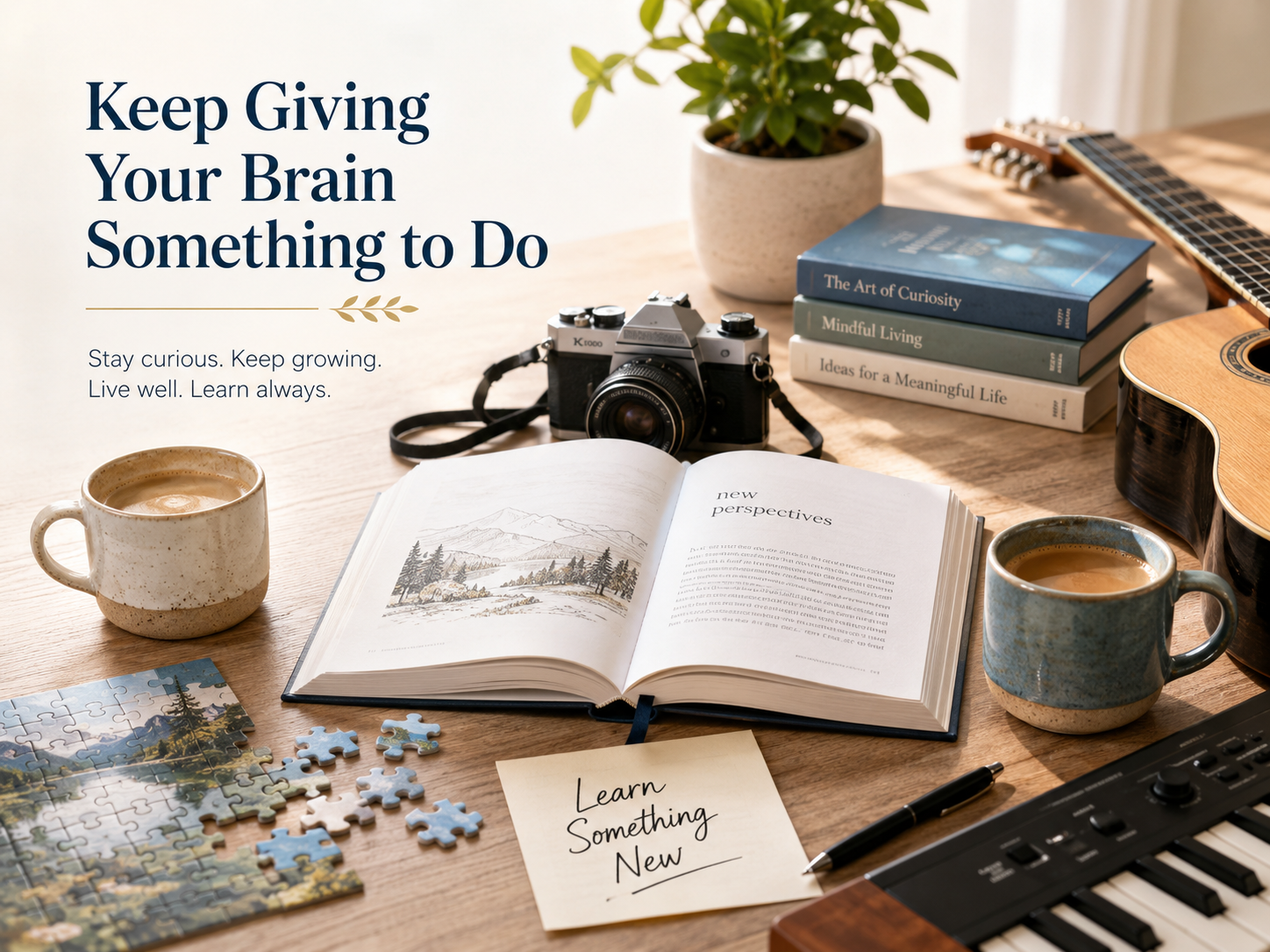
Alt text: Books, music, photography, learning, and social interaction representing meaningful cognitive engagement.
Learning New Things Gives the Brain Work to Do
A brain-training app is not the only way to challenge your mind.
Learning itself can be valuable.
The National Institute on Aging notes that cognitive training has shown benefits for certain abilities in research settings. It also points to promising evidence from meaningful activities such as learning photography, quilting, music, theater, dance, and creative writing, while emphasizing that research is still developing.
The important part is engagement.
Consider activities that require you to:
Learn
Remember
Coordinate
Make decisions
Solve problems
Communicate
Adapt
That could mean:
Learning a language
Taking dance lessons
Playing an instrument
Using new technology
Photography
Traveling somewhere unfamiliar
Joining a book group
Learning a new professional skill
Playing strategy games
Taking a class
The National Institute on Aging also emphasizes that older adults remain capable of learning new skills and forming new memories.
Your brain does not have an expiration date for curiosity.
Where Peptide Research Fits Into Brain Health
Peptides are part of the brain’s normal signaling system, and researchers continue to study peptide pathways involved in communication between nerve cells, metabolism, inflammation, and other aspects of brain function.
That makes peptides an interesting area of neuroscience research, but the evidence differs substantially from one compound to another.
A biological mechanism, animal study, or early human trial should not be treated as proof that a peptide improves memory or mental clarity in people.
Continue learning: Read What Are Peptides, Really? for a clearer explanation of why the evidence behind individual peptides can differ so much.
Social Connection Exercises the Brain in a Different Way
Conversation is cognitively demanding.
You listen.
Interpret tone.
Remember context.
Formulate a response.
Read facial expressions.
Retrieve names and details.
Shift topics.
Laugh.
React.
All of that requires brain activity.
Social connection also gives people reasons to stay engaged with their environment.
NIA includes meaningful activity and social engagement among areas being studied for their potential role in maintaining cognitive health.
That might look like:
Dinner with friends
A walking group
Volunteer work
Family gatherings
Professional networking
Faith communities
Clubs
Classes
Travel groups
Team sports
You do not need a packed social calendar.
Quality matters too.
The goal is not constant activity.
It is staying connected enough that your brain continues interacting with other people and the world around you.
Nutrition Matters, but Beware of the “Brain Food” Shortcut
There is no single food proven to protect memory by itself.
The National Institute on Aging notes that Mediterranean-style and MIND dietary patterns have been associated with cognitive benefits in some studies, but the evidence is not conclusive. A clinical trial of the MIND diet, for example, showed only small cognitive improvements similar to those seen in a comparison group.
That is useful perspective.
Eating well matters.
But you do not need to turn blueberries, olive oil, walnuts, or any other food into medicine.
A reasonable foundation is more useful:
Adequate nutrition
Plenty of nutrient-dense foods
Fruits and vegetables
Fiber-rich foods
Appropriate protein
Healthy fats
Adequate hydration
Dietary choices that also support cardiovascular health
The bigger dietary picture likely matters more than one “memory food.”
Supplements Deserve the Same Skepticism
The brain-health supplement aisle is full of confident promises.
Sharper memory.
Faster recall.
Mental clarity.
Brain protection.
The evidence is rarely that simple.
The National Institute on Aging states that no vitamin or supplement is currently recommended specifically for preventing Alzheimer’s disease or other forms of cognitive decline.
That does not mean nutritional deficiencies should be ignored.
If someone is deficient in a nutrient that affects neurological function, correcting that deficiency may be medically important.
But that is different from assuming everyone needs a supplement marketed for memory.
Be especially cautious with products promising dramatic cognitive improvement without strong human evidence.
Medications Can Affect Thinking Too
If memory or mental clarity changes noticeably, review more than your age.
Some medications can contribute to:
Drowsiness
Confusion
Slower thinking
Poor attention
Sleep disruption
The National Institute on Aging specifically recommends discussing medications and possible effects on memory, sleep, and brain function with a healthcare professional.
Do not stop prescription medications on your own.
Instead, ask:
Could any of my medications or combinations of medications be contributing to this change?
That is especially worth asking when symptoms begin after:
Starting a new medication
Increasing a dose
Adding an over-the-counter sleep aid
Changing several medications
Mixing medications with alcohol
What Is Supporting Your Brain Right Now?
Check the statements that are true for you:
I usually get enough restful sleep.
I move my body regularly.
I know and manage my blood pressure.
I manage conditions such as diabetes or high cholesterol.
My hearing and vision are checked when needed.
I regularly learn or practice something mentally challenging.
I have meaningful social interaction.
My eating pattern supports my overall health.
I have reviewed medications that may affect sleep or cognition.
I address stress, depression, or anxiety when they begin affecting daily life.
You do not need every box checked.
Choose the one area that has slipped the most.
That may be the best place to begin.
One Practical Next Step: Build a Brain-Support Week
For the next seven days, choose one action from three areas.
Move
Examples:
Take a 20-minute walk
Do a strength workout
Dance
Ride a bike
Engage
Examples:
Learn something unfamiliar
Read something challenging
Practice a language
Play music
Take a class
Connect
Examples:
Call someone
Meet a friend
Join an activity
Have dinner without screens
Attend a community event
At the end of the week, ask:
Which activity left me feeling the most mentally engaged?
Keep that one.
You are not trying to build the perfect brain-health routine in seven days.
You are finding habits worth repeating.
When Is Forgetfulness More Concerning?
Occasional forgetfulness can happen to anyone.
The National Institute on Aging notes that mild age-related changes may include taking longer to recall information or occasionally misplacing things. More serious problems tend to interfere with everyday functioning.
Talk with a healthcare professional if you or someone close to you notices patterns such as:
Asking the same questions repeatedly
Getting lost in familiar places
Difficulty following familiar directions or recipes
Increasing confusion about people, places, or time
Trouble managing medications or finances
Difficulty completing familiar everyday tasks
Significant personality or behavior changes
Memory problems that are getting progressively worse
Sudden confusion is different from gradual forgetfulness and can require urgent medical evaluation.
Frequently Asked Questions
Is some forgetfulness normal as we get older?
Yes. Mild changes, such as taking longer to retrieve a name or occasionally misplacing something, can occur with normal aging. Memory changes that interfere with everyday tasks, safety, orientation, or independence deserve medical evaluation.
Do brain games prevent memory loss?
Research on structured cognitive training is promising for certain skills, but NIA cautions that there is not enough evidence to assume commercial brain-training games provide the same benefits as programs studied in clinical research.
What is the single best thing I can do for brain health?
There is no single proven habit that guarantees cognitive health. Physical activity, sleep, cardiovascular health, hearing, learning, social engagement, mental health, and nutrition all contribute to the bigger picture.
Choose Your Next Guide
If concentration changes from day to day:
Read Why Focus Feels Harder on Some Days.
If staying capable is your bigger goal:
Read What Does Healthy Aging Really Mean?
To explore the full pathway:
Return to Brain Health & Focus.
The Most Important Takeaway
Memory is not supported by one supplement, one puzzle, or one perfect food.
Your brain works inside the rest of your life.
It notices how you sleep.
How you move.
How well your heart and blood vessels are functioning.
Whether you can hear.
Whether you keep learning.
Whether you stay connected.
Whether health conditions are being managed.
So instead of asking:
“What can I take for my memory?”
A better starting question may be:
“Am I giving my brain the conditions it needs to work well?”
That gives you far more to work with.
Related Reading
Why Focus Feels Harder on Some Days
https://infinite-longevity.com/post/why-focus-feels-harder-some-days
What Does Healthy Aging Really Mean?
https://infinite-longevity.com/post/what-does-healthy-aging-mean
Why Recovery Takes Longer Than It Used To
https://infinite-longevity.com/post/why-recovery-takes-longer
Explore Brain Health & Focus →
https://infinite-longevity.com/brain-health-focusAbout
Infinite Longevity
Infinite Longevity is an educational wellness platform focused on helping adults better understand the science, research, and practical factors connected to healthy aging, metabolic health, recovery, performance, and emerging peptide research.
Our Learning Center translates complex topics into clear, practical information using current government resources, peer-reviewed research, and recognized medical and scientific sources.
Our content is designed to support better questions and more informed conversations with qualified healthcare professionals. It is not intended to diagnose a condition, prescribe treatment, or replace personalized medical care.
Founded by Marcia Riner, Infinite Longevity was created to make complex wellness and longevity information easier to understand, evaluate, and use responsibly.
Sources
National Institute on Aging: Cognitive Health and Older Adults
National Institute on Aging: Memory Problems, Forgetfulness, and Aging
National Institute on Aging: Hearing Loss, a Common Problem for Older Adults
National Institute on Aging: What Do We Know About Healthy Aging?
Important Notice
This guide is for general educational purposes only. It does not diagnose memory loss, mild cognitive impairment, dementia, depression, sleep disorders, hearing loss, or another medical condition. It does not recommend medication or supplements and does not replace evaluation by a qualified healthcare professional.
Speak with an appropriate licensed healthcare professional about new, worsening, or disruptive changes in memory, thinking, mood, hearing, sleep, medications, or ability to complete normal daily activities.