
Semax vs Selank: Why These Brain Peptides Are So Often Compared | Infinite Longevity
Semax vs Selank: Why These Brain Peptides Are So Often Compared
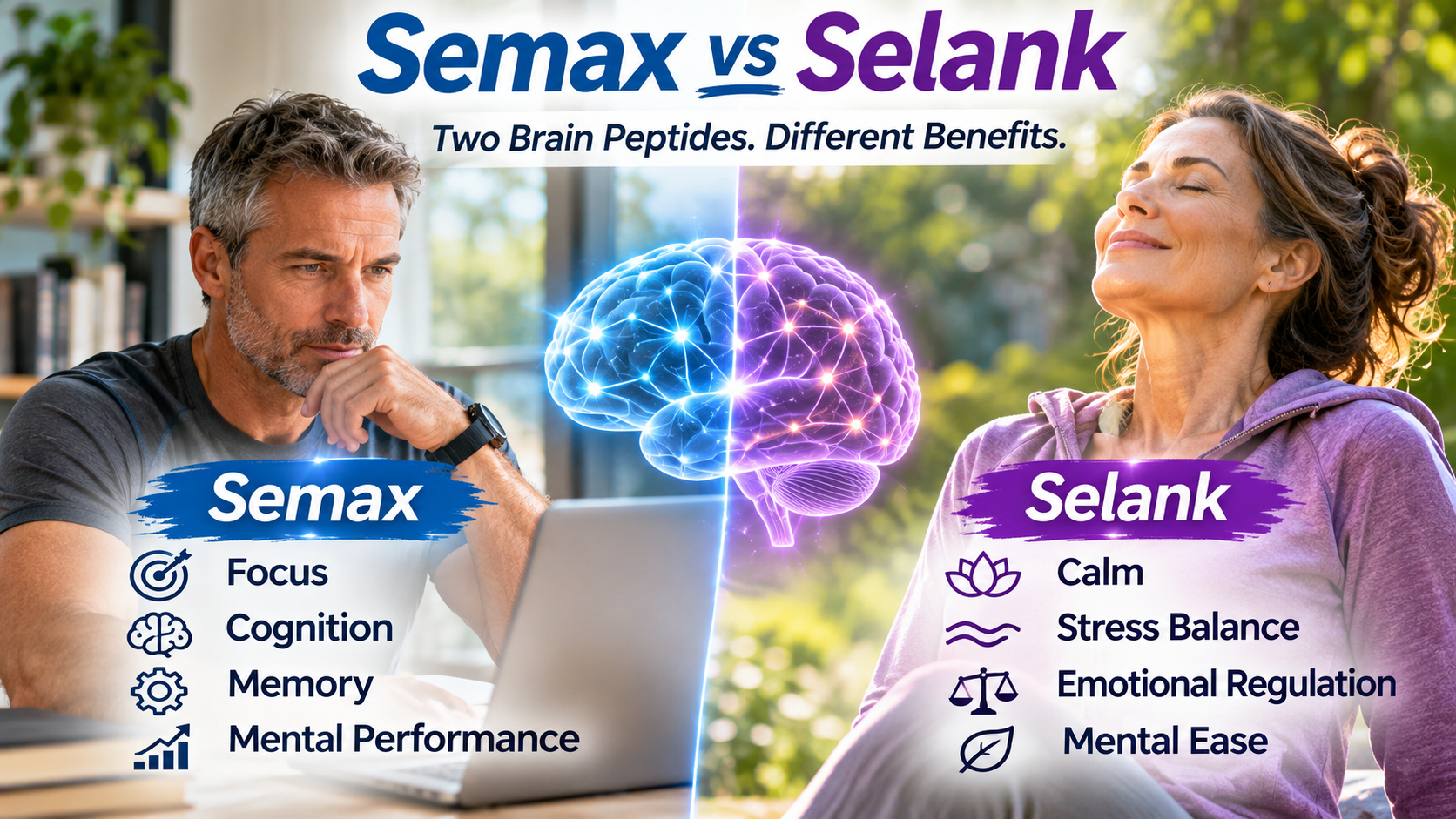
Focus and calm.
Two things your brain needs, but they are not the same thing.
That is one reason Semax and Selank are so often mentioned together.
Both are synthetic peptides that have been studied for effects involving the brain and nervous system.
But the conversations around them tend to go in different directions.
Semax is usually discussed around attention, cognition, memory, and neuroprotection.
Selank is more often discussed around stress, anxiety, and emotional regulation.
That does not make one “better” than the other.
It means they are being explored for different kinds of brain-related effects.
Semax is usually the focus peptide in the conversation. Selank is usually the calm peptide. That is the simple version.
The Quick Answer
Semax and Selank are both synthetic peptides studied primarily in Russia and surrounding research settings.
Semax has been investigated for effects related to attention, memory, cognitive performance, and neurological function. Older human research reported improvements in memory and attention under certain conditions. (PubMed)
Selank has been studied more heavily around anxiety and stress-related symptoms. Human trials in people with anxiety disorders reported anxiolytic effects and, in some studies, mild cognitive or antiasthenic effects as well. (PubMed) (PubMed)
A small functional brain-imaging study has also looked at Semax and Selank side by side in healthy participants and found both shared and distinct effects on brain connectivity. (PubMed)
The easiest way to think about them is:
Semax = focus and cognition
Selank = calm and stress response
That is not the whole story, but it is a useful starting point.
Alt text: Split educational graphic comparing Semax with focus and cognition and Selank with calm and stress regulation.
What Is Semax?
Semax is a synthetic peptide derived from a fragment of ACTH, a naturally occurring hormone involved in the stress-response system.
It was designed to influence neurological function without producing the full hormonal effects associated with ACTH.
Research has explored Semax in areas including:
Attention
Memory
Learning
Cognitive performance
Cerebral blood flow
Neuroprotection
Response to neurological stress
An early human review reported that intranasal Semax was associated with improvements in memory and attention in healthy men performing under extreme conditions. (PubMed)
That history is one reason Semax became associated with the word nootropic.
But “nootropic” is a broad label.
It does not tell you exactly what was studied, who was studied, or whether the findings apply to everyday concentration.
Why Does Semax Keep Coming Up in Focus Conversations?
Because attention is not one simple process.
Your brain has to:
Decide what matters
Ignore competing information
Hold information in working memory
Stay engaged long enough to finish a task
Switch appropriately when circumstances change
Semax research has examined several systems connected with those functions.
Some animal studies have also looked at neurotransmitter systems and brain-derived neurotrophic factor, or BDNF, which plays a role in neuronal adaptation and plasticity. (PubMed)
That does not mean Semax is a proven solution for ordinary distraction.
It explains why researchers continue to find the peptide interesting from a cognition and neurobiology standpoint.
What Is Selank?
Selank is a synthetic peptide derived from tuftsin, a naturally occurring immune-related peptide.
Its research history is different from Semax.
Selank has been studied primarily around:
Anxiety
Stress response
Emotional regulation
Fatigue
Cognitive effects associated with anxiety
Nervous-system signaling
A randomized study involving people with generalized anxiety disorder and neurasthenia compared Selank with medazepam.
Researchers reported similar anxiolytic effects between the two groups, while Selank was also associated with antiasthenic and psychostimulant effects. (PubMed)
Another study comparing Selank with phenazepam in 60 patients with anxiety-related disorders reported anxiolytic effects along with mild nootropic effects. (PubMed)
That is why Selank is usually associated more with:
calm without necessarily wanting sedation.
Calm and Sedated Are Not the Same Thing
This distinction is important.
When people hear “anxiety peptide,” they may picture something that simply makes the brain slower or sleepier.
That is not necessarily the research question around Selank.
The interest has been more about whether stress and anxiety can be reduced while cognitive function remains relatively intact.
That is one reason Selank is frequently discussed by people who want:
less mental noise without feeling mentally dull.
Again, that is the interest around the compound, not a promise of a particular outcome.
Semax and Selank Are Not Opposites
It is tempting to make the comparison too simple:
Semax = stimulation
Selank = relaxation
The biology is more interesting than that.
A small 2020 study used resting-state functional MRI to compare Semax, Selank, and placebo in 52 healthy participants.
Researchers looked at connectivity involving areas including the amygdala, which plays a role in emotional processing, and the dorsolateral prefrontal cortex, which is involved in executive functions such as working memory.
The study found both shared and peptide-specific changes in functional connectivity. (PubMed)
That suggests the two peptides may influence overlapping brain networks in different ways.
So the real question is not:
Which one turns the brain up and which one turns it down?
It is:
Which neurological systems is each peptide influencing, and what effect does that have on cognition or stress?
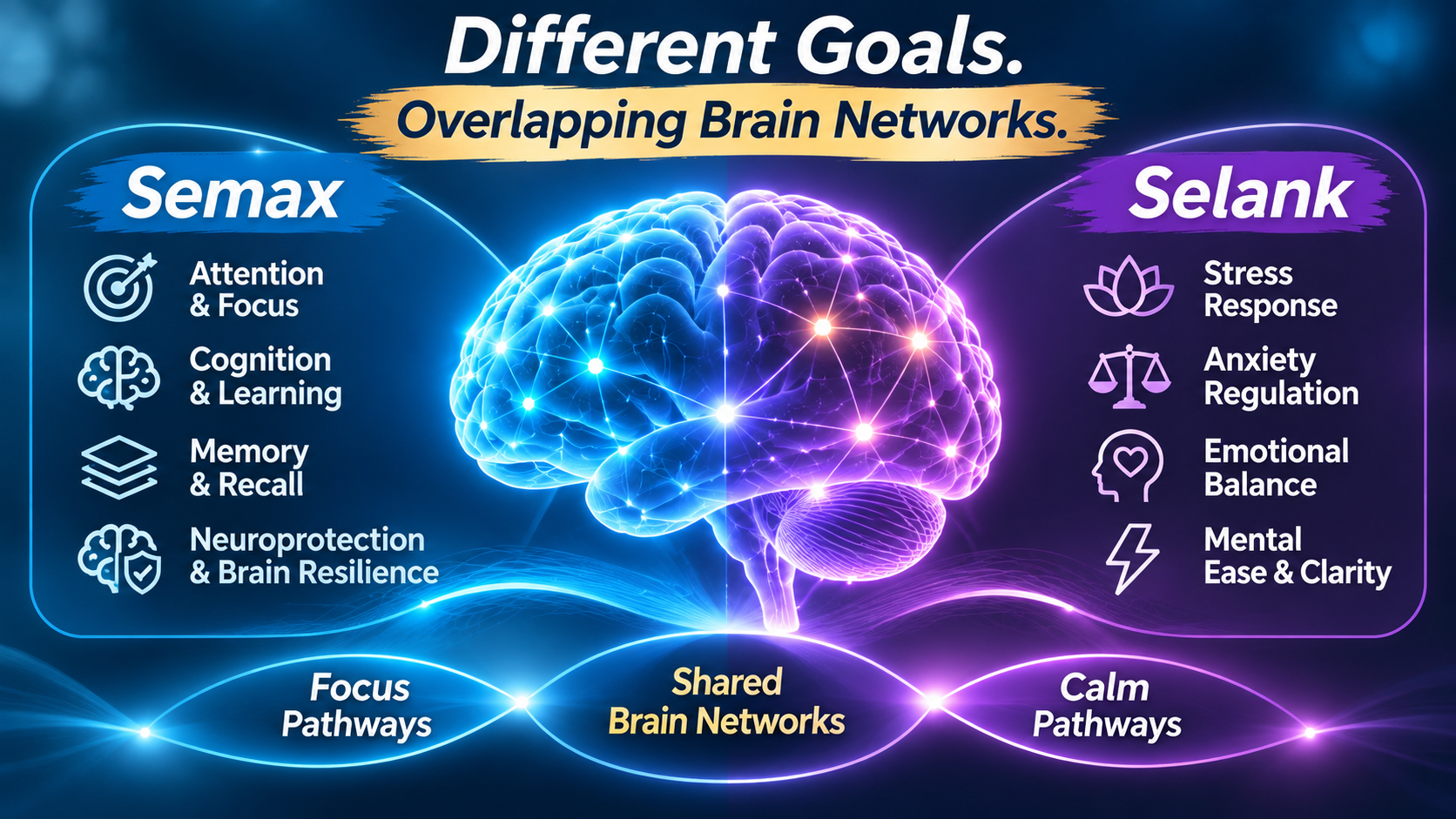
Alt text: Brain network diagram showing Semax associated with cognition and focus and Selank associated with stress and emotional regulation.
Why Focus and Stress Are So Closely Connected
This is where the comparison becomes useful even if you are not interested in peptide research.
Focus does not happen in isolation.
Stress can consume attention.
Anxiety can make it harder to hold information in working memory.
Poor sleep can make concentration more difficult.
Constant interruptions can make the brain feel scattered even when nothing is wrong with memory itself.
That is why Infinite Longevity treats brain health as a system rather than a single symptom.
If focus has been feeling harder lately, start here:
Why Focus Feels Harder on Some Days
And for the bigger picture:
What Supports Memory and Mental Clarity?
Can Someone Be Focused and Calm at the Same Time?
Of course.
In fact, that is usually the goal.
The most productive mental state is not always:
maximum stimulation.
And it is not always:
maximum relaxation.
Think about an athlete before competition.
Too little activation and performance may feel flat.
Too much and decision-making can become frantic.
A similar balance can apply to cognitive performance.
You want enough activation to engage.
Enough calm to think.
Enough attention to stay with the task.
That is one reason Semax and Selank make such an interesting pair to compare.
They represent two different sides of a problem many people recognize:
How do I stay mentally sharp without feeling mentally overloaded?
What Does the Research Actually Look Like?
The research histories of these peptides are not identical.
Semax
Human studies and older clinical literature have explored Semax in areas such as:
Memory
Attention
Neurological conditions
Cerebral circulation
Cognitive performance
Much of the published human literature originates from Russia and is older than the research programs supporting commonly approved U.S. medications. (PubMed)
Selank
Human studies have focused more heavily on:
Anxiety disorders
Stress-related symptoms
Fatigue
Quality of life
Cognitive effects associated with anxiety
Clinical studies have reported anxiolytic effects, including comparisons with established anti-anxiety medications. (PubMed) (PubMed)
Both Together
The 2020 brain-imaging study is particularly interesting because it examined both peptides in the same healthy population.
Researchers found both common and distinct connectivity changes involving brain regions associated with anxiety and executive function. (PubMed)
That does not answer every question.
But it supports the idea that these peptides may influence overlapping brain systems in different ways.
Where the Evidence Stands
What seems reasonably clear
Semax and Selank are biologically active peptides with published research involving neurological and behavioral effects.
Both have human research.
They are not simply names invented by peptide marketing.
What is still developing
Much of the human literature is:
relatively small
geographically concentrated
older
less extensive than the data supporting mainstream approved neurological or psychiatric therapies
What makes them interesting
They offer researchers two different windows into brain signaling:
Semax around cognition and attention
Selank around stress and anxiety
That is enough to make them interesting without turning either peptide into a miracle claim.
One Important Context Point
Semax and Selank are not FDA-approved drugs in the United States.
FDA has also identified limited safety information and quality concerns related to compounded Semax and Selank products, particularly around peptide impurities and immunogenicity. (FDA)
That is the regulatory context.
It does not erase the existing research.
It simply means research interest, clinical evidence, product quality, and regulatory approval are separate questions.
For more on that distinction:
Try This: Is Your Problem Focus or Mental Overload?
This is not a medical test.
It is simply a useful question.
Think about a recent day when concentration felt difficult.
Ask:
Was I unable to focus even though I felt calm?
That may point more toward:
sleep
fatigue
distraction
attention
workload
cognitive demand
Or was my brain too busy to focus?
That may feel more like:
racing thoughts
worry
tension
emotional stress
difficulty settling down
Those experiences can feel similar.
But they are not always the same problem.
That distinction is exactly why FOCUS vs CALM is such a useful way to understand the Semax and Selank conversation.
Frequently Asked Questions
What is Semax used for?
Semax has been studied in connection with cognition, attention, memory, neurological function, and neuroprotection. Human and animal studies exist, although much of the clinical literature comes from Russia. (PubMed)
What is Selank used for?
Selank has primarily been studied for anxiety and stress-related conditions, with some research also reporting cognitive or antiasthenic effects. (PubMed)
Is Semax more stimulating than Selank?
That description is too simple.
Semax is generally discussed more around cognition and attention, while Selank is more closely associated with anxiety and stress regulation. Their biological effects may overlap.
Is Selank sedating?
The research interest around Selank has not been simply sedation. Human studies have examined anxiolytic effects while also reporting cognitive, antiasthenic, or psychostimulant effects in some settings. (PubMed)
Are Semax and Selank the same kind of peptide?
No.
They have different origins, structures, and research histories, although both are synthetic peptides studied for effects involving the nervous system.
Can Semax and Selank be compared directly?
They can be compared conceptually because both involve brain-related research, and at least one human imaging study examined them side by side.
But they should not be treated as interchangeable.
Which is better, Semax or Selank?
That depends entirely on what question you are asking.
The research interests around Semax lean more toward attention and cognition.
The research interests around Selank lean more toward stress and anxiety.
That is a more useful distinction than declaring one universally better.
Choose Your Next Guide
If your focus changes from one day to another:
Why Focus Feels Harder on Some Days
If you want the bigger brain-health picture:
What Supports Memory and Mental Clarity?
If you are newer to peptide science:
What Are Peptides, Really?
Explore the full topic:
Brain Health & Focus
The Most Important Takeaway
Semax and Selank are often grouped together because both are associated with brain-related peptide research.
But they are not doing the same thing.
Semax is more closely associated with:
focus, cognition, memory, and neuroprotection.
Selank is more closely associated with:
stress, anxiety, calm, and emotional regulation.
The interesting part is not deciding which peptide “wins.”
It is understanding that brain performance depends on both sides of the equation.
Sometimes the problem is:
I cannot get my brain engaged.
Other times it is:
My brain will not quiet down enough to concentrate.
That is why the simplest way to remember the difference is still the best one:
Semax: FOCUS
Selank: CALM
Two different goals.
Two different research stories.
One very interesting brain-health conversation.
About Infinite Longevity
Infinite Longevity is an educational wellness platform focused on helping adults better understand the science, research, and practical factors connected to healthy aging, metabolic health, recovery, performance, and emerging peptide research.
Our Learning Center translates complex topics into clear, practical information using current government resources, peer-reviewed research, and recognized medical and scientific sources.
Our content is designed to support better questions and more informed conversations with qualified healthcare professionals. It is not intended to diagnose a condition, prescribe treatment, or replace personalized medical care.
Founded by Marcia Riner, Infinite Longevity was created to make complex wellness and longevity information easier to understand, evaluate, and use responsibly.
Sources
Functional Connectomic Approach to Studying Selank and Semax Effects
Semax and Selank Effects on Human Serum Enkephalin-Degrading Enzymes
FDA: Certain Bulk Drug Substances That May Present Significant Safety Risks
Important Notice
This guide is for general educational purposes only.
It does not recommend Semax, Selank, a compounded product, a research-use peptide, or any treatment for anxiety, attention problems, memory concerns, or neurological conditions.
Persistent or significant changes in mood, anxiety, concentration, memory, or cognitive function should be discussed with an appropriate licensed healthcare professional.