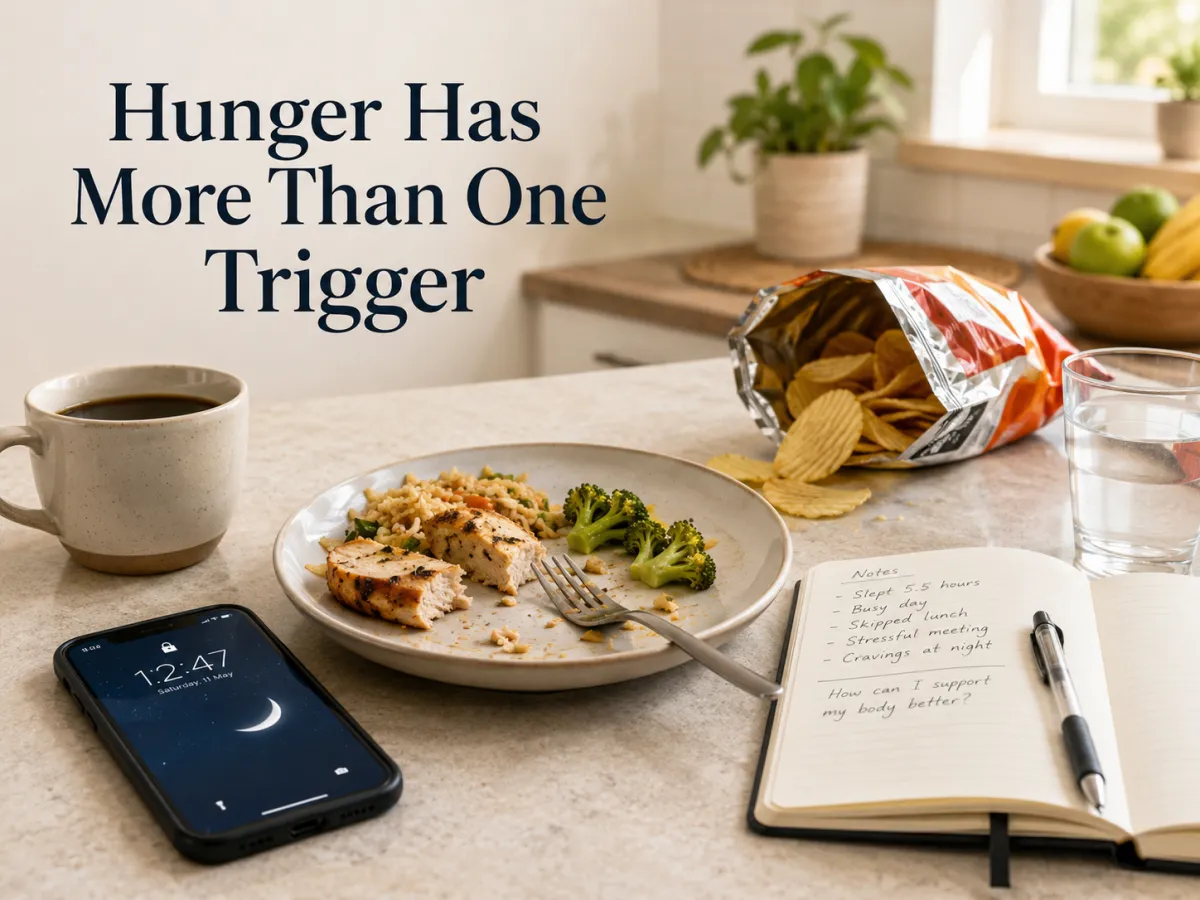
Appetite Is More Than Willpower | Infinite Longevity
Appetite Is More Than Willpower
You finish dinner.
You are not exactly hungry.
Then something happens.
You walk into the kitchen. You see something you like. You have had a long day. Maybe you slept badly the night before.
Suddenly, eating sounds very appealing.
It is easy to interpret moments like this as a discipline problem.
Why can’t I just stop eating?
But appetite is not controlled by one decision or one hormone.
Your brain, digestive system, hormones, sleep, stress, emotions, habits, food environment, medications, and the foods themselves can all influence when you feel hungry, how satisfied you feel, and how much you want to keep eating.
That does not mean personal choices do not matter.
It means those choices are being made inside a biological and environmental system.
Willpower may influence what you do with hunger, but it does not create or control every signal behind it.
The Quick Answer
Appetite is regulated through communication between the brain, digestive system, hormones, and the surrounding environment. Gut hormones such as ghrelin, GLP-1, PYY, and CCK participate in hunger and fullness signaling, while sleep, stress, food availability, habits, emotions, and medications can also influence how much and when we want to eat.
That is why persistent hunger is more useful to understand than simply overpower.
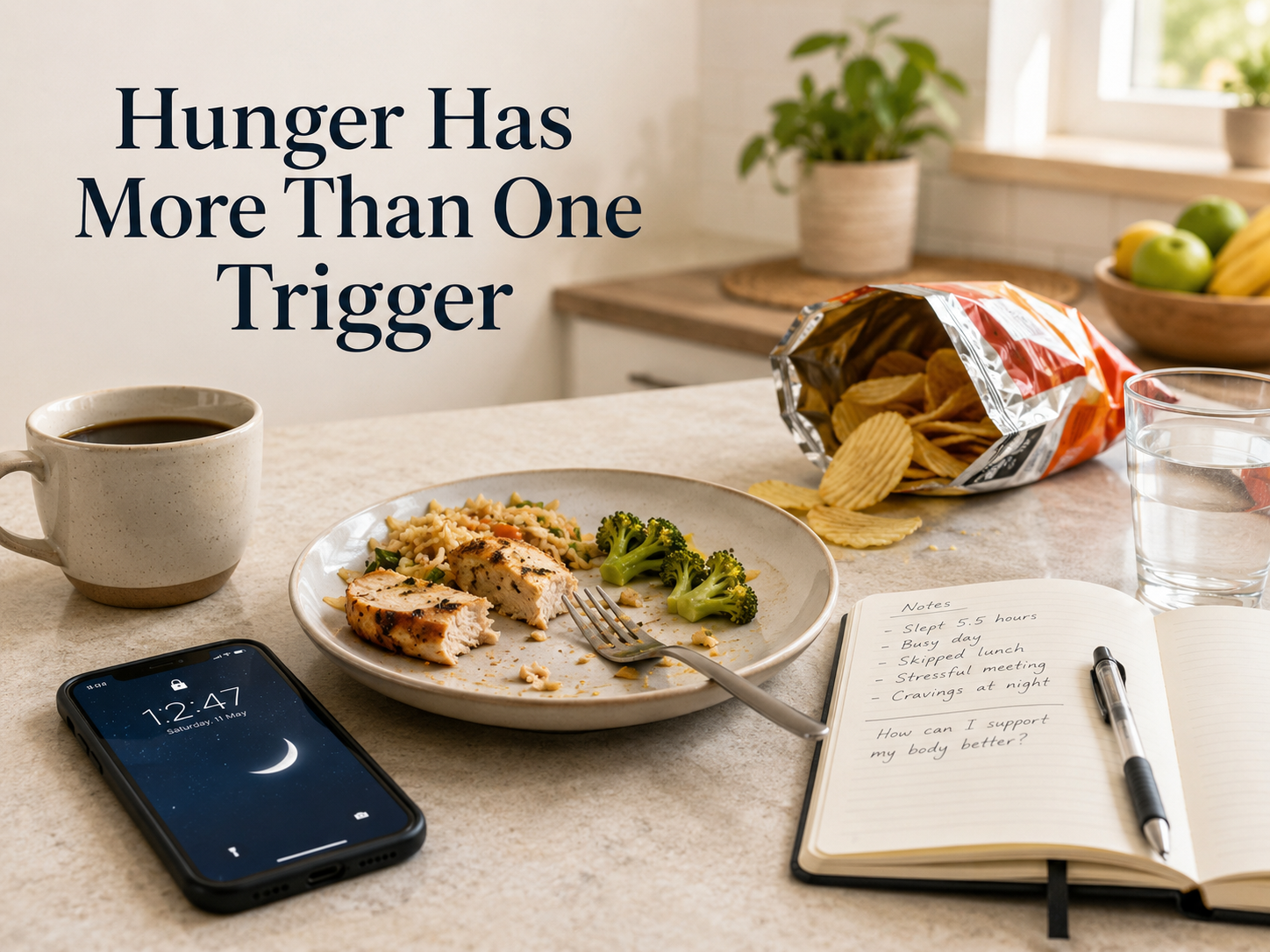
Alt text: Everyday factors such as meals, sleep, habits, stress, and food availability can all influence appetite.
Hunger Is a Biological Signal
Hunger is not something your body invented to sabotage your goals.
It serves a purpose.
The brain receives information about energy availability, food intake, gastrointestinal activity, and other physiological signals. The gut and brain communicate through neural and hormonal pathways that help influence hunger, meal size, and satiety.
Several hormones participate in this process.
For example, ghrelin is associated with stimulating appetite, while hormones including GLP-1, PYY, and CCK participate in signals connected with satiation and satiety.
That does not mean one hormone controls whether you want dessert tonight.
Appetite regulation is much more complicated than that.
Your brain is continuously integrating signals from:
The digestive system
Energy stores
Food cues
Previous meals
Emotions
Habits
Sleep
Stress
Social situations
Your physical environment
This is why hunger can feel different from one day to the next even when your intentions have not changed.
Where GLP-1 Fits Into the Appetite Conversation
GLP-1, short for glucagon-like peptide-1, is one of the peptide hormones involved in communication between the digestive system and brain. It participates in signals related to appetite, fullness, and glucose regulation.
That biology is also why GLP-1 pathways have become an important area of medical and pharmaceutical research. Some GLP-1-based medications are FDA-approved for specific medical uses, while other compounds discussed online may be compounded, investigational, or sold for research purposes. Those categories are not interchangeable.
The important distinction is that understanding how GLP-1 works in the body does not mean every product associated with the GLP-1 pathway has the same evidence, regulatory status, safety profile, or intended use.
Want to understand those differences? Read What Are Peptides, Really? and What “Research Use Only” Actually Means.
Hunger, Fullness, and the Desire to Eat Are Not Exactly the Same
We often use the word “hungry” for several different experiences.
But they are not identical.
Hunger
The physical or motivational drive to eat.
Satiation
The signals that help bring a meal to an end.
Satiety
The period after eating when the desire to eat is reduced.
Desire to eat
Wanting food even when physical hunger may be relatively low.
That last one matters.
You can be physically satisfied after dinner and still want popcorn when a movie starts.
You can smell fresh bread and suddenly want some.
You can feel stressed and want a familiar comfort food.
Modern appetite research recognizes both homeostatic signals related to energy needs and hedonic influences related to reward, sensory cues, habits, and psychological factors.
That does not make the desire imaginary.
It simply means:
Wanting food and needing food are not always the same signal.
Sleep Can Make Hunger Feel Louder
If you have ever had a terrible night of sleep and spent the next day looking for snacks, you are not necessarily imagining the connection.
The National Institute of Diabetes and Digestive and Kidney Diseases notes that insufficient sleep may leave people feeling hungrier, consuming more calories, and choosing less nutritious foods and beverages.
Clinical-trial research also suggests that restricting sleep can increase appetite, hunger, eating occasions, portion size, and energy intake. At the same time, findings on individual appetite hormones such as ghrelin and leptin have not been perfectly consistent across studies.
That nuance is important.
You do not need to memorize hormone levels.
Pay attention to the pattern.
After poor sleep, do you:
Get hungry earlier?
Want more calorie-dense foods?
Snack more?
Feel less satisfied?
Eat simply because you are awake longer?
Have less energy to prepare food?
If yes, addressing sleep may be more useful than criticizing yourself for needing “more discipline.”
Sometimes evening hunger starts the night before.
Stress Can Change Eating in Either Direction
Stress does not affect everyone the same way.
Some people lose their appetite.
Others eat more.
Some are not physically hungry but find themselves reaching for food because eating creates a temporary break, comfort, distraction, or reward.
NIDDK notes that emotions such as boredom, sadness, anger, happiness, and stress can influence eating even when physical hunger is not present. Long-term stress is also among the factors that may affect body weight and health.
This is where simply saying:
“Stop emotional eating.”
is not especially helpful.
A better question is:
What was I asking food to do for me?
Maybe you needed:
A break
Comfort
Stimulation
A reward
Something pleasurable
Relief from boredom
A way to mark the end of the workday
Food can absolutely be pleasurable.
The goal is not to remove pleasure from eating.
It is to recognize when eating is solving a problem that might have other solutions too.
The Food Environment Matters
Imagine two different kitchens.
In one, highly appealing snack foods are open on the counter and visible every time you walk through.
In the other, those foods exist, but they are put away and require a deliberate choice to get them.
Your biology did not change.
Your environment did.
Food cues, availability, convenience, texture, and reward can affect eating behavior. Appetite research recognizes sensory and environmental cues as part of the broader system influencing food intake.
NIH researchers demonstrated another piece of this in a controlled inpatient study. Participants ate more calories and gained weight during an ultra-processed diet compared with an unprocessed diet, even though the foods presented were matched for several nutritional characteristics.
That does not mean every processed food causes overeating.
It means the foods available to us and how easily they are eaten can influence intake in ways that go beyond conscious intention.

Alt text: A kitchen environment showing how visible snack foods and prepared meal options may influence eating decisions.
Skipping Meals Can Backfire Later
Some people intentionally eat very little during the first half of the day because they are trying to control calories.
Then evening arrives.
They are tired.
They are extremely hungry.
And suddenly the plan becomes much harder to maintain.
That does not mean everyone needs the same meal schedule.
Some people naturally prefer fewer meals. Others feel better eating more regularly.
But if your most difficult eating period consistently occurs after you have gone many hours without enough food, it is worth noticing.
Ask:
Am I trying to solve evening hunger without looking at what happened earlier in the day?
Your answer may not be another rule at 8 p.m.
It may be a more satisfying lunch.
What Makes a Meal Feel Satisfying?
There is no perfect meal formula for every person.
But satisfaction matters.
Meals that leave you thinking about food again twenty minutes later may not be meeting your needs very well.
That can involve:
Portion size
Protein
Fiber-rich foods
Energy density
Taste
Meal timing
Eating speed
Personal preferences
Researchers continue to study how food composition, texture, eating rate, and other factors affect appetite and energy intake. A 2026 randomized crossover trial, for example, found that eating rate influenced energy intake even within ultra-processed diets, suggesting that how quickly a food is consumed may be another part of the picture.
The goal is not to engineer every bite.
It is to notice whether your normal meals leave you comfortably satisfied.
Your Medications May Matter
Sometimes appetite changes are not behavioral at all.
Certain medications can increase hunger or influence weight regulation. NIDDK lists examples including some corticosteroids, medications used for depression or other psychiatric conditions, certain diabetes drugs, and some blood-pressure or allergy medications.
Do not stop a medication because you believe it is affecting appetite.
Instead, discuss the change with your healthcare professional or pharmacist.
A useful conversation might begin with:
“My hunger changed noticeably after starting this medication. Could it be related?”
That is much more productive than trying to fight a medication-related effect with willpower alone.
Your Appetite May Change Over Time
Appetite is not necessarily identical throughout life.
Research suggests that gut-hormone responses and eating behavior can change across the life course as nutritional needs and physiology change.
Hormonal transitions, medical conditions, medications, sleep changes, stress, activity, and body composition may also influence how hunger feels.
This is another reason yesterday's successful strategy may not perfectly fit today.
You are not required to eat exactly the way you did ten or twenty years ago.
You are allowed to learn what works for your body now.
What Is Driving Your Hunger?
Check any statements that feel familiar:
I become especially hungry after poor sleep.
My strongest hunger happens late in the day.
I regularly skip or delay meals.
Stress makes me want to eat even when I am not physically hungry.
I snack when food is visible or easily available.
My meals do not keep me satisfied very long.
I often eat while distracted.
My appetite changed after starting a medication.
My hunger feels different than it did several years ago.
Choose the one or two patterns that happen most often.
You are not trying to label yourself.
You are looking for clues.
One Practical Next Step: Keep a Three-Day Hunger Log
You do not need to count calories.
For three normal days, briefly write down:
Before eating
How hungry am I?
Low, moderate, or strong.
What happened beforehand?
Poor sleep?
Stress?
Long time since the last meal?
Food cue?
Habit?
Social situation?
After eating
How satisfied do I feel?
Two hours later
Are you thinking about food again?
At the end of three days, look for repetition.
Maybe your biggest appetite problem is not dinner.
Maybe it is a lunch that never satisfies you.
Maybe it is sleep.
Maybe it is your 3 p.m. stress pattern.
Maybe it is the open snack drawer beside your desk.
That gives you somewhere useful to start.
When to Speak With a Healthcare Professional
Changes in appetite are common, but sometimes they deserve medical attention.
Talk with a qualified healthcare professional when hunger or appetite changes are:
Sudden or unexplained
Extreme or persistent
Accompanied by excessive thirst or frequent urination
Connected with significant weight loss or gain
Associated with vomiting or digestive symptoms
Occurring after a medication change
Accompanied by severe fatigue
Connected with loss-of-control eating
Causing significant distress
Interfering with normal daily life
Persistent binge eating, purging, severe food restriction, or significant anxiety around eating deserves professional support.
Frequently Asked Questions
Why am I hungry even after I eat?
Several possibilities exist. The meal may not have been large or satisfying enough, you may have eaten quickly, sleep or stress may be influencing appetite, or the desire to eat may be driven by reward or habit rather than physical energy needs. Persistent unusual hunger can also be associated with medications or health conditions.
Does poor sleep really increase appetite?
It can. NIDDK notes that insufficient sleep may increase hunger and calorie intake. Clinical research also finds that sleep restriction can influence hunger and eating behavior, although changes in specific hormones are not completely consistent across every study.
Is emotional eating always unhealthy?
No. Eating can be social, comforting, celebratory, and pleasurable. The concern is when food becomes the primary or only strategy for managing emotions, or when eating repeatedly feels out of control or causes distress.
Choose Your Next Guide
If weight seems to respond differently than it once did:
Read Why Weight Feels Different Over Time.
If strength and body composition are changing:
Read Why Muscle Matters More Than Most People Realize.
To explore the full pathway:
Return to Weight & Metabolic Health.
The Most Important Takeaway
Appetite is not a simple contest between hunger and discipline.
Your brain and body are collecting information all day.
How well you slept.
When you ate.
What you ate.
What food is around you.
How stressed you feel.
What habits you have built.
What medications you take.
And what your body may need right now.
So instead of asking:
“Why don’t I have more willpower?”
Try:
“What is making hunger louder today?”
That question gives you something useful to work with.
About Infinite Longevity
Infinite Longevity is an educational wellness platform focused on helping adults better understand the science, research, and practical factors connected to healthy aging, metabolic health, recovery, performance, and emerging peptide research.
Our Learning Center translates complex topics into clear, practical information using current government resources, peer-reviewed research, and recognized medical and scientific sources.
Our content is designed to support better questions and more informed conversations with qualified healthcare professionals. It is not intended to diagnose a condition, prescribe treatment, or replace personalized medical care.
Founded by Marcia Riner, Infinite Longevity was created to make complex wellness and longevity information easier to understand, evaluate, and use responsibly.
Related Reading
Why Weight Feels Different Over Time
https://infinite-longevity.com/post/why-weight-feels-different-over-time
Why Muscle Matters More Than Most People Realize
https://infinite-longevity.com/post/why-muscle-matters
What Does Healthy Aging Really Mean?
https://infinite-longevity.com/post/what-does-healthy-aging-mean
Explore Weight & Metabolic Health →
Sources
The Gut-Brain Axis in Appetite, Satiety, Food Intake, and Eating Behavior
Ultra-Processed Diets Cause Excess Calorie Intake and Weight Gain
Appetite-Related Gut Hormone Responses Across the Life Course
Important Notice
This guide is for general educational purposes only. It does not diagnose an eating disorder, metabolic condition, hormonal disorder, or other health condition. It does not provide individual nutrition advice, recommend medication changes, prescribe treatment, or replace care from a qualified healthcare professional.
Speak with an appropriate licensed healthcare professional about significant appetite changes, unexplained weight changes, medication effects, eating concerns, blood-sugar symptoms, or other changes in your health.