The Hidden Cost of Constant Distraction
The Hidden Cost of Constant Distraction
You sit down to answer one email.
A notification appears.
You check it.
Then you remember something else you need to do.
You open another tab.
A text comes in.
Five minutes later, you are back at the original email trying to remember what you were about to say.
Nothing dramatic happened.
But your attention had to restart several times.
That is the hidden cost of constant distraction.
It is not only the time spent looking away. It is the repeated mental effort required to stop, switch, remember where you were, and get back into the task.
You may not have a focus problem. You may have an interruption problem.
The Quick Answer
Constant distraction can make focus harder because the brain has to repeatedly redirect attention, update priorities, and return to unfinished tasks.
What we often call multitasking is usually rapid task switching. Research on multitasking consistently finds that performance can decline when several demanding tasks compete for the same cognitive resources.
Notifications, messages, open tabs, stress, poor sleep, and unfinished thoughts can all compete for attention.
The goal is not to eliminate every interruption.
It is to recognize that attention is limited, and some tasks deserve protection from unnecessary interruption.
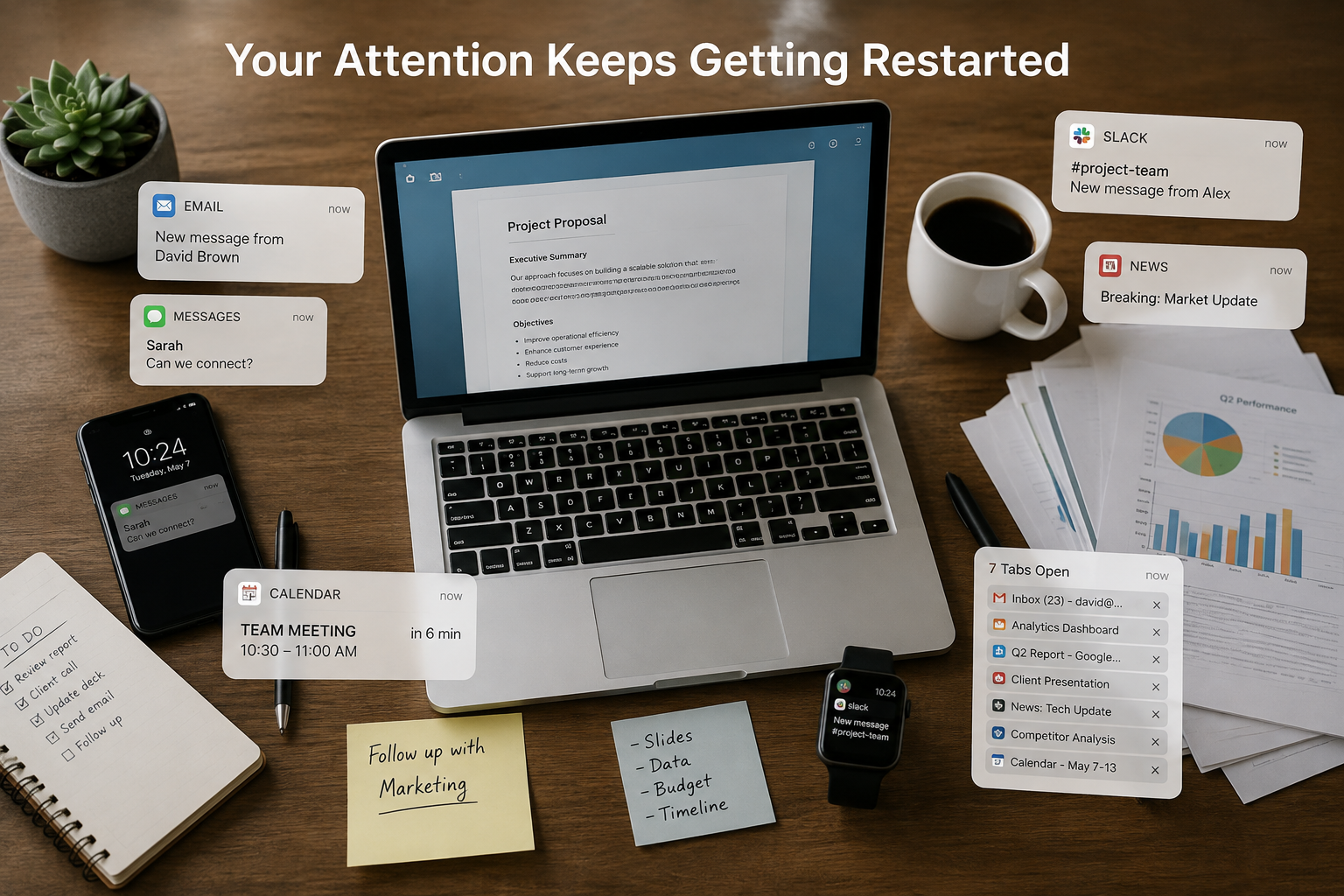
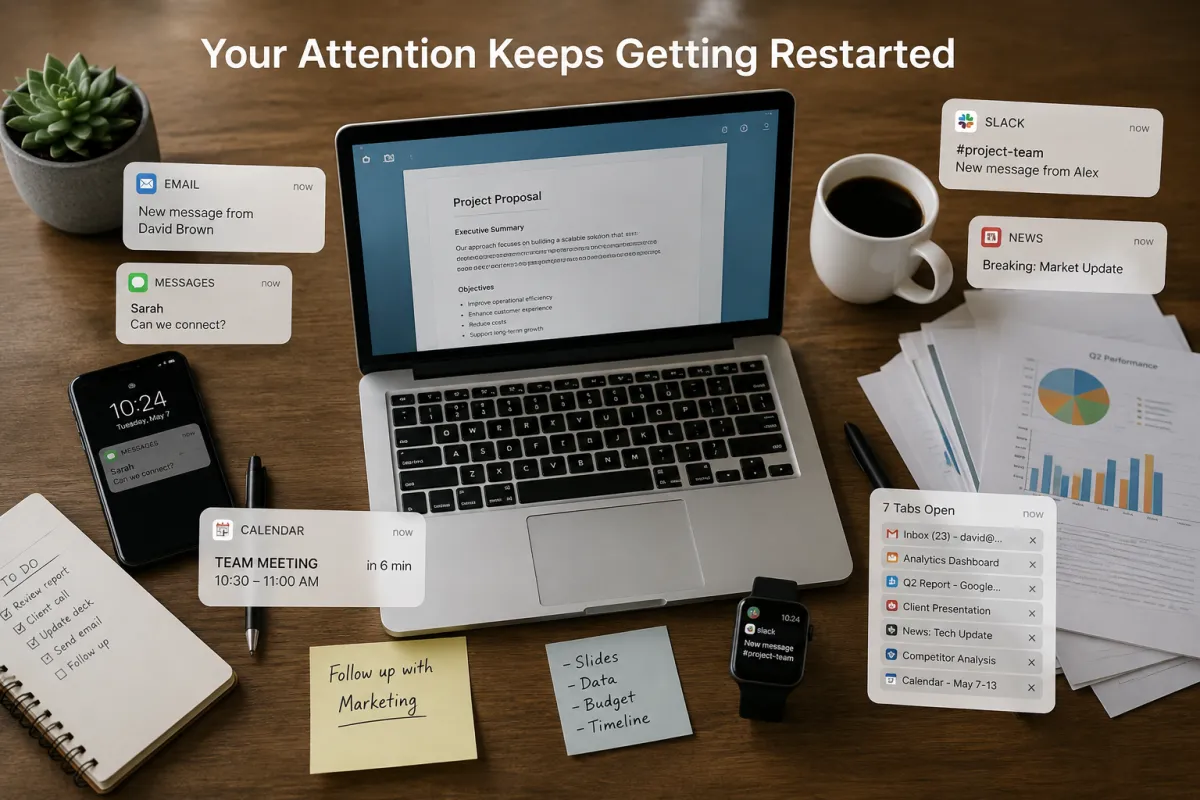
Alt text: A work desk with multiple digital notifications and open tasks showing how interruptions repeatedly pull attention away from focused work.
Multitasking Is Usually Task Switching
Some activities can happen together easily.
You may be able to walk while talking or fold laundry while listening to music because one activity requires relatively little conscious attention.
But try to:
Write an important proposal
Follow a complicated conversation
Respond thoughtfully to a message
Remember several instructions
all at the same time.
That feels very different.
When two demanding tasks need the same mental resources, the brain often switches rapidly between them rather than truly handling both at once.
That switching is useful when circumstances genuinely require it.
It becomes costly when it happens all day.
Why Interruptions Cost More Than the Interruption Itself
An interruption may last only a few seconds.
But returning to the original task can require you to reconstruct:
What you had already decided
What information you were holding in mind
What you were about to do next
Which problem you were trying to solve
Research on interruptions links them with demands on attention, executive control, and working memory.
That is why a quick notification can be more disruptive during complex work than during something routine.
The problem is not simply:
I lost 20 seconds.
It may be:
I lost the thread.
Are You Distracted, or Are You Mentally Full?
These can feel almost identical.
You may describe yourself as distracted when what is really happening is:
Too many unfinished tasks
Too many decisions
A packed schedule
Poor sleep
Ongoing stress
Constant availability to other people
Too little downtime
Your brain may not be functioning poorly.
It may simply have too many things competing for priority.
That distinction matters because ordinary overload can start to feel like evidence that something is wrong with your memory or concentration.
The Infinite Longevity Brain Health & Focus pathway looks at sleep, stress load, energy, movement, mental stimulation, and daily environment together because focus rarely depends on one factor alone.
Explore Brain Health & Focus: Infinite Longevity Brain Health & Focus
Try This: The 20-Minute Attention Test
This is not a medical test.
It is simply a way to see how much your environment may be affecting your concentration.
Choose one task that normally requires focus.
For 20 minutes:
Put your phone out of reach.
Turn off email and messaging alerts.
Close browser tabs you do not need.
Work on only one task.
Keep paper beside you.
Write down unrelated thoughts rather than acting on them.
At the end, ask:
Was it easier to stay with the task?
Did I get more done than expected?
How often did I want to check something?
Did the urge to switch decrease after a few minutes?
If your focus improves in a quieter environment, that tells you something useful.
You may not need more stimulation.
You may need less competition for your attention.
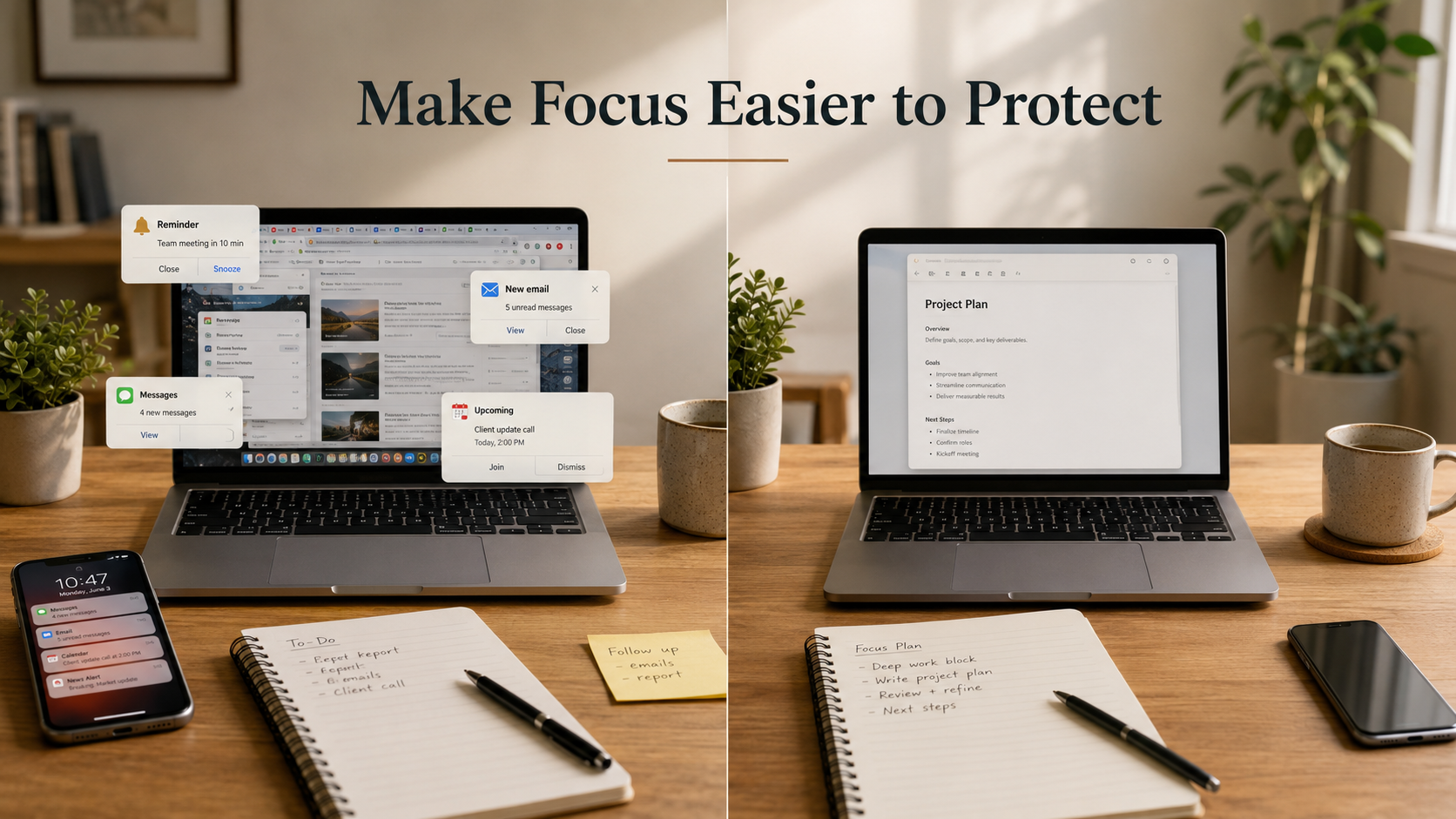
Alt text: The same workspace shown with frequent digital distractions and then simplified to support uninterrupted concentration.
Where Peptide Research Enters the Focus Conversation
Peptides are part of normal brain signaling, and researchers continue to study peptide pathways involved in cognition, stress response, memory, and neurological function.
Two names you may see discussed online are Semax and Selank.
Both have been studied in connection with neurological or cognitive questions, particularly outside the United States. But that does not make either an established treatment for everyday distraction or concentration problems.
FDA currently lists Semax and Selank among substances that may present significant safety risks when used in compounding. FDA notes concerns including limited human safety information and potential risks related to peptide impurities and immunogenicity.
The important distinction is simple:
Interesting peptide research is not the same as a proven focus treatment.
If this area interests you, start by understanding how peptide evidence differs from one compound to another.
Continue learning:
What Are Peptides, Really?
What “Research Use Only” Actually Means
How to Protect Attention Without Trying to Be Focused All Day
You do not need eight uninterrupted hours of deep concentration.
Most people cannot structure life that way.
Instead, identify the work that actually deserves protected attention.
That might be:
Writing
Reviewing financial information
Learning something difficult
Planning
Solving a complicated problem
Having an important conversation
Create a short protected block around that activity.
During that time:
One task. Fewer alerts. Fewer open windows.
It can also help to keep a notebook nearby.
If an unrelated thought appears, write it down instead of immediately acting on it.
You have given the thought somewhere to go without abandoning what you were doing.
Sleep Still Matters
Distraction becomes harder to manage when you are tired.
Poor sleep can affect attention, working memory, decision-making, mood, and mental stamina.
That is why a day full of interruptions may feel manageable after good sleep and nearly impossible after a bad night.
If your focus has changed noticeably, look at the larger picture:
Sleep
Stress
Workload
Alcohol
Medications
Illness
Physical activity
Energy levels
For more on those connections, read:
Why Focus Feels Harder on Some Days
One Practical Next Step
Tomorrow, choose one 30-minute protected attention block.
Before starting:
Decide exactly what you will work on.
Put your phone out of reach.
Close unnecessary apps and tabs.
Silence nonessential alerts.
Keep paper nearby for unrelated thoughts.
Work on one task until the time ends.
Then ask:
Did reducing interruptions make concentration easier?
If the answer is yes, you have learned something useful.
You changed the environment and changed the experience.
When to Speak With a Healthcare Professional
Occasional distraction is normal.
A noticeable or persistent change in attention deserves more consideration when it:
Appears suddenly
Continues to worsen
Interferes with work or daily responsibilities
Occurs with significant memory problems
Includes confusion or unusual behavior
Follows a head injury
Appears after starting or changing medication
Occurs with major sleep problems, anxiety, depression, or other symptoms
Difficulty concentrating can have many causes.
A healthcare professional can help determine whether something beyond ordinary distraction, fatigue, or overload may be contributing.
Frequently Asked Questions
Why does constant distraction make it harder to focus?
Every interruption can require the brain to redirect attention and then reconstruct what it was doing before the interruption. Repeated switching can increase cognitive load and make demanding work less efficient.
Is multitasking actually possible?
Some simple or highly automatic activities can happen together. But when two demanding tasks require similar cognitive resources, people usually switch between them rather than handling both equally well at the same time.
Is being easily distracted a sign of cognitive decline?
Not necessarily.
Sleep, stress, workload, medications, mood, and environmental distraction can all affect concentration. Persistent or worsening changes should be evaluated rather than automatically blamed on aging.
Are Semax and Selank peptides for focus?
They are peptides that have been studied in areas related to neurological function, cognition, or stress and are frequently discussed online. They should not be treated as established U.S. treatments for everyday focus problems. FDA has identified safety and quality concerns related to their use in compounding.
What is the easiest way to see whether distractions are hurting my concentration?
Try a short period of uninterrupted work with your phone away, notifications off, unnecessary tabs closed, and only one task available. Compare how easily you focus with your normal environment.
Choose Your Next Guide
If your concentration seems different from one day to another:
Why Focus Feels Harder on Some Days
If you want to understand the bigger brain-health picture:
What Supports Memory and Mental Clarity?
If the peptide discussion caught your attention:
What Are Peptides, Really?
If you want to understand research labeling:
What “Research Use Only” Actually Means
Explore the full topic:
Brain Health & Focus
The Most Important Takeaway
Your brain is capable of switching attention.
That does not mean constant switching is free.
Every notification, browser tab, message, unfinished thought, and interruption competes with whatever you had already decided deserved your attention.
Before assuming your ability to focus is disappearing, change the environment and see what happens.
Turn a few things off.
Work on one thing.
Give your brain enough uninterrupted time to settle into it.
You may discover that your focus is still there.
It has just been getting interrupted.
About Infinite Longevity
Infinite Longevity is an educational wellness platform focused on helping adults better understand the science, research, and practical factors connected to healthy aging, metabolic health, recovery, performance, and emerging peptide research.
Our Learning Center translates complex topics into clear, practical information using current government resources, peer-reviewed research, and recognized medical and scientific sources.
Our content is designed to support better questions and more informed conversations with qualified healthcare professionals. It is not intended to diagnose a condition, prescribe treatment, or replace personalized medical care.
Founded by Marcia Riner, Infinite Longevity was created to make complex wellness and longevity information easier to understand, evaluate, and use responsibly.
Sources
Couffe C, Michael GA. Failures Due to Interruptions or Distractions: A Review and a New Framework. PubMed source
Koch I, Poljac E, Müller H, Kiesel A. Cognitive structure, flexibility, and plasticity in human multitasking. PubMed source
Kiesel A, et al. Control and interference in task switching: a review. PubMed source
Guo J, et al. Effects of interventions to reduce the negative consequences of interruptions on task performance. PubMed source
U.S. Food and Drug Administration. Certain Bulk Drug Substances for Use in Compounding that May Present Significant Safety Risks. FDA source
Important Notice
This guide is for general educational purposes only. It does not diagnose an attention, memory, neurological, or mental-health condition and does not recommend a drug, peptide, supplement, or individualized treatment.
Persistent, sudden, or worsening changes in concentration, memory, behavior, or cognitive function should be discussed with an appropriate licensed healthcare professional.
Publishing and SEO Details
SEO Title: The Hidden Cost of Constant Distraction | Infinite Longevity
Meta Description: Constant distraction can make focus harder than it needs to be. Learn how task switching, notifications, stress, and mental overload affect attention and what you can test today.
Slug: hidden-cost-of-constant-distraction
Primary Keyword: constant distraction and focus
Secondary Keywords:
Why am I so easily distracted
Multitasking and focus
Task switching
Notifications and concentration
Digital distraction
Mental overload
How to improve focus
Attention and brain health
Semax research
Selank research
Category: Brain Health & Focus
Featured Answer:
Constant distraction can make concentration harder because the brain must repeatedly redirect attention and return to unfinished tasks. Reducing unnecessary task switching and protecting short periods for one demanding task can make focus easier.
Article Excerpt:
Notifications, multitasking, unfinished tasks, and constant input may be costing more mental energy than you realize. Learn what distraction does to attention and try a simple test to see whether your environment is part of the problem.
Internal Links:
Why Focus Feels Harder on Some Days
What Supports Memory and Mental Clarity?
What Are Peptides, Really?
What “Research Use Only” Actually Means
Brain Health & Focus